News

Filter by:

Limit to news where the title matches:
Limit to items where the date of the news item:
Date range
Limit to news items where the audience is one or more of:
Limit to news items where the faculty or school is one or more of:

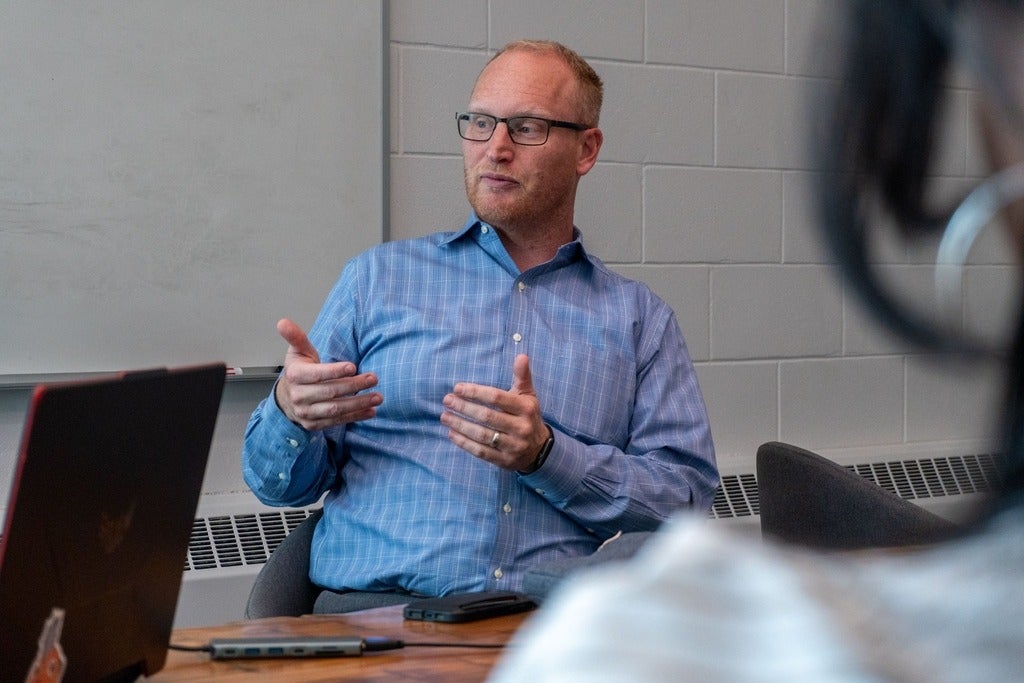
On October 19, Ben Dachis, Vice President of Research and Outreach at Clean Prosperity and a member of FCI’s advisory board, sat in as FCI co-op students presented their work. For Tony Lin and Steven Men, it was a working session with an advisor who has been part of their project from the start. Their Growth Management Platform (GMP) shows cities how a growth decision ripples through development charges, property taxes, emissions and traffic. Dachis compared those trade-offs to a balloon: squeeze one side and the other bulges. He urged the team to build the structure first, add detail later, and share their work early, flagging assumptions so the people who hold better data can step in. The GMP is now close to a minimum viable product.

Preethi Raghuraman, a junior product manager at FCI, and Krishnam Jhalani, an FCI co-op student, joined Managing Director Eryn Stewart in Iqaluit for their first trip north. They met with the Nunavut Economic Development Association (NEDA), FCI's longtime partner on a tool to help Community Economic Development (CED) officers in Nunavut's 25 hamlets create and track their CED plans. Listening to NEDA reshaped the project. Long plans often end up on a shelf, staff change over time, and internet connectivity is limited, so the tool is shifting toward short visual summaries, progress tracking between plan cycles, spoken input, and private storage for each hamlet's documents. "Once we sat down with the people it's being built for," says Preethi, "it was clear the best version could only come from listening."

When a 13-year-old girl stops riding her bike to school, the reasons usually extend far beyond the bike path. During their initial on-campus residency week for the Master of Future Cities (MFC) program, student teams analyzed municipal transportation data and developed practical strategies to address why women and young girls opt out of cycling networks. Using Waterloo as a primary case study, one team introduced "Bridging the Cycling Gap," mapping the transition into early adolescence through a fictional persona named Maya and proposing a gamified social app to reward riders for using municipal cycling routes.

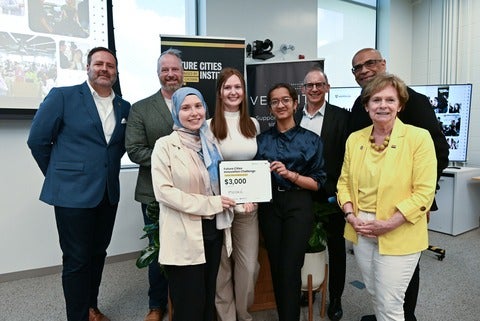
The Future Cities Institute founded by CAIVAN partnered with Velocity to host the Future Cities Innovation Challenge. The high-intensity, two-week sprint brought interdisciplinary student teams together to build data-backed business concepts targeting the Canadian housing crisis, modern infrastructure demands, and municipal service systems.

Graduate students from the Master of Future Cities (MFC) program recently returned from an intensive, two-week field course in Singapore. Organized by the Future Cities Institute founded by CAIVAN, this experiential learning trip allowed students to step out of the classroom and see how long-term foresight, multi-purpose infrastructure, and high-density housing strategies are deployed in the real world.

FCI and community partners hosted a BUILD NOW design workshop bringing newcomer-focused community organisations into direct conversation with the BUILD NOW team. Participants offered feedback on housing design, neighbourhood planning, and amenities, contributing firsthand knowledge to the early development of the region's largest affordable housing project.

Thursday, April 2, 2026

2026 i-Capstone Symposium

The i-Capstone Symposium brought students, municipal leaders, and industry partners together for a day of final presentations on real urban challenges worked on throughout the term. University of Waterloo President Vivek Goel, Waterloo Mayor Dorothy McCabe, and representatives from the Region of Waterloo were among those in attendance. Student awards were supported by GLOCAL Foundation of Canada, AWS Canada, and the Global Futures Office, with the event made possible through the ongoing support of CAIVAN.

Wednesday, April 1, 2026

FCI x Brave Career Hackathon

The FCI x Brave Career Hackathon challenged student teams to build AI-powered tools for pressing urban systems problems in a single day, from zoning and data fragmentation to infrastructure capacity. Grounded in real problem statements from the City of Kitchener, the event produced a strong set of ideas from teams that worked quickly and thought carefully about the complexity of the challenges in front of them.

Ten FCI co-op students from across disciplines spent a week in focused sprint working on two tools designed to support Northern communities: one for grant writing, one for community economic development planning. The work addressed real administrative and capacity gaps that smaller Northern municipalities face, and the cross-disciplinary makeup of the team brought a range of perspectives to problems that benefit from exactly that kind of scrutiny.

FCI brought over 60 planning students together with the BUILD NOW: Waterloo Region leadership team for a hands-on design charrette focused on Canada's largest affordable home ownership initiative. Students pressure-tested real concepts and offered grounded feedback, many as members of the very demographic BUILD NOW is designed to serve. A strong example of what academia and industry can produce when they work in the same room, toward the same problem.