The Qubit Club - Quantum for Kids!
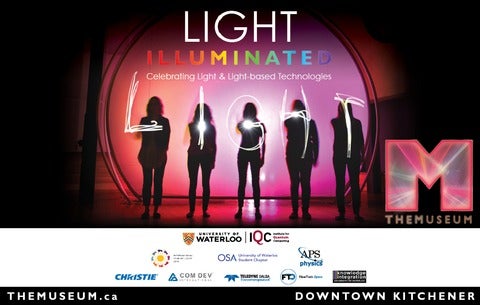
What is quantum? Join us for the Qubit Club at THEMUSEUM to learn all about quantum with some fun and exciting science demonstrations!
Join us at the Institute for Quantum Computing for a two-week introduction to the theoretical and experimental study of quantum information processing.
On February 11, 2016 it was announced that gravitational waves have been detected affecting an instrument on earth. In addition to the realization of a 100 year old prediction the astounding sensitivity of the detector demanded the approaching and overcoming of seemingly fundamental quantum limits on measuring the motion of 25Kg masses. Quantum mechanics is usually thought of applying only to the very small (zeptogrammes and nanometers).
Join us at the Institute for Quantum Computing for a two-week introduction to the theoretical and experimental study of quantum information processing.
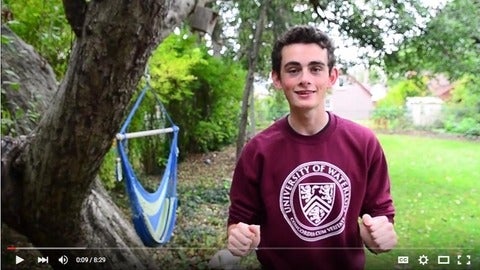
John Fish could end up travelling to the Silicon Valley later this week as the winner of the Breakthrough Junior Challenge. He is one of the 15 finalists out of more than 2,000 students from 86 countries, and only one of two Canadians to get this far in the annual challenge that invites students, ages 13-18, to share their passion for math and science with the world through video.
The Institute for Quantum Computing (IQC) will open its doors to all members of the community as part of Reunion at the University of Waterloo. Bring the whole family to discover the excitement of quantum mechanics and learn about the world-class research that is happening right here in our community!
A former QCSYS student was awarded the CAP Physics Prize and Excellence Award – Senior Silver Medal at the Canada-Wide Science Fair 2015 in Fredericton, New Brunswick for a project that he did with IQC researchers.
In 1981, Richard Feynman proposed a device called a “quantum computer” to take advantage of the laws of quantum physics to achieve computational speed-ups over classical methods. Quantum computing promises to revolutionize how we compute.