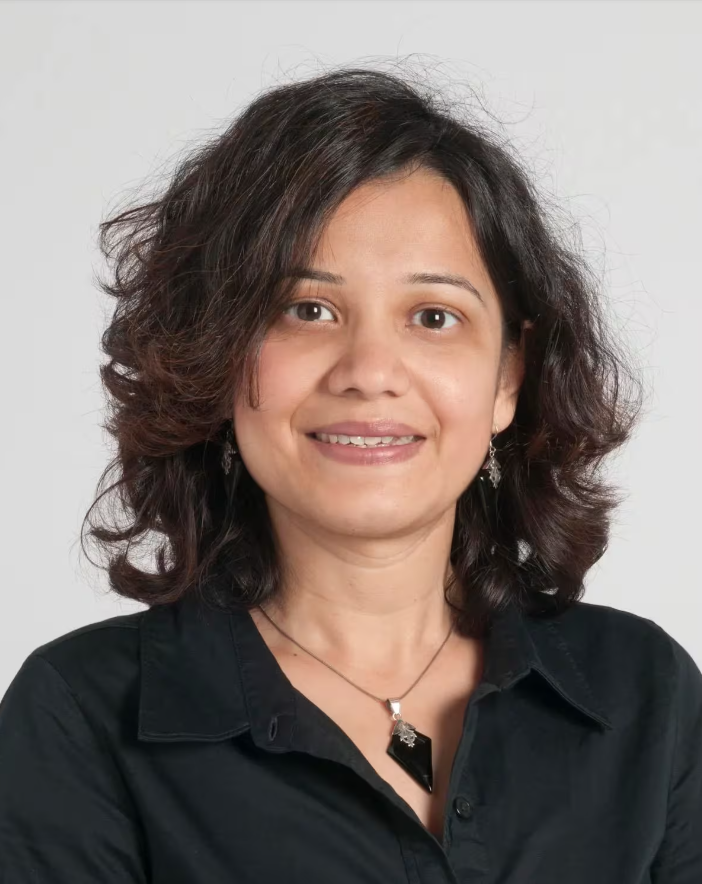
Dr. Fatema Ghasia
Professor of Ophthalmology
Director of Visual Neurosciences and Ocular Motility Lab
Cole Eye Institute, Cleveland Clinic
Biography
Dr. Ghasia directs the Visual Neurosciences and Ocular Motility Laboratory at the Cole Eye Institute, where she combines ophthalmology, neuroscience, visual science, and neuroengineering to advance the understanding and treatment of vision and eye movement disorders. A clinician-scientist and strabismus surgeon, her research focuses on conditions such as strabismus, amblyopia, nystagmus, cerebral palsy, Parkinson’s disease, and cerebellar ataxias. Using advanced eye-tracking, electrophysiology, psychophysics, and computational methods, she identifies objective biomarkers of visual and ocular motor dysfunction. Her work aims to improve diagnosis, predict treatment outcomes, monitor disease progression, and develop innovative therapies, including AI-based detection and neuromodulation approaches.
Abstract
Amblyopia is a neurodevelopmental disorder resulting from disrupted binocular visual experience during early childhood. While reduced visual acuity and impaired stereopsis are its hallmark clinical features, amblyopia also affects ocular motor control, producing characteristic abnormalities in fixation eye movements (FEMs). These observations have stimulated growing interest in objective biomarkers derived from eye movement behavior that may complement traditional clinical measures and provide additional insight into disease detection and classification.
This lecture will explore how advances in eye-tracking technology and artificial intelligence (AI) are transforming our ability to quantify visual dysfunction through eye movement behavior. Using high-resolution recordings obtained during simple fixation tasks, AI-based approaches can identify disease-specific patterns in fixation stability, microsaccades, drift dynamics, vergence control, and binocular coordination. Machine learning and deep learning models trained on these signals have demonstrated the ability to distinguish amblyopia from normal vision, differentiate amblyopia from strabismus, classify disease severity, and identify patients with coexisting nystagmus. Furthermore, explainable AI methods are beginning to reveal which eye movement features contribute most strongly to classification, providing new insights into the ocular motor manifestations of amblyopia.
Beyond their diagnostic utility, these approaches offer a new framework for understanding amblyopia as a disorder that affects both sensory and motor aspects of visual function. The integration of eye tracking, computational modeling, and AI has the potential to enable objective, nonverbal, and scalable assessments that can be applied across a wide range of clinical settings, including populations that are difficult to evaluate using conventional methods. By highlighting recent advances and ongoing challenges, this lecture will discuss how AI-driven analysis of fixation eye movements may help bridge visual neuroscience and clinical practice, advancing the development of precision diagnostics for amblyopia and other neurodevelopmental visual disorders.