First Year Arrival Checklist and Information

Last updated: June 2026

Below are a number of important tasks to complete in the next few weeks, prior to starting the Doctor of Optometry program in September 2026. See the tabs below for more details as needed.

To do now:

To do soon: 

  • Starting July 6th: If you plan to drive, apply for a parking pass for either
  • September 8 & 9th: Save the date for Orientation days (mandatory)
    • Prepare to have your photo taken (see Photos section for details)
  • Download Microsoft Teams
  • Access your Microsoft 365 account, including your username@uwaterloo.ca email.
  • Apply for and pick up your WatCard

Course enrolment - you'll be automatically enrolled into your courses and labs for each upcoming term, approximately 6 weeks before the start of that term (mid-July, mid-November, mid-March).

  • Schedule swaps for preferential reasons are not possible. 
  • Once your schedule is visible on Quest, you can request a Proof of Enrolment letter directly in Quest for a number of purposes including student financial aid applications. 

To do by September

First Year - Important Information

About the School of Optometry and Vision Science

The University of Waterloo, the School of Optometry, and you

The University of Waterloo acknowledges that much of our work takes place on the traditional territory of the Neutral, Anishinaabeg and Haudenosaunee peoples. Our main campus is situated on the Haldimand Tract, the land granted to the Six Nations that includes six miles on each side of the Grand River. Our active work toward reconciliation takes place across our campuses through research, learning, teaching, and community building, and is coordinated within the Office of Indigenous Relations. 

The University of Waterloo is a comprehensive public university in the city of Waterloo, Ontario, Canada. The university was founded in 1957 by Drs. Gerry Hagey and Ira G. Needles, and has since grown into an institution of more than 42,000 full and part-time undergraduate and graduate students. Waterloo is notable for being the first university in North America to create a Faculty of Mathematics, and for having a large co-operative education program.  

You can browse the website including a brief history of UW at or watch this video for a snapshot of a day in the life as a University of Waterloo student. 

The University is also known as Waterloo or UWaterloo (not U of W!) 

We often refer to the School of Optometry and Vision Science as “WOVS,” “Optometry” and/or “the School.” 

Our School Pin was designed by Dr. Dustin Diotte, Class of 2022. You’ll get the inside joke about geese when you get here! 

School of Optometry and Vision Science Pin - eye with a goose in the pupil

Waterloo Eye Institute

We are building the Waterloo Eye Institute (WEI), a $55 million initiative that will push the boundaries of eye and vision care, optometric education and vision research. A once-in-a-generation project, it will create 68,000 square feet of new and renovated space. 

While the WEI is under construction, the Waterloo clinic and all its services have moved to the interim clinic located at 419 Phillip St, Unit C.

First- and second-year students will continue to spend most of their time at 200 Columbia St. W., because classrooms and study spaces will be unaffected. Clinic experiences will be similar in quantity and quality, but more will be at the Health Sciences Optometry Clinic (HSOC - in downtown Kitchener) than in previous years. Travel time will be accounted for in scheduling.

Construction on the Waterloo Eye Institute began in 2024 and the anticipated completion date is late 2026.  

The School of Optometry and Vision Science Administration

Director
Dr. Ben Thompson | OPT 303 | ben.thompson@uwaterloo.ca 

Associate Director of Academics and Student Affairs
Dr. Natalie Hutchings | OPT 339 | optometry.ada@uwaterloo.ca (on sabbatical)

Dr. Shamrozé (Zay) Khan | zay.khan@uwaterloo.ca (interim)

Associate Director of Clinical Education 
Dr. Nadine Furtado |OPT 332 | nfurtado@uwaterloo.ca

Associate Director of Research  
Dr. Vivian Choh | OPT 260 | vivian.choh@uwaterloo.ca 

Undergraduate Officer - Student Affairs
Dr. Shamrozé (Zay) Khan | zay.khan@uwaterloo.ca

Clinic Director  
Dr. Tammy Labreche | OPT 253 | tlabrech@uwaterloo.ca

Program Manager, Optometry 
Michaela Tatu | OPT 340 | optometry.ugc@uwaterloo.ca 

Student Affairs and Admissions Co-ordinator
Jess Tikal | OPT 301 | jessica.tikal@uwaterloo.ca

Uwaterloo online systems - WatIAM, LEARN, Portal, Quest, Microsoft 365, 2FA

The University of Waterloo uses various online systems – WatIAM, Quest, Microsoft 365, Portal and LEARN. This short video (start at 1:35) provides an overview of each of them. 

WatIAM  

WatIAM is your universal username and password for all campus systems, like Quest, Microsoft 365, your uwaterloo email, LEARN, and others. You need to register with WatIAM to be able to access these systems. You can use the Campus People Directory to search the University of Waterloo community for the email address of an Instructor or peer, for example. 

Enrol in Duo two-factor authentication 

All students and employees must enrol in the University's two-factor authentication (2FA) service powered by Duo Security. 2FA provides an extra layer of security to your University accounts. Verifying your identity using a second factor (like your mobile device) prevents others from accessing your accounts, even if they know your password. 

Enrol using the Duo Mobile App for the most secure and convenient 2FA experience. 

Microsoft 365  

As a member of the University of Waterloo community, you will gain free access to the Microsoft 365 suite (Teams, Word, Excel, PowerPoint, 5TB of Cloud Storage and more).

Your uWaterloo student email is part of the suite (Outlook).

The Registrar’s Office will create your M365 account once the system recognizes you as a student. When that happens, you can log in and explore.  

All official University communication will be sent to your uWaterloo email account, including course selection and fee deadline reminders as well as messages from The Faculty of Science, WOVS, and your professors.   

When communicating with the University, emails must be sent from your @uwaterloo email account only. 
Please include your 8-digit student ID number on all correspondence.  

Quest   

Quest is the online system that is used to view your schedule, receive notices concerning tuition, and to access your grades. Please ensure Quest is updated with the address where you will be living during the Fall term. Please also include your cell phone number.  

LEARN 

LEARN is the online learning management system used by the University of Waterloo and by your instructors, and it’s where you’ll find individual course information (e.g., materials, notes, and activities). Instructors will often communicate with your class via LEARN. Each term, you will only have access to LEARN when your student fees are paid or arranged. You will need to log on to LEARN to complete WHIMS certification. Normally, access to your LEARN courses is available at midnight on the first day of classes unless the instructor chooses otherwise.  

WatCard

The WatCard is the official identification card for the University of Waterloo. It is used for several purposes on and off-campus, e.g. accessing library services.

You will need the physical card to access student services such as meal plans, GRT UPass, and athletics facilities, and to write in-person exams.

To apply for your WatCard, first ensure that your name is up-to-date and correct on WatIAM. If you are new to the University of Waterloo, fill out the application form (and be ready to upload a photo) after you’ve paid your tuition. You will need to pick up your WatCard in person from The Centre in Needles Hall.

Courses, program requirements and regulations

  • A list of courses by term and optometry program information can be found in the Undergraduate Studies Calendar:
  • You are automatically enrolled into your courses and labs each upcoming term, approximately 6 weeks before the start of that term (mid-July, mid-November, mid-March). 
  • The OD program is a cohort program; multiple sections are NOT offered for courses.
  • Courses are generally not livestreamed and in-person attendance is expected (and mandatory for certain elements – see the attendance policy).
    • Lectures cannot be recorded without express consent from the course instructor, including the use of an AI note taker. 
  • The minimum cumulative overall and term averages needed to remain in the Optometry program are 60%.
  • The minimum passing grade for a course Optometry is 60%.
  • Grades below the specified passing grade result in a course failure. Two or more course failures within a term prevent a student from proceeding with their cohort.  5 or more course failures result in dismissal from the program.
  • The factors involved in determining your standing within the program are: your term average, overall average, number of course failures, and the student standing (e.g., Satisfactory, Conditional). You can learn more about academic standings (scroll to Optometry) and additional optometry academic regulations.  

Important dates - academic year | Religious observances

Fall 2026 term
September 8 and 9 First-year Optometry student orientation 
September 10 Classes begin for first-year students.
October 12 Thanksgiving - University closed 
October 10-18 Reading week 
December 8 Classes end
December 10 Examinations begin
December 22 Examinations end
December 24 Unofficial grades begin to appear on QUEST
December 24-31 University Holiday closure
January 21, 2027 Academic standing decisions and official grades available on Quest
Winter 2027 term
January 1-3 University Holiday closure
January 11 Classes begin
February 15 Family day - University closed
February 13-21 Reading week
March 26 Good Friday - All classes cancelled and offices closed
April 12 Classes end
April 15 Examinations begin
April 29 Examinations end
May 1 Unofficial grades begin to appear on QUEST
May 20 Academic standing decisions and official grades available on Quest

Visit the Registrar’s Office Important Dates page for a full list. 

Religious Observances 

The University acknowledges that, due to the pluralistic nature of the University community, some students may seek ongoing accommodations on religious grounds. Please email the Program Manager now if you have a religious accommodation that will require ongoing, regular (e.g. weekly) accommodation in the program. 

Tuition and fees, textbooks, and required Optometry equipment

Tuition and Fees

See Student Financial Services for tuition and fee schedules, how to arrange payments, and information regarding your student account. The University of Waterloo charges tuition fees one term at a time.

Fees are due prior to the start of term. Student fee bills are posted on Quest approximately one month prior to the start of lectures each term. Students are notified at their uwaterloo.ca e-mail address at that time. Fall term fees are due on August 25th, 2026.

Textbooks

UW no longer has a one-stop location to identify books; rather, instructors will specify in course outlines what textbooks are required. Course outlines will be available on LEARN the first day of classes. The W Store Course Materials provides details on where print and etextbooks can be purchased, by searching for the titles or ISBNs. The School strongly advises that you obtain books from appropriate sources that respect the authors’ copyright.  

Scrubs and Clinic (and Lab) Dress Code

  • In-person clinical experience will begin in the Fall term. All students must adhere to the clinic dress code when assigned to patient care, as well as during all labs. 
  • The clinic dress code for students is as follows:  
  • 2- or 3-pocket V-neck scrub top and pants in ciel/ceil blue. Other colours are not permitted. Shirts worn under scrubs must be white, black or the colour of the scrub uniform. Multiple sets of scrubs (at least 2) are recommended. Students must purchase their own scrubs before they arrive for the Fall term. Popular brands include FIGS, Jaanuu and Walmart brand, among others. Any scrub style pant in ceil blue is permitted as long as it appears professional.
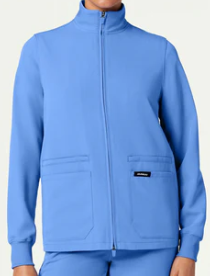
  • Scrub jackets must also be ciel/ceil blue. Students often purchase fleece or jersey connect. Matching jackets can be found online (e.g., Amazon, FIGS, or other brands). 
  • Example of ciel / ceil blue scrub colour:
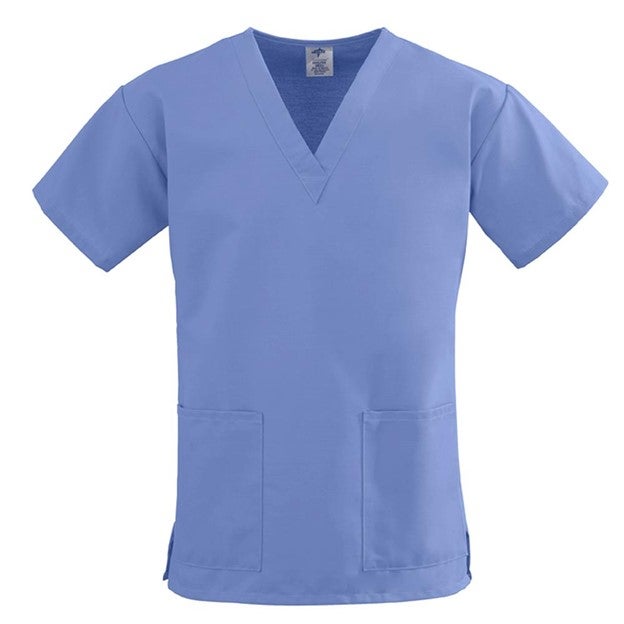
    Ciel / ceil blue scrubs with pocket
Ceil blue under scrub shirt, layered with standard scrub shirt overtop
Ceil blue scrub jacket
  • Footwear that is clean, safe and in good repair (running shoes are permitted). 

  • WOVS Optometry clinic nametag (these will be ordered for you).  

  • Head coverings are allowed for religious observance only. 

  • Minimal fragrances, perfumes, colognes or after-shave lotions.  

  • Personal hygiene and halitosis must be addressed. 

  • Hair is to be neat, clean and not obstructive to the examination. (Long hair is to be tied back to meet the clinic’s infection control protocols). 

Dress Code for Clinical Labs 

  • Clinical Techniques labs follow the clinic dress code (i.e. scrubs). This is relevant for your Winter term, unless your Fall lab instructors specify otherwise. 

Equipment

Required and recommended equipment lists will be provided to you. Equipment reps are chosen for each cohort within the first month of classes. More details to follow. 

Lockers  

Lockers are available for Optometry students and will be assigned when you arrive in the Fall. The cost is $30.00 (debit/credit only). Students have their locker for the entire four years of the program. Locks are provided with the purchase of a locker. Only locks obtained from the School are to be used.  

Photos  

Individual photos of incoming students are taken during Orientation week. Only head coverings for religious observance are allowed in the photos. The photos are used to produce a class composite so that faculty will be able to get to know you. 

Scholarships, awards and Bursaries

Scholarships, awards and bursaries

The University of Waterloo administers a number of scholarships, bursaries, awards and assistance. The University’s Student Awards & Financial Aid office (SAFA) is the primary contact for information on these resources, as well as for needs related to provincial and government loans.  

Bursaries are non-repayable awards based primarily on financial need but may have other selection criteria. See bursary information and applications.

SAFA is responsible for advertising award opportunities, collecting applications, and coordinating with Faculties and/or award committees to complete the selection process. The Undergraduate Awards Database allows you to search for annual award opportunities at Waterloo and in the Optometry program. 

Scholarships, apart from the ones listed below, do not require an application as everyone is automatically considered.   

Award 

Criteria 

How to Apply 

A.H Basman, OD Scholarships (administered by the Manitoba Association of Optometrists) 

Manitoba residents attending ACOE-accredited optometric programs. Based on academic performance as well as extra-curricular, community, and volunteer participation. A minimum grade point average of 3.5 or 75% is required. 

Application form  

Contact: Manitoba Association of Optometrists at mao@mb-opto.ca 

Nova Scotia Association of Optometrists Bursary 

 Nova Scotia residents  

Contact the association at nsao@accesswave.ca  

Dr. David McKenna Memorial Scholarship (administered by COETF) 

First year WOVS student from the East Coast of Canada with a preference going to students from Prince Edward Island. Demonstration of leadership skills, community involvement and academic excellence (minimum admission average of 80% or greater). 

Students will be invited to apply in August of each year. 

Dr. Reed Dawkins Entrance Award 

Outstanding undergraduate student entering first year of the Optometry program on the basis of academic excellence and demonstrated financial need. 

Students will be invited to apply in August of each year.   

Attendance policy

The School of Optometry has an Attendance Policy that outlines mandatory versus non-mandatory student activities (labs and clinic are mandatory activities, for example), and explains the process by which students can file absence requests. The absence request process will be explained in more detail during Orientation.

Orientation

Save the date:

  • Tuesday September 8th and Wednesday September 9th
  • 8am to 6pm 
  • Mandatory attendance for academic Orientation activities.
    • There will be no classes on these days.

Orientation activities are co-arranged by the School Administration and a second-year orientation committee. Orientation activities hosted by the School administration take place on the first two days after the Labour Day weekend. More information will be sent closer to September.

As part of orientation, you will receive an eye examination conducted by a 3rd year student for which you need to complete the eye exam intake form – see checklist above. 

Photos

Prepare to have your individual photo taken on the first day of Orientation. 

This will be to create a class composite that instructors can refer to in order to get to know the students' names and faces. 

Close to graduation you will also get the opportunity to take formal grad photos, for the graduating class composite. 

Optometry student support

AccessAbility Services   

If you live with permanent, temporary, or suspected disabilities that you suspect will require academic accommodation or our general awareness, we encourage you to contact AccessAbility Services. AccessAbility Services is the university’s centralized office for student academic accommodations and collaborates with the Optometry Undergraduate Studies Committee and course instructors to arrange appropriate accommodations for students with disabilities without compromising the academic integrity of the curriculum. You can apply online. The office is located in Needles Hall North, Room 1401.

Registering with AccessAbility late in the term may not allow time for AccessAbility to process requests, so it's recommended that you register as soon as possible (now) before the fall term. For ongoing accommodations, you must register again every term and select the courses for which you wish to have accommodation.  

The Undergraduate Studies Committee (UGSC)  

The Optometry Undergraduate Studies Committee is composed of the Associate Director of Academics and Student Affairs (Chair – Dr.Hutchings, on sabbatical. Dr. Khan, interim), the Associate Director of Clinical Education (Dr. Furtado),  Undergraduate Studies Officers (Dr. Khan), and the Program Manager (Ms. Tatu). The committee meets termly (fall and winter) with student leaders to get individual class feedback about student issues. The UGSC is also involved in planning milestone events such as Orientation, The White Coat Ceremony, and Convocation. The UGSC also reviews and processes all absence requests and academic decisions (e.g. course failures, etc.). 

Undergraduate Officers (Advisors) 

The Optometry Undergraduate Officers are faculty members who are appointed (for a specific period of time) to advise and provide support to optometry students. The Undergraduate Officers can offer advice on academic difficulties, academic standing, regulations, policies and procedures. They are also a resource if you are experiencing personal challenges or concerns, or if the class has identified an issue that is affecting them as a whole. Dr. Khan is currently Optometry’s Undergraduate Officer.  

Health and Well-Being 

Health and Well-Being includes Health Services (located across from the Student Life Centre) and Counselling Services (Needles Hall North, 2nd floor).  

  1. Counselling Services 

Counselling Services has many resources students can use to get support, including individual appointments with a counsellor, urgent help, seminars and even online workshops (coping skills, stress management, etc). There is no charge for counselling appointments to registered University of Waterloo students on or off campus.

  1. Health Services 

Health Services provides convenient, confidential, and comprehensive medical care – including primary care, travel, and nutrition clinics among others. Health Services works in coordination with other health-related services on campus and in the Kitchener-Waterloo community. 

Visit the Health and Well-Being webpages for hours, contact information, and booking appointments. 

Student Success Office  

South Campus Hall 2nd Floor 

The Student Success Office, also located in South Campus Hall, is designed to support students in their goals both inside and outside of the classroom. They offer services such as academic skill-building. 

White Coat Ceremony

White Coat Ceremonies mark the transition of students from students of the Basic Sciences to students of a healthcare profession.

For the Class of 2030, the White Coat Ceremony will be held in the second year of study. Supporters and loved ones are invited to join you to celebrate. More details to come!

WHMIS (Workplace Hazardous Materials Information System Training – students)

WHMIS certification is a requirement for all newly enrolled students regardless of previous training at other institutions, and is required at the University of Waterloo to be eligible to graduate. The certification is valid for only 5 years. If you already have WHMIS certification from uWaterloo, check the date to make sure that it will still be valid by the time you graduate. If not, retake the course.

Safety Orientation/WHMIS online is available for all undergraduate students through the LEARN system and should be completed in the first two weeks of term. Students must self-enroll in WHMIS Online before being able to participate. To self-enrol: 

  • Go to the LEARN home page 

  • Login using your University of Waterloo WatIAM username and password (same as QUEST)  

  • Click "Self Registration" from the ribbon at the top of the page 

  • Select the course name WHMIS 2015 (SO2017) from the list  

  • The training module will then appear in your list of courses 

  • Take the certification 

Parking

Apply for a student parking permit.
Fall parking permits will be available July 6th, 2026.  

Parking permits for the X lot, located behind the School of Optometry and Vision Science building, can be purchased in person or online from UW Parking Services GSC 1112.

Note that due to a limited amount of space, students living in residence cannot purchase both a Residence parking permit (i.e. CLV) plus an X lot (“Unreserved”) permit. They must purchase the Residence permit. Students may choose to bus to the School using their GRT U-Pass.

On-campus housing

The Region of Waterloo