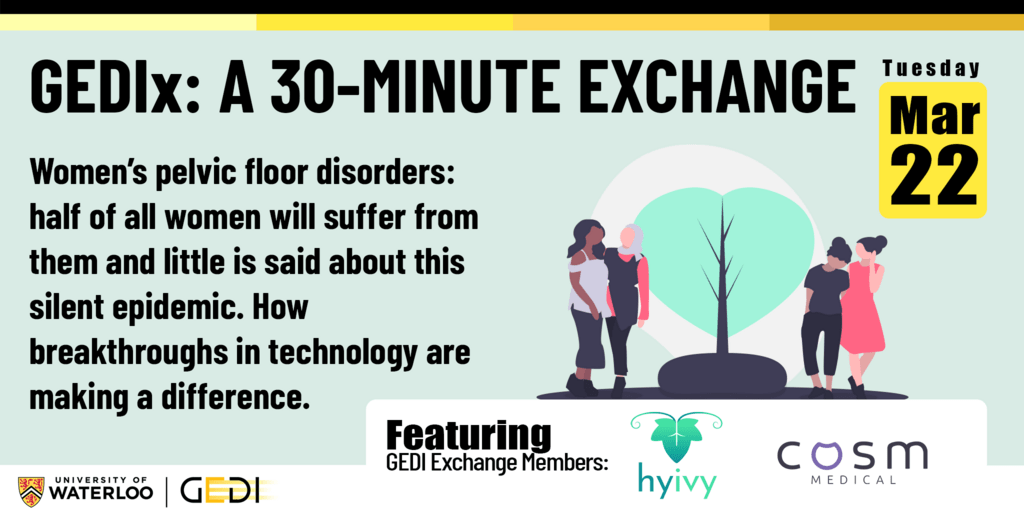
GEDI Exchange - A 30 Minute Exchange with Hyivy and Cosm Medical
Women’s pelvic floor disorders: half of all women will suffer from them and little is said about this silent epidemic. How breakthroughs in technology are making a difference.


Sustainable Engineering Design Challenge
The return to campus hallways and classrooms is an opportunity to reflect on and understand how students, particularly first-year students, experienced online learning during the COVID-19 pandemic.
This session seeks to share lessons learned regarding embedding EDII into grant applications. Dr. Trevor Charles will discuss his experience embedding EDI principles to his research group and in a recent NSERC grant application.
Join for a special seminar presentation with Austin Roorda, Professor, UC Berkeley, Herbert Wertheim School of Optometry & Vision.
Are you interested in quantum mechanics or cryptography?
Then check out CPI's next event on Feb 28th from 6:30pm to 8:00pm. Learn how quantum computers can create security risks and how we can mitigate them!
CPI's Michele Mosca and Sara Zafar Jafarzadeh discuss why it is important to act now, even though cryptographically-relevant quantum computers are not available.
Join us for a special edition of Research talks, "Black History is World History: From Moment to Global Movement," featuring Michaëlle Jean, University of Waterloo Chancellor, St. Paul’s University College and former Governor General and Commander-in-Chief of Canada.
Please register to receive a link to this virtual event.
Join Peter Carr, continuing lecturer at the University of Waterloo, to learn more about this eight–week program developed in partnership with the Ontario Society of Professional Engineers (OSPE) and the Faculty of Engineering.
In her most recent book, Discriminating Data (2021), Wendy Chun reveals how polarization is a goal—not an error—within big data and machine learning. These methods, she argues, encode segregation, eugenics, and identity politics through their default assumptions and conditions. Correlation, which grounds big data's predictive potential, stems from twentieth-century eugenic attempts to “breed” a better future. Recommender systems foster angry clusters of sameness through homophily. Users are “trained” to become authentically predictable via a politics and technology of recognition.