Design team members: Hafeez Esmail, Mashael Yazdanie, Karim Gillani
Supervisor: Professor Paul Fieguth
Background & project description
Pakistan has one of the highest deforestation rates in the world. As a result, the country now faces an imminent environmental and energy crisis. Deforestation contributes to soil erosion, landslides, river silting and the loss of biodiversity. The dependency of rural populations on wood as a primary source of fuel for cooking, heating and lighting is unsustainable and there is dire need to introduce and popularize alternative energy solutions within the nation.
Biogas is one possible sustainable alternative fuel to wood. Biogas is methane gas which is produced during the anaerobic digestion of organic waste, such as dung. Biogas digester technology has been in use for decades and its applications have been widely successful in rural areas of China, India and Nepal, to name a few. The use of family sized biogas digesters yields several environmental and economic advantages; however, a primary disadvantage of the current system design is that gas production decreases drastically during the winter season when digester temperatures drop below 15ºC.
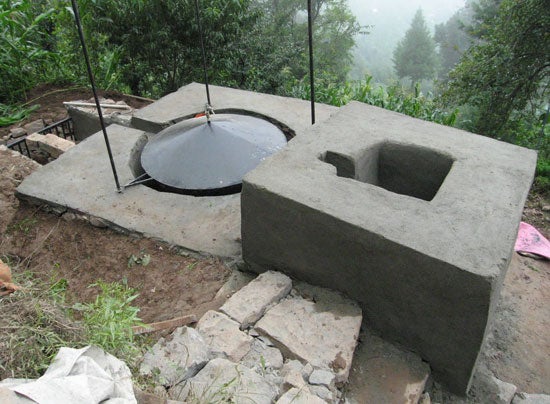
This project aims to improve the operation of family sized biogas digesters during the winter season in rural areas of Pakistan, through increasing the digester chamber temperature.
Design methodology
The methodology applied to this design challenge can be divided into 6 phases: information gathering, concept generation, model generation, model analysis and refinement, concept selection, and verification.
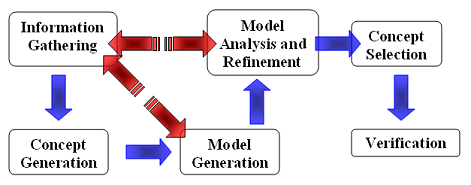
Before an appropriate solution can be developed, a thorough investigation has to be conducted in order to find out what solutions have already been proposed (information gathering). Once these solutions have been analyzed and the team has an understanding of why the respective solutions are not currently being implemented, a solution generation phase is entered. Here various solutions are presented and evaluated against criteria and constraints (concept generation). Solution concepts are then modeled mathematically using MATLAB (model generation). The results of the model are then analyzed and the model, as well as solution parameters, may be tweaked (model analysis and refinement). Once the team has satisfactorily modeled all solution concepts of interest, the concept that performs best analytically, in addition to meeting all criteria and constraints, is selected (concept selection). The analytical model may then be verified experimentally, using a small scale modeling scheme or through a full scale experimental model constructed in rural Pakistan, in cooperation with the Pakistan Council of Renewable Energy Resources (PCRET).