Design team members: Brittany Hanam, Andrew Lee, Kristen Yee Loong
Supervisor: Professor P. Fieguth
Background
In efforts to reduce the dependence on non-renewable energy resources such as coal, oil and natural gas, research and development has turned to renewable resources. Two widely-used renewable energy technologies are solar photovoltaic and wind power. Unfortunately, solar photovoltaic and wind power vary hourly, daily and seasonally, making it difficult to predict and provide reliable energy to the grid on demand.
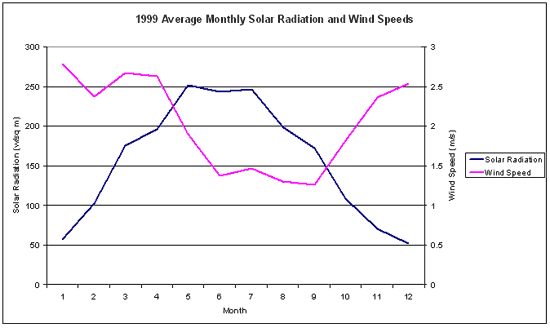
However, studying wind and solar trends, it is evident that there is a complementary relationship between wind speeds and solar radiation (as shown in the graph), allowing for system integration of the two resources.
Dispatching energy on demand allows generators to be able to sell reliable energy at peak times and obtain financial incentives. Alberta operates on an open market with generators competing and bidding throughout the day while in Ontario, the Renewable Energy Standard Offer Program (SOP) remunerates renewable energy projects at a fixed price at all hours of the day and offers incentives for peak hour generation (3.52 cents/kWh). However, wind and solar do not qualify for this program due to their intermittent behaviour.
To be able to control energy production and dispatch solar and wind energy on demand, a storage system must be employed. A new technology is the Vanadium Redox Battery (VRB). The VRB is a high efficiency flow battery and is advantageous over lead acid batteries and hydrogen fuel cells for:
- Their long life electrodes
- Unlimited deep discharges
- 1:1 charge-discharge time ratio (5:1 for lead-acid)
- Closed-system flow of electrolyte can be stored in plastic containers without high pressure
- The system has a modular configuration (allowing dynamic system resizing)
- The system has the ability to supply power to the grid while charging
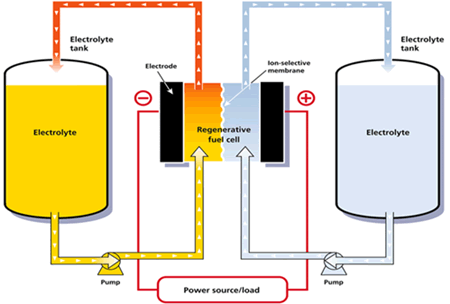
Concept of Vanadium Flow Battery. Source: VRB Power Systems
Project description
The primary objective of the project is to determine the relationship between the Internal Rate of Return (IRR) and the size of a Vanadium Flow Battery system that is implemented with a renewable energy generation facility. The renewable energy systems to be investigated are commercial scale three-blade horizontal axis wind turbines and commercial scale solar photovoltaic systems.
Three scenarios will be evaluated:
- Wind farms without flow battery
- Photovoltaic farms without flow battery
- Flow battery integration with a combined wind and photovoltaic farm.
The scenarios will be evaluated under two energy markets: the Ontario Standard Offer Program (SOP) and the Alberta open market system. Sensitivity analysis will be performed to determine the impacts of flow battery, wind and photovoltaic system pricing.
Design methodology
A tiered approach is being taken by first developing the simple models and then systematically adding more complex components to the model.
- Establish the energy production models for a PV facility and a wind energy facility
- Create production models using data collected from in-situ measurement stations and generator power curves
- Develop long term correlations with permanent weather stations to estimate long term yields of facilities
The Economic Analysis:
-
The
Ontario
Market,
fixed
price
(SOP):
- Determine revenue generated for a PV and wind facility under the SOP using the base energy models.
- Investigate the feasibility of integrating flow battery storage systems and economic change with peak performance
- Develop charge/discharge control scheme for flow battery simulation to determine controlled energy dispatch and maximize return
-
The
Alberta
market,
hourly
price
fluctuations:
The Alberta market is very different than the Ontario SOP market. Pricing fluctuates every hour as opposed to being fixed. Because of these market based price fluctuations, estimates of future energy prices are necessary when analyzing the revenue streams of a multi-year project.- Research to determine forecasted energy pricing and energy demand models (base models)
- Develop algorithm to model charge/discharge strategy for flow battery
- The economic models will be updated for the province of Alberta.