Building real-world impact in 36 hours
How three MBET candidates won the Experience Ventures Hackathon
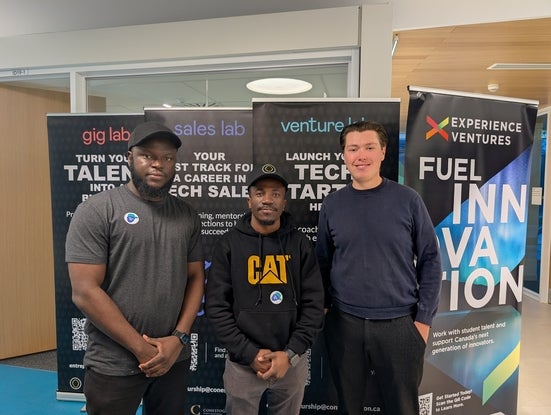
Three Master of Business, Entrepreneurship and Technology (MBET) candidates took first place at the Experience Ventures Hackathon after developing a fully functional zero-waste analytics tool in just 36 hours. Charles Huxley, Tom Kizito, and Joshua Olonade’s winning approach reflects the mindset they each brought to the MBET program: build fast, solve real problems, and deliver value that works in the real world.
Why they came to the MBET program
Each team member arrived at the MBET program with different professional backgrounds but a shared goal: to turn ideas into viable ventures.
Joshua spent more than a decade leading technical teams and building large-scale web applications across Nigeria, the UK, and Canada. He joined MBET to combine his technical expertise with strategic thinking and to tap into the University of Waterloo’s innovation ecosystem. “For someone who wants to build global solutions,” he says, “technical skills alone aren’t enough. I needed an ecosystem.”
Charles and Tom came with strong technical experience and a desire to learn the entrepreneurial frameworks needed to launch and grow ventures. For Tom, MBET offers “the perfect environment to transform innovative ideas into successful businesses” through hands-on learning, mentorship, and real industry challenges.
The challenge: turning zero-waste data into 67% sales growth
The hackathon partner, Full Circle Foods, asked teams to help grow sales of sustainable products using customer transaction data. While many teams focused on high-level strategy, the MBET trio focused first on the client’s constraints:
- What tools did the business already use?
- What technical skills existed internally?
- What could be implemented immediately?
This “constraint-first” mindset, reinforced throughout the MBET program, guided every decision.
“The best solution isn’t the most impressive one,” Joshua explains. “It’s the one the customer can actually use, today.”
The winning solution: The Zero-Waste Dashboard
Rather than presenting theoretical recommendations, the team built and deployed a fully functioning Customer Analytics Platform — the only live product demonstrated at the competition.
In only 36 hours, they developed an end-to-end system that:
- Processes customer transaction files instantly
- Segments customers by purchase behaviour
- Identifies top-performing zero-waste items
- Recommends product pairings to increase cart size
- Highlights new category opportunities
- Compares online vs. in-store performance
The platform requires minimal technical experience and can be implemented with a simple data upload or light API integration. Judges recognized the team for delivering a tool Full Circle Foods could use immediately to make informed, data-driven decisions.
“We didn’t want to walk in with a slide deck,” the team shared. “We wanted to walk in with something the client could use that same day.”
How MBET shaped their approach
The team credits the MBET program’s emphasis on rapid prototyping, customer discovery, and testing assumptions for their ability to execute under pressure.
Key MBET lessons applied during the competition included:
- Focus on the job to be done
- Validate assumptions through user insights
- Reduce scope to build real value fast
- Prioritize usability over complexity
You start realizing that great products don’t start with technology. They start with understanding a meaningful problem deeply. When you understand the problem, the solution becomes obvious.
Advice for future entrepreneurs
Their message for aspiring founders and future MBET cohorts is straightforward:
Solve the customer’s real problem, not the one that looks impressive on a slide. Clarity beats complexity. And above all: ship something real.
What’s next for the Zero-Waste Dashboard?
The team has shared the platform with Full Circle Foods and is exploring opportunities to support other small and midsize retailers who have data but lack simple tools to turn it into actionable insights.
“The best next step isn’t always the biggest one,” Joshua notes. “It’s the one that proves the concept and creates real value.”
Their hackathon win is only the beginning and a strong example of how MBET students turn entrepreneurial thinking into real-world impact.