Submit content for the Daily Bulletin through the Daily Bulletin article or When and Where intake forms.
For all other requests, please contact communications@uwaterloo.ca.
Inside Waterloo’s Teaching Innovation Incubator: three experiments testing what’s next
A message from the Office of the Associate Vice-President, Academic.
At the University of Waterloo, innovation is often about testing what comes next.
That spirit extends beyond the labs, startups, and research projects synonymous with our University. It is also shaping how our students learn. Through the Teaching Innovation Incubator, faculty, staff, and students come together to develop, test, and evaluate bold interdisciplinary teaching ideas with the potential to shape the next generation of education at the University. Supported by the Teaching Innovation and Educational Leadership (TIEL) team within the Teaching Support and Innovation (TSI) unit, the Incubator brings together the talent, expertise, and, where appropriate, technology needed to turn ideas into teaching innovations.
Three projects received Incubator funding for 2025–2026 and are making meaningful progress. Each is exploring a different question about what the future of learning could look like at Waterloo.
What if students could experience the realities of clinical practice before entering it?
For psychology students, moving from studying therapeutic concepts to applying them in practice can be significant. The Family Simulation Training (FaST) project is exploring whether simulated clinical experiences can help bridge that gap.
Led by Dillon Browne (Psychology), Andy Houston (Critical and Creative Humanities) and Rebecca Zehr (FamilyPsycle Lab), the project seeks to bridge the gap between classroom learning and professional practice by allowing students to observe and engage with realistic, simulated therapeutic scenarios.
The approach was piloted in Winter 2026 in PSYCH 337, Trauma, Stress, and Resilience in Families. Students observed live simulations of family therapy dynamics while the research team gathered feedback, reflections, interviews, and other evaluation data to understand the impact on learning.
Now, the team is asking a practical Waterloo question: How can an innovative teaching model become sustainable at scale? Professional actors are central to the current approach, but the team is exploring whether undergraduate students trained in improv could participate through a structured academic model, creating learning opportunities for both groups while improving feasibility.
The next step could be testing whether simulation-based learning can transfer beyond Psychology and into other disciplines and professional programs.
What happens when a classroom becomes a laboratory for complex problems?
The Data, Society, and Planetary Futures (DSPF) project is exploring how students can navigate challenges that do not belong neatly to one discipline.
Led by Florian Kerschbaum (Computer Science), Dan Gorman (History), Jatin Nathwani (Waterloo Institute for Sustainable Energy) and Maral Niazi (Balsillie School), the project is developing a virtual Human-Tech Lab where students explore issues at the intersection of science, technology, policy, governance and society.
The team has been developing adaptable case studies, learning activities and facilitator-ready resources designed to work across disciplines and for instructors with or without technical expertise. Central to the lab are AI-supported simulations that allow students to engage with complex technology and policy scenarios, critically assessing the AI-generated outputs.
The goal: a flexible model, integrable in many different learning environments, that brings faculty, subject-matter experts and students together for interdisciplinary, experiential learning across Waterloo.
Could AI make personalized learning more scalable?
Led by Victor Cui (Conrad School of Entrepreneurship), the Digital Twin Teaching Platform for Mass-Customized Learning project is exploring whether AI can provide students with course-specific support that reflects an instructor’s teaching approach and materials.
The team is developing Astelle, a digital twin teaching platform designed to make personalized learning more scalable. Over the past year, the project has progressed from concept development to platform development building the Astelle platform, working through technical and privacy considerations, and establishing the infrastructure needed to support future growth
An initial pilot has been completed, offering valuable experience and early signals worth watching around enhanced student critical thinking rather than cognitive offloading, more customized support, and a more central role for faculty relative to generative AI in education. Future opportunities will allow Waterloo instructors to participate in pilots, provide feedback, or explore how a digital twin could support their courses.
Interested in exploring your own innovative teaching and learning idea?
The next Teaching Innovation Incubator open call launches September 30, 2026. If you have been wondering whether a teaching idea could work in your course, we encourage you to attend an upcoming information session to learn more about the Incubator funding and support. More information about the Open Call and the information session will be posted to the Daily Bulletin during the first week of October.
Student Communications Survey results
A message from the Office of the Associate Provost, Students.
When it comes to communicating with students, are you curious about what social media platforms we should be using? Have you ever considered how many emails are too many to send? Do you wonder if your emails are being read?
We surveyed a representative sample of our student community in the fall of 2025 to ask about student preferences when it comes to communications from the University. The results are in, and the final report is now available.
We have gathered insights ranging from what topics matter the most, and how frequently students receive emails, to how they experience communications from the University. The report summarizes our findings and allows you to dive into the data using the dashboard to sort and filter the results you are most interested in.
Some key takeaways:
- 73% of students are satisfied with communications from the University, a positive sentiment that has improved over time (72% in 2023, 67% in 2021).
- 79% of students feel University communications demonstrate care and concern, representing a steady increase from previous survey years (72% in 2021, 76% in 2023).
- The top three social media platforms our students use are Instagram (88%), YouTube (73%), and LinkedIn (60%).
Student feedback remains a key input into how the University of Waterloo evolves its communication practices to better support the student experience. Leveraging the key takeaways from this report, will ensure you are delivering the information students are looking for, when they need it and on the channels they prefer.
For more information about the survey and its results, contact Claire Taylor or Sean Ruby from the Office of the Associate Provost, Students.
Could green tea extract fight Alzheimer’s disease?
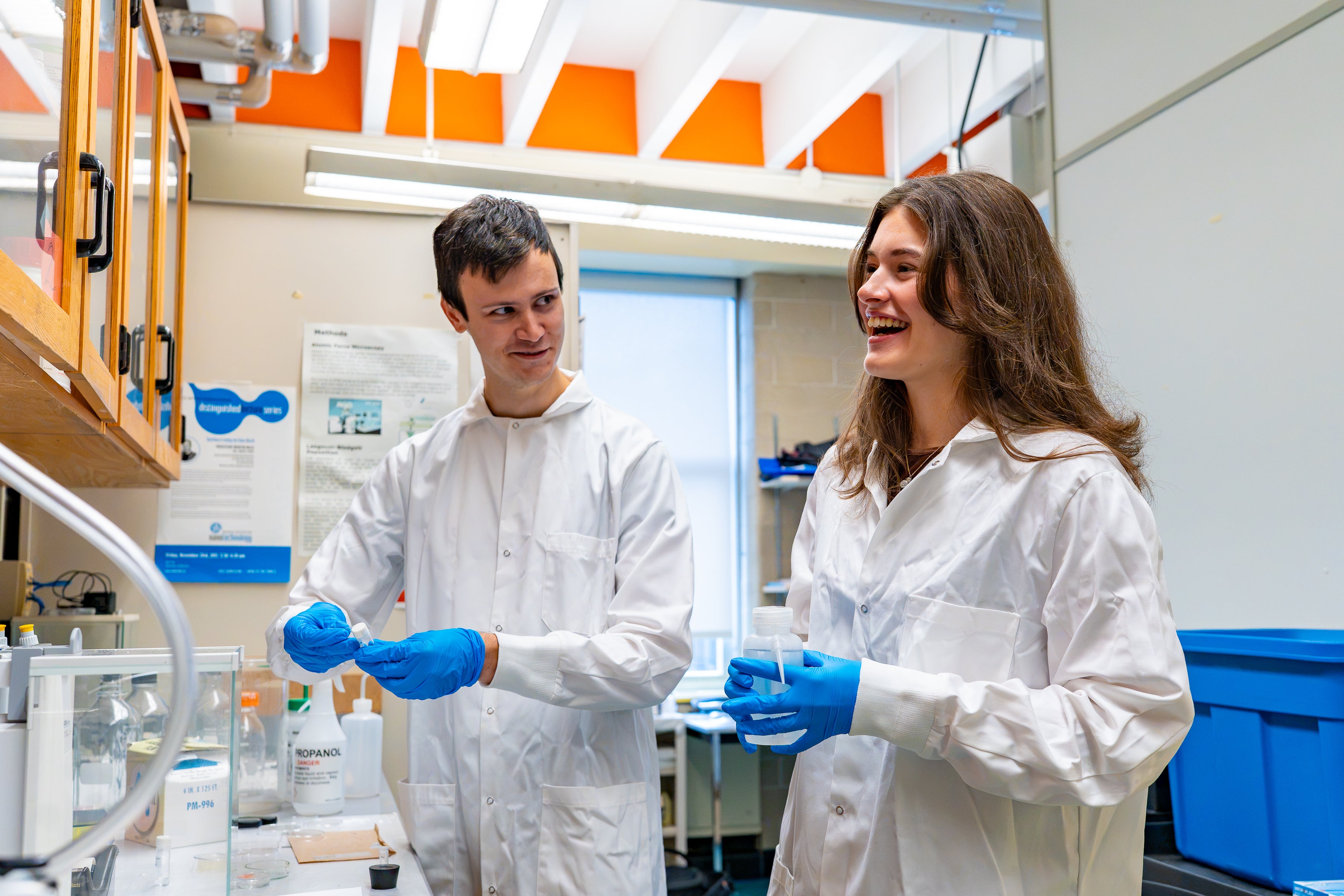
Hugh Hossfeld (left, third year Honours Science) and Isabella Barichello (right, third year Biomedical Engineering).
This article was originally published in Waterloo News.
Three University of Waterloo students are conducting research in Dr. Zoya Leonenko’s lab, searching for answers to Alzheimer’s disease at the nanoscale.
Charlotte Baur (fourth year Biological and Medical Physics), Hugh Hossfeld (third year Honours Science), and Isabella Barichello (third year Biomedical Engineering) are Research Assistants investigating how epigallocatechin gallate (EGCG), a plant antioxidant found in green tea, might help protect against cell damage that leads to this neurodegenerative disease.
“We’re looking at the lipid membrane of a cell,” Baur says. “We model it after a neuron and study its electrophysiology, which means we look at how the membrane conducts ion currents and how certain molecules can effect that ability.”
Their work takes place in Leonenko’s lab in the Department of Physics and Astronomy, where they study the role of neuronal membrane in Alzheimer’s disease and how the membrane can be protected. They test model versions of neuronal cell membranes and examine how they respond to amyloid beta, a small protein cluster that clumps together in the brain and forms large plaques. It is a major contributor to Alzheimer’s disease.
The research builds on previous studies where compounds such as melatonin and trehalose have been examined for their potential protective effects, creating a foundation for the research team’s focus on EGCG.
Using electrophysiology techniques, Baur and Hossfeld examine how amyloid beta damages the neuronal membrane, and whether EGCG offers protection from amyloid beta oligomers forming pore-like openings that allow ions to pass through.
“What we hope to see is a decrease in ions passing through into the membrane,” Hossfeld says. “If fewer ions are passing through, that suggests that EGCG is offering a barrier of protection. A preventative effect would be where those events disappear completely.”
When conducting experiments, Baur and Hossfeld observed reduced membrane permeability, suggesting green tea extract could help shield the membrane from damage.
While Baur and Hossfeld focus on what happens when amyloid beta attacks the inside of the membrane, Barichello approaches the problem from a different angle using surface plasmon resonance (SPR).
“Using SPR, I study how amyloid beta attaches to the membrane’s surface, and whether treatment with EGCG can reduce or prevent the amyloid build-up on the membrane,” Barichello says.
In the lab, she designed experimental protocols, conducted control studies, and analyzed molecular binding patterns to investigate EGCG’s potential protective effects.
As a team, the three students are providing a clearer picture on whether reducing amyloid-induced membrane damage could slow or prevent the progression of Alzheimer’s disease. While more research remains, their work in Leonenko’s lab is contributing valuable insights into one of the most complex neurological disorders that could one day contribute to future treatments that protect brain health.
Growing smarter to tackle Ontario's farm challenges
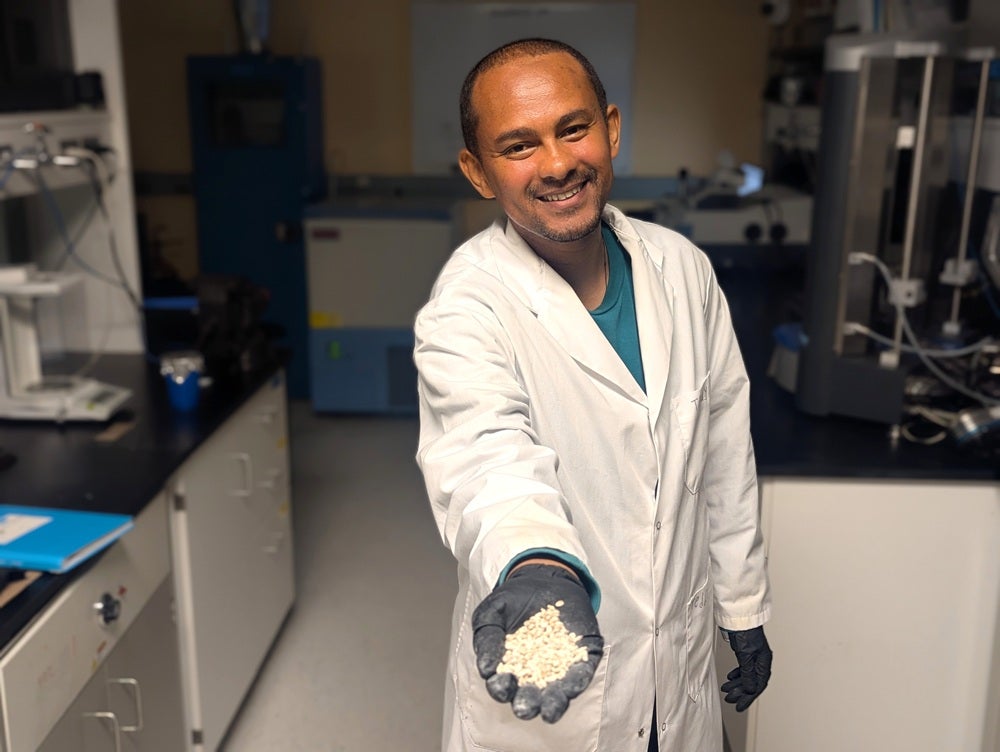
Tewodros Taddese Tiruneh, an engineering PhD student, displays seeds he helped coat with a biodegradable hydrogel to hold moisture in a project led by Dr. Tizazu Mekonnen.
This article was originally published in Waterloo News.
Researchers at the University of Waterloo are working with government, academic and industry partners to tackle several challenges in Ontario’s agricultural sector, including short growing seasons, rising production pressures and crops that can fail long before anyone sees warning signs.
“The problems we face today are complex, and their solutions demand equally complex expertise,” says Dr. Christian Euler, a chemical engineering professor at Waterloo. “By collaborating across disciplines, we move toward addressing these problems and strengthening Ontario's food resilience.”
To address issues related to growing seasons, the provincial government has built a 5,200-acre greenhouse industry worth $1.8 billion annually.
But while controlled environments boost productivity through precise management of growing conditions, they also increase the risk of rapid pest and disease spread, and reliance on manual monitoring delays response times.
A team from Waterloo and the University of Guelph partnered with the Ontario Ministry of Agriculture, Food and Agribusiness (OMAFA) to take on those problems by designing a system that monitors greenhouse crops for early signs of disease, infection and plant stresses before they are visible.
“This initiative uses cutting-edge computer vision, metabolic modelling and machine learning-based state estimation to catch problems early in order to protect yield, reduce crop losses, and make better use of resources like water, energy, and fertilizers,” says Dr. Nasser Mohieddin Abukhdeir, a professor in the Department of Chemical Engineering at Waterloo.
Researchers coated these seeds with a biodegradable polymer material to hold moisture and improve their survival rate after planting.
Dr. Medhat Moussa of the University of Guelph and Dr. Fadi Al-Daoud, Greenhouse Vegetable Specialist at OMAFA, are also part of a research group that combines complementary skills for the project. Moussa, for example, uses multispectral and depth cameras to capture growth metrics and stress indicators.
“It’s a pleasure to collaborate with Professor Abukhdeir and his team to address important questions that will help improve the production of greenhouse fruits and vegetables for Ontario growers,” says Al-Daoud. “This project will develop technologies that will allow greenhouse growers to identify stresses earlier, helping growers to proactively reduce negative effects on crop yield.”
Euler is developing metabolic models that reveal information about plants before symptoms appear.
“The models build on what we know about plant metabolism and genomic information to understand what’s happening inside the plant,” he says. “Metabolic changes precede visible changes by at least three days.”
That initiative — funded by the governments of Canada and Ontario through the Sustainable Canadian Agricultural Partnership, a federal, provincial and territorial initiative — could yield an important predictive tool for greenhouse production.
Another collaborative project, which includes industry partner Corteva Agrisciences, addresses a challenge in eastern Ontario, where farmers struggle with a short growing season and a narrow window for planting winter wheat, often before soybeans have been harvested.
The project involves the use of drones to scatter winter wheat seeds into standing soybeans, offering a promising workaround, but early trials revealed a major flaw.
Aiming to improve seed survival
“With drone-planting, the seed is on the surface of the soil and not planted as it normally is,” says Dr. Joshua Nasielski, a Guelph professor who leads the project. “As a result, seeds dried out before they could sprout. We might plant 1.6 million seeds an acre but get less than half to survive.”
That’s when Waterloo chemical engineering professor Dr. Tizazu Mekonnen was brought in to innovate a seed coating made from a polymer material to improve water retention.
Drawing on his expertise in sustainable polymers, Mekonnen designed a biodegradable, super-absorbent hydrogel from potato starch that acts like a sponge to hold moisture close to the seed so it can survive until rain arrives. And unlike synthetic plastic coatings used to plant wheat, the coating fully degrades.
“The current method functions,” says Mekonnen, Canada Research Chair in Sustainable Multiphase Polymers. “The problem is that after the seed grows, the plastic stays in the soil. Imagine decades of applications of those very tiny plastics buried in the soil and turning into microplastics that contaminate soil and water systems.” The research group, which includes technician Ian DeSchiffart, is hopeful it will see an increase in the number of surviving wheat plants.
Building closure
The Douglas Wright Engineering Building (DWE) will remain closed until Sunday, October 4. Please avoid DWE and the surrounding affected area until further notice. Classes and planned activities scheduled in DWE will be relocated or rescheduled as needed, and affected students, faculty, and staff will receive further details.
Take the President's Survey
Share your perspective on Waterloo’s future. President Bill Rosehart wants to hear from you. The voluntary and anonymous survey takes approximately 15 minutes to complete. Complete the survey by Wednesday, September 30.
Dean of Health Nominating Committee Consultations
Share your views on matters concerning the search for the new Dean of Health to consultant Dr. Laverne Smith. Complete this short questionnaire by October 1. You may also reach out to any member of the committee to share your input directly.
When and Where
The Campus Wellness Student Medical Clinic offers healthcare visits with Physicians and Nurse Practitioners to current undergraduate and graduate students. Services include: vaccinations, immunity testing, naturopathic services and more.Counselling Services offers appointments with counsellors in person as well as via phone and video. Students can book appointments for these services by calling Campus Wellness at 519-888-4096.
The privately-runStudent Health Pharmacy(located in the lower level of the Student Life Centre) is now offering new COVID booster shots and flu shots. Covid booster shots are available by appointment only – please call ext. 33784 or 519-746-4500. The Student Health Pharmacy’s summer hours are Monday to Friday, 9:30 a.m. to 4:30 p.m. Naloxone kits are still available – pick them up in the pharmacy at no charge.
The Waterloo Eye Institute optometry clinics in Waterloo and downtown Kitchener offer comprehensive eye exams and eyewear, including glasses and contact lenses, with the Waterloo location offering various specialized services including urgent eye care. Discounts apply for University of Waterloo students and employees. The Waterloo Clinic is at a nearby interim location, 419C Phillip St, during construction at the School of Optometry and Vision Science. The Kitchener Clinic remains at the Health Sciences Campus, 10B Victoria St. S. Book online or by phone at 519-888-4062.
Employee Recognition Awards nominations: Recognize a colleague or team who brings Waterloo’s values to life through their actions and contributions. Nominations are open until Thursday, October 1.
Science Grad School Fair, Tuesday, September 29, 1 to 4 p.m., STC, Main Commons (by STC 1001 and Starbucks)
Campus Bird Walk, Tuesday, September 29, 7:30 to 8:15 a.m., Brubacher House
GIS Speed Run Session 2: GIS Data Types and Open Data, Tuesday, September 29, 12:45 to 1:45 p.m., online.
When the System Fails: A Story of Mental Health, Islamophobia and Accountability Documentary Film Screening and Conversation, Tuesday, September 29, 5 p.m. to 7 p.m., EC5, Room 1111
Science Grad School Fair, Tuesday, September 29, 1 p.m. to 4 p.m., Science Teaching Complex (STC), Main Commons. Registration required.
Film screening and conversation: My Brother, Soleiman, Tuesday, September 29, 5 p.m. to 7 p.m., Enterprise Theatre, East Campus 5 (EC5), Room 1111. Registration required.
National Day for Truth and Reconciliation, Wednesday, September 30, Sunrise Ceremony at 7 a.m. on the B.C. Matthews Hall Green and Commitment Polishing Ceremony at 10 a.m. that will include a Cedar Circle and Pipe Ceremony.
Project 529 Bike Registry Registration Rallies, (weather dependent), Wednesday, September 30, 11 a.m. to 1 pm at QNC/MC bike racks (by the overpass); Thursday, October 1, 8:30 to 10:30 a.m. at QNC/MC bike racks (by the overpass); Tuesday, October 6, noon to 2 p.m. at SLC Green; Wednesday, October 7, 11 a.m. to 1 p.m. at CPH/Ring Road. Let's end bike theft. Bring your bike to register and get a free 529 Shield.
Community Well-being Fruits and Veg Market, Wednesday, September 30, 11 a.m. to 3 p.m., SLC Marketplace, PSE 1st floor, and EV3
Noon Hour Concert Series - Subhira Quintet, Worldly Jazz from Chile, Wednesday, September 30, noon, Conrad Grebel University College Chapel, Combines musical ethnic roots of Chile and other countries with classical music, jazz and South American rich dancing traditional music. Free Admission.
From Idea to Impact: Understanding Markets and Consumers, Thursday, October 1, 12:30 to 1:30 p.m., online.
Knowledge Mobilization Community of Practice, "Knowledge Mobilizationin Canada and Beyond: Where Are We and Where Are We Going?"Thursday, October 1, 1:30 to 3 p.m. Location: EC5 1111 (Enterprise Theatre). For questions, contact Nadine Quehl (nquehl@uwaterloo.ca).
Cyber Awareness Kick-off: A year in review, Friday, Oct 2, 9 to 10 a.m., virtual
2026 Cheriton Research Symposium, Friday, October 2, 10:00 a.m. to 4:30 p.m., DC 1302.
He Who Saw All Things: A Celebration of Mesopotamian Civilization. Sunday, October 4, 6 to 7:30 p.m. at the Theatre of the Arts, Modern Languages.
Kairos Blanket Exercise hosted by St. Jerome's University, Monday, October 5, 3 p.m. to 6 p.m., St. Jerome's Chapel, dinner included.
More Feet on the Ground Certificate, Monday, October 5, 3 to 4 p.m., PSE 7303/7363.
The Co-Op Workplace Simulation Oct. 5, Monday, October 5, 4:45 to 7 p.m., 2nd floor IDEAs clinic, PSE.
Safeguarding Science Webinar: Module 2: Dual-Use Technologies: Know Your Research - Know Your Partners - Assess the Risk(English) - Tuesday, October 6, 1 to 2:30 p.m.
WUSA Bike Auction, Tuesday, October 6 at noon, SLC Green
GIS Speed Run Session 3: Every Map is Wrong!, Tuesday, October 6, 12:45 to 1:45 p.m., online.
WaterLeadership Certificate: Knowledge Mobilization 101, Wednesday, October 7, 10 to 11:30 a.m. in E2-2350. Earn the certificate, gain transferable skills. All undergrads and grads welcome from all faculties. Space is limited, registration required.
Indigenous Speakers Series presents Sarah Deer, Wednesday, October 7, 3 to 4:30 p.m. Theatre of the Arts, ML
Cybersecurity at Home and Beyond, Wednesday, October 7, noon to 1 p.m, EIT 3142
Anti-Racism Reads: Alt-Right From 4Chan to the White House, Thursday, October 8, noon 1 p.m., LIB 338
From Idea to Impact: Investigating Industries and Companies, Thursday, October 8, 12:30 to 1:30 p.m., online.
Instructional Innovations Week, Tuesday, October 13 to Friday, October 16. Featuring a range of sessions exploring innovative approaches to teaching and learning, with a particular focus on generative AI and emerging technologies.
Introduction to Crochet, Wednesday, October 14 and 21, noon to 1:00 p.m. (class is held over two weeks). It will also be held on Monday, November 2, 5 to 7 p.m., and on the Cambridge Campus on Tuesday, September 29, 5:30 to 7:30 p.m. Location will be sent at registration. Note: This workshop costs $25
Launching the AI and Teaching Instructor Resources Site - (CTE7568), Tuesday, October 13, 12:30 to 1 p.m., Online
Introduction to Assessment Redesign and GenAI - (CTE7567), Tuesday, October 13, 1:30 to 3:30 p.m., MC 2036
Teaching Critical Thinking in a Time of AI (CTE7563), Thursday, October 15, 1:30 to 3 p.m., MC 2036
GenAI Assessment Showcase (with faculty examples) (CTE7564), Thursday, October 15, 10:30 a.m. to noon, MC 2036
Identity offboarding, Friday, October 16, 9 to 10 a.m., virtual
Augmented Reality Video for Online / Hybrid Teaching and Tutoring (CTE7566), Friday, October 16, 1:30 to 3 p.m., Tech Sandbox (LIB 329)
Bodies, Bones, and Burials: What Human Remains Reveal About the 1845 Franklin Northwest Passage Expedition, Wednesday, October 21, 7 to 8:30 p.m., Humanities Theatre, Hagey Hall
Safeguarding Science Webinar: Module 7 - Conducting Open-Source Due-Diligence (English), Thursday, October 22, 1 to 2:30 p.m.
Upcoming service interruptions
Stay up to date on service interruptions, campus construction, and other operational changes on the Plant Operations website.