Breeding habitat selection in eastern population sandhill cranes
Master of Environmental Studies graduate Kiaunna Lee uses high-resolution satellite telemetry to uncover new insights into breeding habitat.
Canada’s eastern boreal forest supports a wide diversity of wildlife, including sandhill cranes. This migratory bird is a species of management interest and uses the eastern boreal forest of Ontario and Quebec for breeding. Recently, the boreal forest has experienced more intensive logging, farming, and mineral extraction. This development is expected to increase, and the impact this will have on crane breeding habitat is poorly understood. Conducting research in remote areas like the boreal forest is difficult, especially when you are researching an animal you do not want to disturb.
Kiaunna Lee, a recent graduate of the Master of Environmental Studies program, found this research problem interesting and exciting. She chose the Faculty of Environment for its interdisciplinary approach to wildlife research, management, and conservation. Her master’s thesis researched the multi-scale patterns of breeding habitat selection in sandhill cranes across Canada’s eastern boreal forest. In a recently published article, Lee and her co-authors used high-resolution satellite telemetry data to assess how land cover and land use influenced breeding habitat selection of 42 sandhill cranes in Ontario and Quebec.
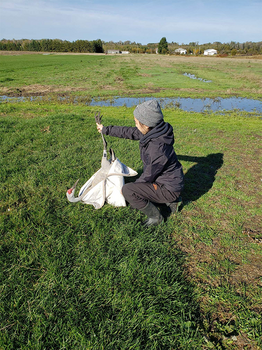
From 2019-2022, cranes were briefly captured and fitted with a leg-mounted solar-powered global positioning system (GPS) device. The use of high-resolution satellite telemetry data provided a unique opportunity to investigate crane movement and breeding ecology in remote areas of the boreal forest.
Lee was present during the final year of tagging and remembers it fondly. “It was such a memorable experience. Lots of early morning, sunrise over the fields, teamwork, and carefully tagging cranes before sending them back on their way. Equal parts exciting and rewarding.”
By studying the crane’s movements, Lee was able to identify the start and end of their breeding season, as well as the preferred breeding habitat. The cranes exhibited the strongest selection for wetlands, which provide important foraging, nesting, and brood-rearing resources throughout the breeding season. These results highlight the importance of wetlands as a key component of sandhill crane breeding habitat in the eastern boreal forest.
“We hope this work helps inform future planning so that development considers and protects these intact wetland systems and the habitat features breeding cranes rely on.”
Lee is now at the University of Western Ontario, pursuing a PhD with research interests in the movement ecology and predator-prey dynamics coyotes around Long Point National Wildlife Area. Her master’s provided her with a strong foundation in wildlife analysis and scientific writing that she uses every day in her PhD. It also built her confidence in designing research projects and translating ecological findings into meaningful conservation insights.

The research, Spatial drivers of breeding habitat selection in Eastern Population sandhill cranes, authored by Lee and others, was recently published in the Canadian Journal of Zoology.