In May 2015, a class of undergrads from the Faculty of Environment participated in a new Geography (GEM) field course entitled, “Rouge National Urban Park: Geographic Interpretation, Communication, and Outreach in Practice”. One could speculate that creating a large national urban park – the first in Canada – might be a challenge, but our students found out first-hand how complex the situation actually is.
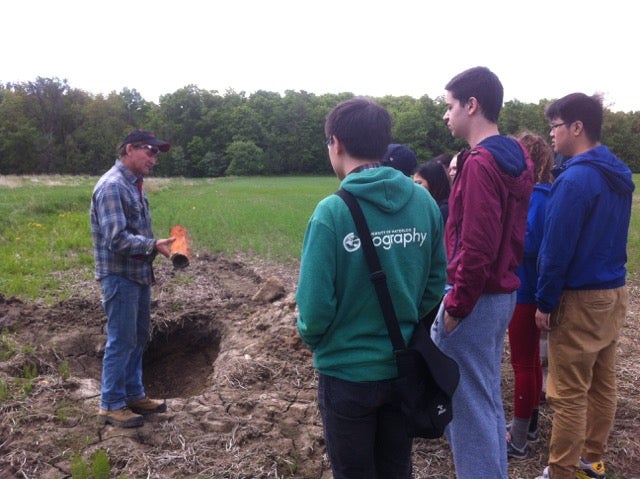
During our time in the field, we met with a wide variety of stakeholders, including park managers, planners, farmers, ecologists, archeologists, historians, recreationalists, and citizen scientists, to explore such questions as: How can national urban parks and urban environments interact? How can competing issues of tourism, education, ecology, recreation, agriculture, and stormwater management be addressed? What role does/can the geographer have in these conversations and decisions?
By their third or fourth year of their degree, students generally have a good grasp of core concepts of GEM and are able to apply them to real-world situations. This experience provided such an opportunity and people who we spoke with were eager to hear both what students were excited about and how they might play a role in the future of this landscape and others. In such an immersive experience, students cannot help but broaden their understanding of geography: “I found the course to be thought-provoking. It really highlights the issues faced by the park, particularly in regards to effectively managing an area with such diverse stakeholders and how difficult it can be to appease everyone,” offers fourth-year Geography student Jacob Samsoondar, who grew up about a five-minute walk from the Rouge River.
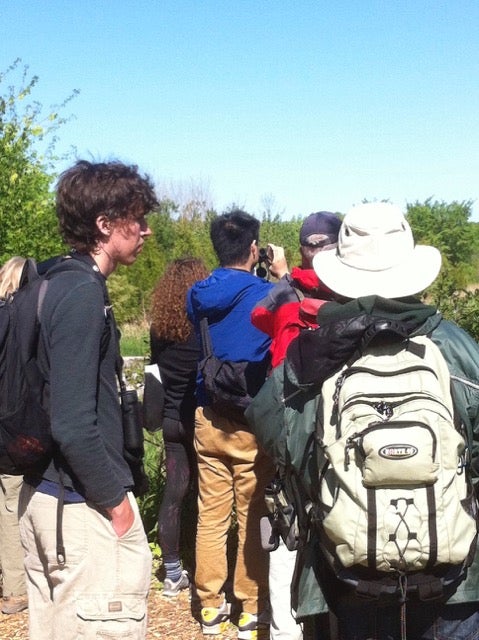
But why take a field course such as this? Why in Toronto? Aren’t field courses traditionally done in “nature”?
Holli Campbell, a fourth year Environment and Resource Studies student from Drayton, explains her motivations for participating:
Toronto is growing on me. At first I despised the city, as I would often get confused or lost trying to navigate myself through the area. Now my perceptions have changed. I believe that the GTA will provide various opportunities for innovative thinking/designs/strategies to ensure the preservation of the environment, especially with the increased pressures of urban development. I am a strong believer that green space is important no matter where one lives, and needs to be incorporated into urban areas effectively.
Campbell’s sentiments were similar to many others in the class, and combining the concept of “urban” with that of “nature” continues to intrigue and provoke. Sonya Meek, a guest speaker who is also an Geography alum, offers this insight: “So often people apply to work for us and they have lots of experience conducting field work in remote locations – but we operate in Toronto and those skills aren’t necessarily as relevant here. Providing students with an opportunity to apply skills in an urban environment is invaluable.” Meek now works as a Senior Manager of Watershed Planning for the Toronto and Region Conservation Authority.
The ability to effectively communicate their experiences and findings was honed in the final assignment of the course. Students were challenged to determine key management issues – based on conversations with experts in the field, groundtruthing, and research – and to propose tangible strategies to mitigate them. One group chose to focus on transportation routes through the Park (roads, rails, etc.), while the other proposed ways to create and support sustainable trails that enhance the current network. Reports have been sent to key decision-makers.
Throughout the course, students noted how much everyone loves the land and wants what’s best for both it and for the local residents. This incredible energy shone through in each story told on the trail, in the classroom, and at the office. We would like to thank the various people who were so willing to support this initiative: Mike Whittamore from Whittamore’s Farm, Margie Kenedy and Sonya Meek from the Toronto and Region Conservation Authority, Larry Noonan from the Friends of Rouge National Urban Park and other naturalists who hiked with us, Lilli Duoba and George Duncan of the Town of Markham, Michelle Holmes, Sheryl Santos, and Richard Scott of Parks Canada, and all those who love the park.
Article written by Amanda Hooykaas, PhD, FRCGS, Adjunct Faculty Member and Field Course Developer, Faculty of Environment, University of Waterloo