Electrical and Computer Engineering Open House – Harnessing Quantum Technologies
A half-day open house showcasing the latest developments in topological quantum materials, superconducting quantum circuits, quantum sources and detectors.


Candidate: Stefanie Beale
Supervisor: Raymond Laflamme
The fields of opto- and electromechanics have facilitated numerous advances in the areas of precision measurement and sensing, ultimately driving the studies of mechanical systems into the quantum regime. To date, however, the quantization of the mechanical motion and the associated quantum jumps between phonon states remains elusive. For optomechanical systems, the coupling to the environment was shown to preclude the detection of the mechanical mode occupation, unless strong single photon optomechanical coupling is achieved.
Colloquium
Chris Ferrie will take you through a historical journey of his own coming of age with digital software and what that experience has granted him. The lesson to be learned is that children will take advantage of the opportunities they are given, but only if their parents and teachers show genuine interest in the activities giving rise to those opportunities. 20 years from now, there will be a Quantum Technology equivalent of Bill Gates. That future leader is only a young child today.
Interested in learning more about the Transformative Quantum Technologies (TQT) initiative? Attend the TQT information session from 1:00 – 3:00 PM in the RAC 2 Quiet Labs foyer. Please join us to learn about TQT’s program opportunities, latest research developments and future directions.
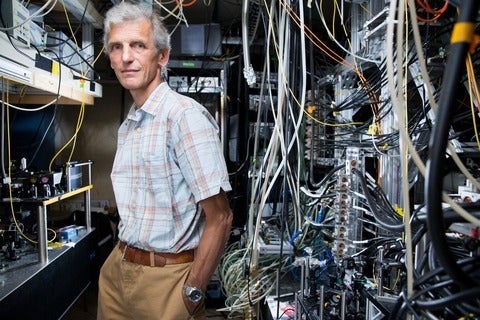
The properties of ultracold atoms can be profoundly modified with the help of laser beams. They can modify the wavefunction of neutral atoms in such a way that they show behavior of charged particles, e.g. electrons in high magnetic fields. In this way, synthetic magnetic fields and spin-orbit coupling have been realized, and a supersolid phase has been observed. A supersolid is superfluid and breaks translational symmetry, i.e. it has shape.
We devise an all-optical scheme for the generation of entangled multimode photonic states encoded in temporal modes of light. The scheme employs a nonlinear down-conversion process in an optical loop to generate one- and higher-dimensional tensor network states of light. We illustrate the principle with the generation of two different classes of entangled tensor network states and report on a variational algorithm to simulate the ground-state physics of many-body systems.
In recent years, the magnetic random-access memory (MRAM) have been attracting attention as a next generation memory device due to their fast switching speed and non-volatility characteristics. The biggest challenge for the switching device using a magnetic material is an easy magnetization reversal.