The Melding of Music and Visual Art - Alum Caroline Bordignon
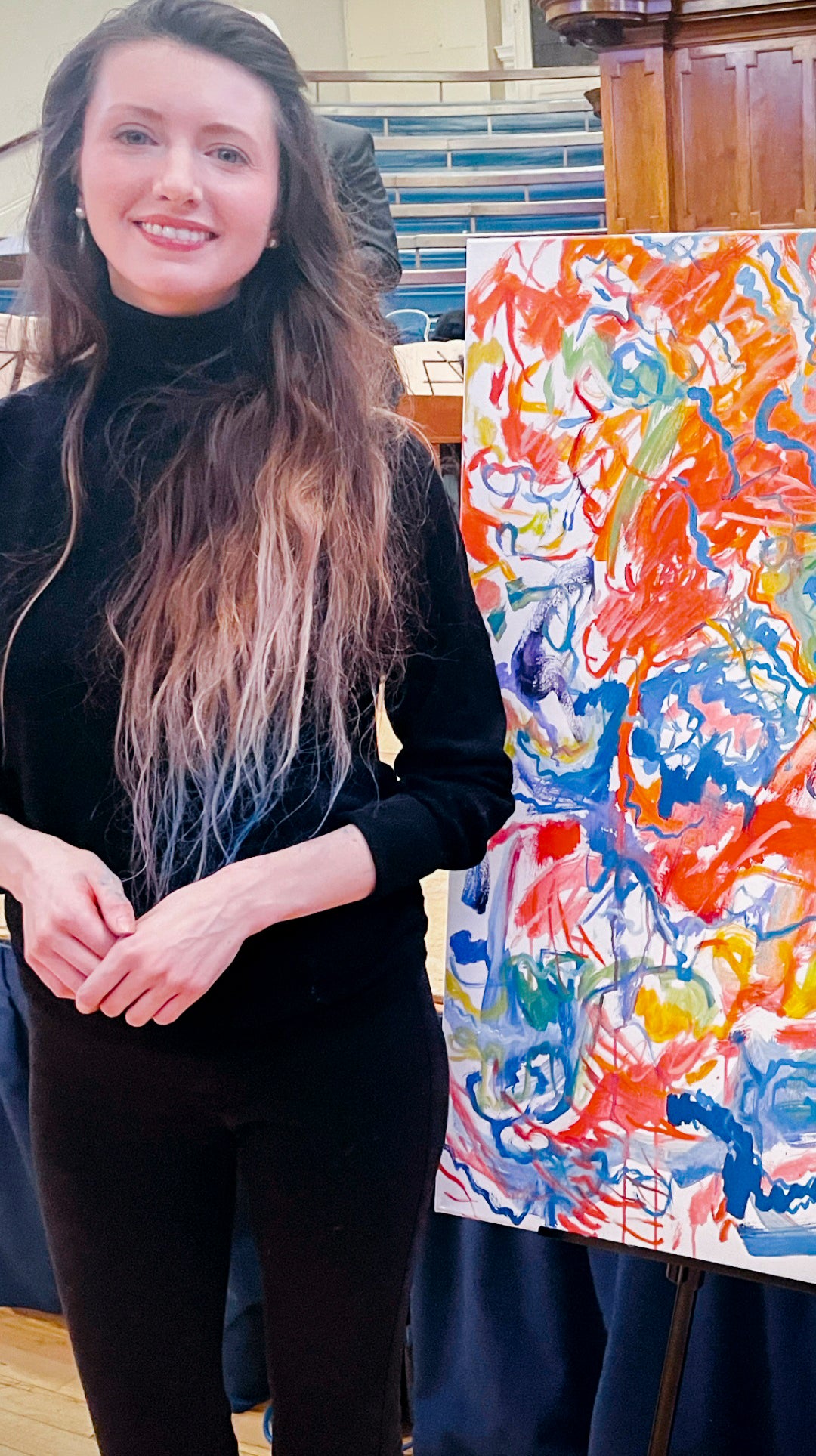
Caroline Bordignon (BA 2014) is a contemporary composer and fine artist. Her work explores aspects of colour, light, space, time and how they interrelate in visual and musical expression through synaesthesia.
Caroline has always been drawn to both music and visual art. When considering university options, she chose to study at the University of Waterloo and Conrad Grebel University College, where she pursued a joint honours degree in Music and Visual Arts. That was where she began to understand how connected the two art forms are, especially in her perception of sound and colour. “It was my discovery of having Synaesthesia (the crossing of sound to colour senses) and seeing music that led me to combine both art forms, especially in a live setting, to show how music can be experienced in a visual way,” she explained.
She knew her career path needed to include both composition and artistic expression, and she has found a way to combine both art forms in a uniquely integrated approach.
Caroline enjoys composing music inspired by still artwork, both her own art and that of others, “which deepens the experience of the works.” She also practices “live painting” which is “more of a 'process' that unfolds over time rather than a finished result.” For example, earlier this year, Caroline brought a visual dimension to a performance of Haydn’s The Creation with the Nottingham Festival Chorus, as she painted what she heard in real time.
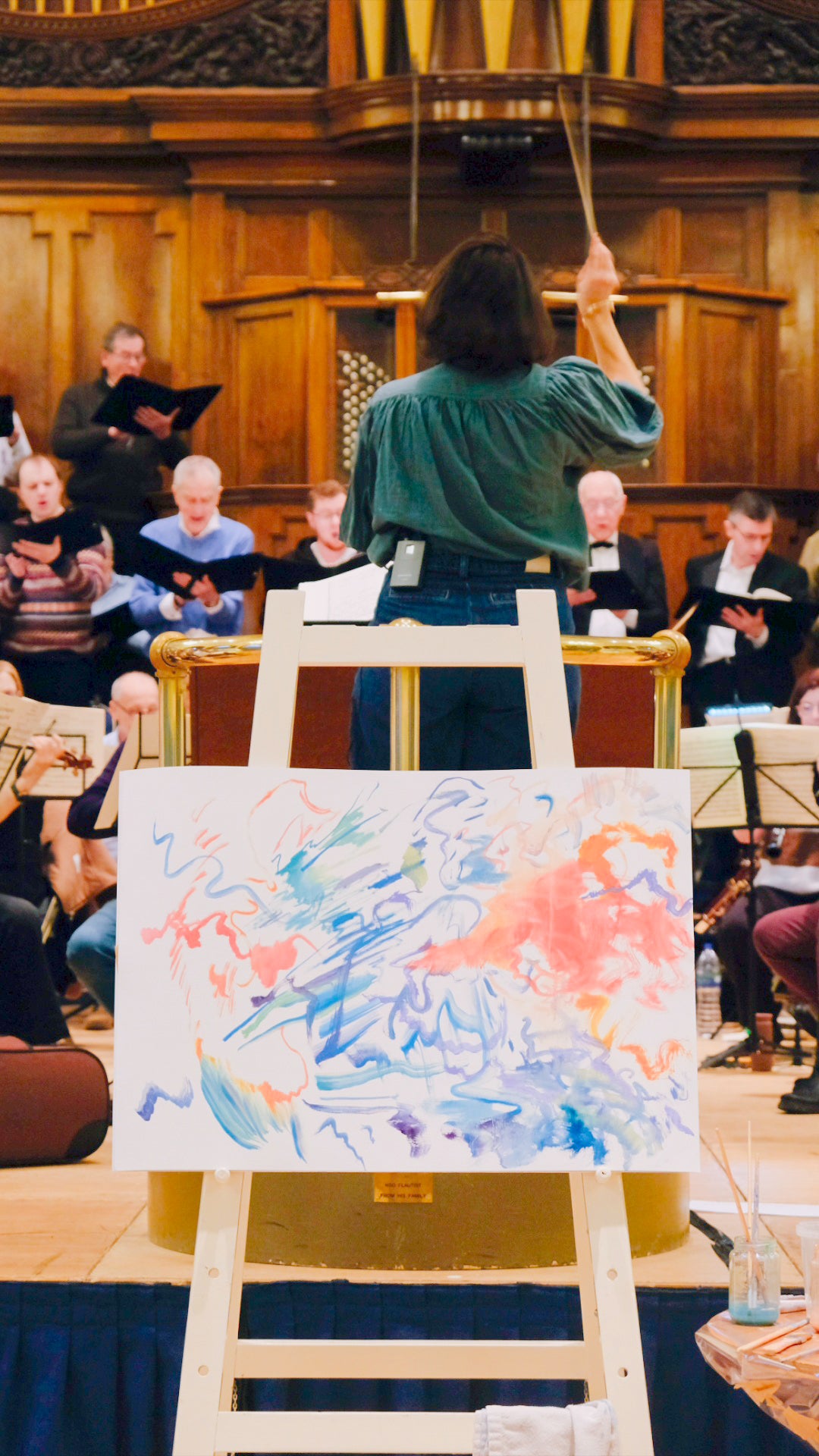
“When I listen to a piece of music, I try to create a visual representation of my synaesthesia and what I am seeing,” Caroline explained. “While I hear notes as colours, the image is influenced by many other elements including rhythm, tempo, timbre, context of notes within key signatures, intervals, and instrumentation. For example, a symphony looks to me like a moving, colourful tapestry of shapes formed from many individual parts, while a solo string instrument like the violin, is more like a single, luminous moving line.” Caroline shared that the Aurora Borealis is a good example of how synaesthesia appears to her, resembling a wash of strings. “Brass instruments tend to create much stronger, vibrant colours while the flute is more transparent. Unpitched percussion instruments are more neutral, earthy, and brown.” Caroline hopes that when audiences experience music and art together in this way, they can use their imagination to see how visual colour and music interrelate.
“My music studies at Grebel shaped the way I think about art and creative expression today because this was the place I learned most about the historical connections between music and visual art while studying both art forms,” Caroline noted. “It was interesting to learn about the parallels and connections between artists and composers and how they expressed similar ideas but in different ways.” She explained that many of them knew each other in their lifetimes and exchanged ideas. “Both Monet and Debussy were especially inspired by water and light, Monet loved to paint water lilies while Debussy is known for his 'water music,' including his famous orchestral work 'La Mer.'”
One of the highlights of Caroline’s undergraduate degree at Grebel and Waterloo was writing an orchestral piece that was performed at the Sound of Land festival in 2014. Her love of composition has continued to be a central aspect of her career. “Composition brings to life music from your imagination that no one has heard or experienced before,” she reflected. “It is a surreal experience to hear something you have imagined in real life, especially as new music is a completely unique sound that no one has heard before.” Currently Caroline is a PhD Candidate in composition at the Royal Northern College of Music in Manchester, UK where she previously completed her Master of Music in Composition.
Caroline is already an accomplished composer, and her works have been performed internationally by ensembles like the London Symphony Orchestra, Vienna Chamber Orchestra, and Icelandic ensemble Caput, with performances spanning the U.K., Europe, Asia, and North America. The performances often include live painting by Caroline. Her compositions and interdisciplinary collaborations have been featured at major festivals and venues including the International Society of Contemporary Music World New Music Days Festival, broadcast on BBC Radio 3, and highlighted by organizations such as the Royal Liverpool Philharmonic and Birmingham Contemporary Music Group.
By bringing sound and colour together, Caroline offers audiences a glimpse into the way she experiences the world. Her growing international career reflects the creative foundation she developed through her studies in Music and Visual Art at Grebel and the University of Waterloo.