Veracruz Goldenrod
Solidago veracruzensis Semple is the most recently described member of the Tortifoliae Group of S. subsect. Triplinerviae occurring in central Veracruz state in Mexico with disjunct populations in southeastern Tamaulipas and central Oaxaca (Semple 2018). It is similar to S. pringlei and S. macvaughii native to Nuevo León and Aguascalientes, Mexico, respectively, and S. altissima var. pluricephala native to the southeastern US. It has slightly larger involucres and broader phyllaries than var. pluricephala, and its upper stem leaves usually have a few small serrations on the margins. It has slightly larger involucres but fewer disc florets and longer mid stem leaves on average than S. pringlei.
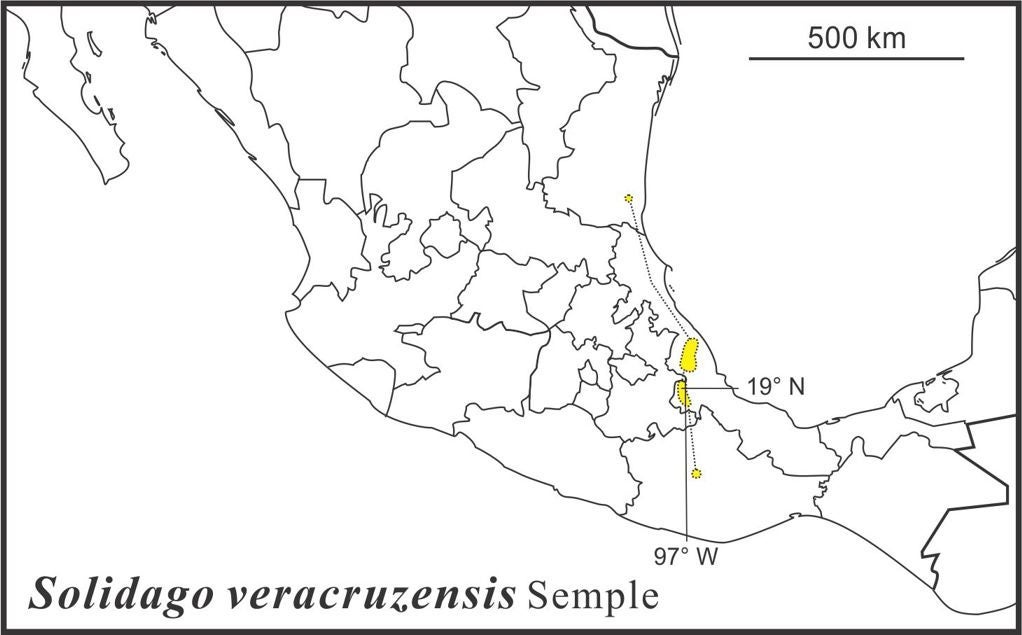
Solidago veracruzensis is native to disturbed oak and pine woods, roadsides, fields and relatively undisturbed grassland remnants at 650-2050 m ele.
In a multivariate study including S. altissima, S. juliae, S. pringlei and S. veracruzensis, all specimens of S. veracruzensis were placed into S. veracruzensis in the a posteriori classificatory analysis in both the four species level a priori group analysis and in the analysis of the three varieties of S. altissima (var. altissima, var. gilvocancescens, and var. pluricephala) and S. veracruzensis (Semple 2018).
The ranges of S. durangensis, S. gypsophila, S. juliae, S. macvaughii, S. pringlei, and S. veracruzensis are allopatric in Mexico and the five species may represent vicariant derivatives of a single common ancestor.
The chromosome number is unknown.
Last revised 15 April 2025 by J.C. Semple
© 2025 J.C. Semple, including all photographs unless otherwise indicated.




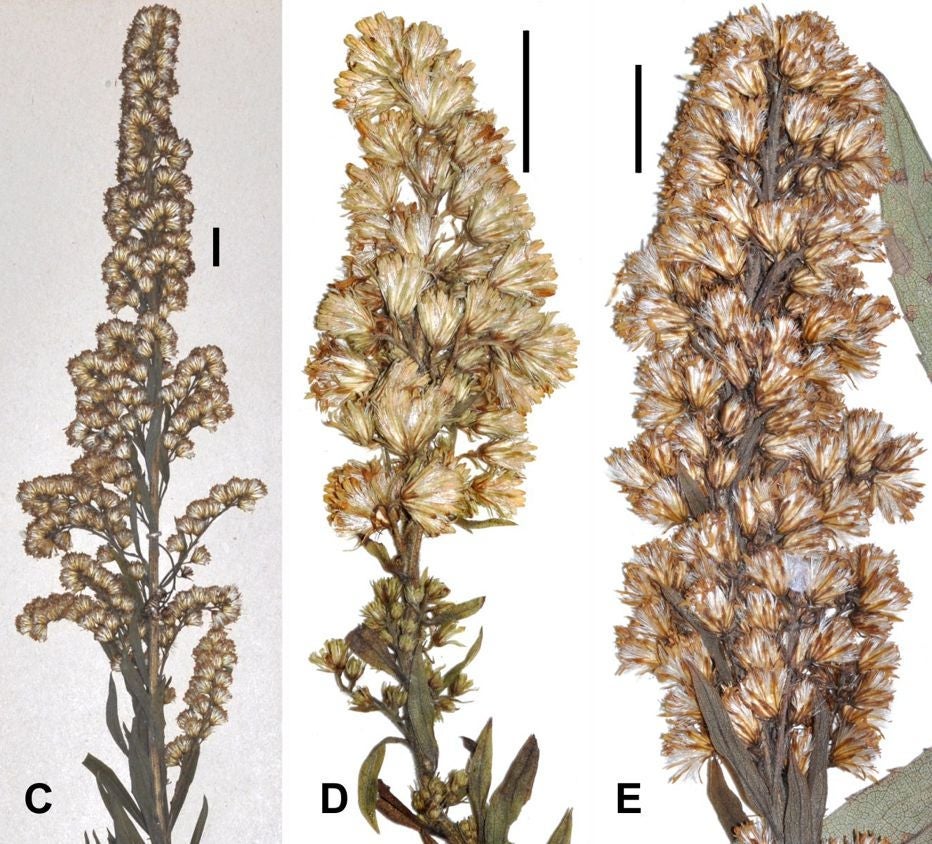

1-4. Solidago veracruzensis. 1. Holotype, Ventura 4382 MEXU. 2. Stems and leaves, Semple 2018 Fig. 4 A-H. 3. Small inflorescences, Semple 2018 Fig. 6 C-E. 4. Heads and phyllaries, Semple 2018 Fig. 4 I-J.
Semple, J.C. 2018. Solidago veracruzensis, a new species of goldenrod in S. subsect. Triplinerviae (Asteraceae: Astereae) from Mexico. Phytoneuron 2018-52: 1–18.