Seminar Speaker Series
Biography
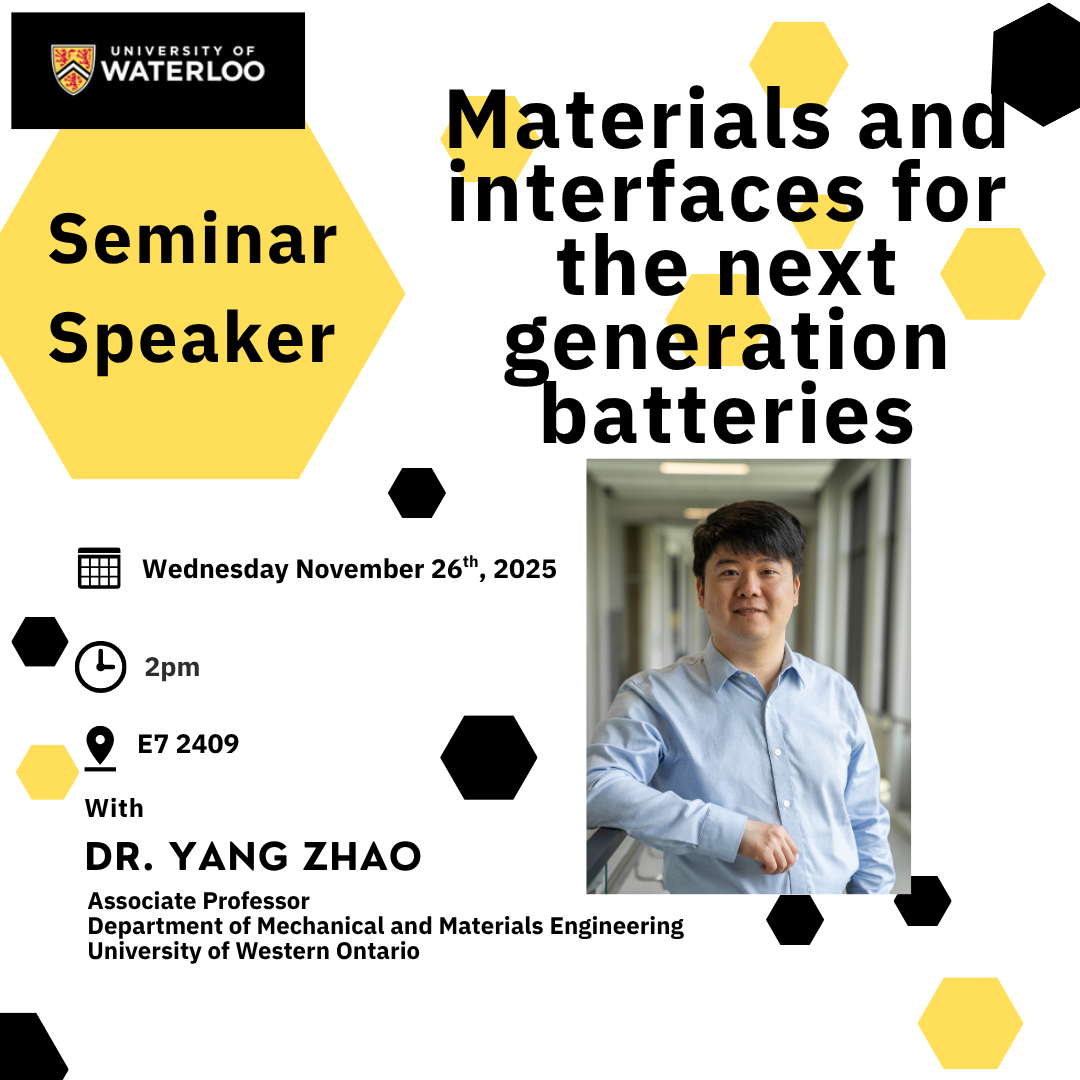
Dr. Yang Zhao is currently an Associate Professor in the Department of Mechanical and Materials Engineering at the University of Western Ontario.
Dr. Zhao obtained his Ph.D. degree from the University of Western Ontario in 2018. He had his postdoc training at the Advanced Light Source of Lawrence Berkeley National Laboratory and the University of Western Ontario in 2019-2020. Dr. Zhao has published over 160 journal articles in peer-reviewed journals with citations of over 18,000 times, and his personal H-index is 74.
He is serving as the editor for Materials Today and the Early Career Board for Nano Letters, Materials Today Energy and Renewables. He is also the symposium organizer of the 2022 ACS Spring 2022 Meeting, the 2023 ACS Fall Meeting, the 2024 MRS Spring Meeting and the 2024 CSC Meeting. His current research interests focus on advanced materials and interfaces for next-generation energy storage systems.
Abstract
Batteries beyond Li-ion received increasing attention in the past years with the demand for high energy density, long lifetime and safety. My group is working on the advanced materials and interfaces for the next-generation batteries, such as Li metal batteries, Na batteries, solid-state batteries, etc. In this talk, I will introduce our recent work on designing new battery materials and interfaces for various systems.
For the first part, I will talk about our research that contributed to the design of artificial interfaces for battery electrodes (cathode/anode) using atomic layer deposition (ALD) and molecular layer deposition (MLD) techniques. I will highlight our studies of three generations of artificial interfaces for Li and Na metal anodes.
The second part of the talk will focus on the solid-state Na batteries, including solid-state Na-ion and Na-S batteries. For the solid-state Na-ion batteries, I will introduce our work on designing the new dual-anion framework solid-state electrolytes of sodium oxychloride and sodium chalcohalide. Then I will talk about the mechanism understanding of the redox reactions for solid-state Na-S batteries
For the last part of the talk, I will introduce our work on developing an in-situ method for the interface study for anode-free solid-state batteries