


The department's small class-sizes, engaging teaching practices, and hands-on learning in our state-of-the-art facilities empower our students to solve real-world problems.
The Department of Chemical Engineering is a vibrant center of collaborative research addressing some of the most pressing challenges in energy and materials. Our faculty members are engaged in a diverse array of research in areas such as machine learning and process systems engineering, CO2 capture and conversion, polymer engineering, renewable energy, synthetic biology, environmental remediation, and materials science that push the boundaries of innovation.


Find out more by exploring the programs, research and news stories on this site.
News
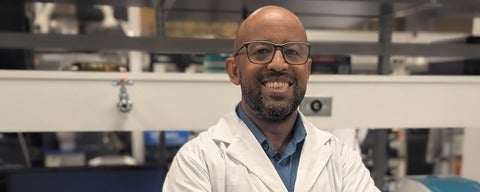
Tizazu Mekonnen’s water filtration innovation
Professor Tizazu Mekonnen’s research group has engineered a new method of capturing microplastics in water systems with 90 percent efficiency. The approach is customizable, inexpensive, easy to produce, and uses no toxic ingredients, making it promising for commercial and residential use.
Microplastics are ubiquitous and found in every corner of the planet. The problem is so prevalent that microplastics are also found in our bodies. A study from the National Institute of Health found microplastics can even be found in breast milk and can come from unexpected sources like your laundry.
“Our clothes are mostly a mix of Polyethylene terephthalate (PETs) in the form of polyester and cotton or pure polyester. When you pull out the dryer filter, you can see how much fiber it captures. Those are all microplastics and that filter can capture only a portion of it,” says Professor Tizazu Mekonnen.
Due to the high-speed spinning washing machines release even more microplastics, sending them into wastewater systems.

Engineering a more resilient food future
Researchers in the Department of Chemical Engineering are leveraging their diverse skills to boost food resilience in Ontario.
Dr. Nasser Mohieddin Abukhdeir and Dr. Christian Euler are collaborating with the Ontario Ministry of Agriculture, Food and Agribusiness (OMAFA) and the University of Guelph, to develop an advanced monitoring system that can detect early indicators of plant disease, infection, and stress in greenhouse crops before visible symptoms appear.
That initiative — funded by the governments of Canada and Ontario through the Sustainable Canadian Agricultural Partnership, a federal, provincial and territorial initiative — could yield an important predictive tool for greenhouse production.
A similar spirit of problem‑solving drives another collaborative project, this time with industry partner Corteva Agrisciences and the University of Guelph. The challenge is Eastern Ontario farmers have struggled with the shorter growing season and a narrow window for planting winter wheat — often before soybeans are harvested.

Chemical Engineering Researchers Create Nature-Inspired 3D-Printed Battery Components
Researchers in the Department of Chemical Engineering have developed a new 3D-printed electrode design for redox flow batteries, a promising technology for storing energy generated by wind and solar power. Their work shows how carefully designed internal structures can help battery liquids move more effectively through the system while reducing the energy needed to pump the liquid.
Led by Professor Maxime van der Heijden, the research team created porous electrodes using 3D printing. The goal was to improve what engineers call mass transport, the movement of molecules in the battery liquid to the places where energy-storing reactions occur.
Redox flow batteries work differently from the lithium-ion batteries found in phones and electric vehicles. Instead of storing energy in solid materials, they store energy in liquid electrolytes held in external tanks. Because the amount of stored energy can be increased by using larger tanks, these batteries are attractive for large-scale renewable energy storage and grid applications.
Electrodes are a critical part of the battery because they provide the surface where chemical reactions take place. Making electrodes porous increases the available surface area and creates more locations where these reactions can occur.
Events
PhD Comprehensive/Graphene Materials for Redox Flow Battery Applications by Andreina Camano Alcedo
Graphene Materials for Redox Flow Battery Applications