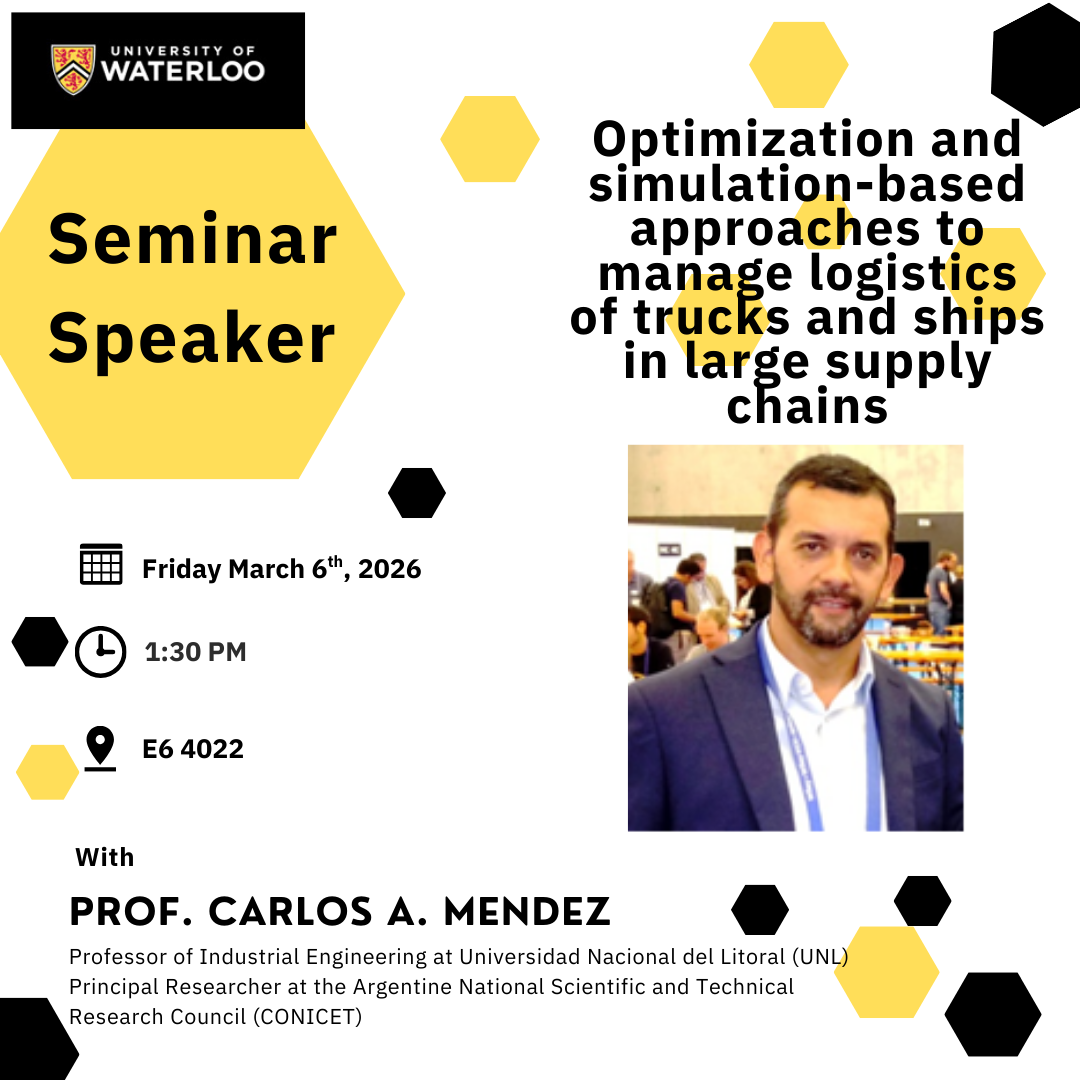
The Chemical Engineering Department is hosting a special graduate lecture on Optimization and simulation-based approaches to manage logistics of trucks and ships in large supply chains.
Abstract:
This seminar will introduce two alternative models to deal with different strategic and operational logistic problems of trucks and ships in large supply chains. The first one describes an efficient MILP-based heuristic procedure to deal with distribution scheduling of large size problems of industrial gases. The work proposes new strategies for generating efficient routes for product distribution in combination with an aggregated production scheduling. The problem takes into consideration a predefined time horizon, a set of production plants, a set of customers with daily product demands, a fleet of trucks to distribute gases, min/max production rates in plants as well as min/max tank levels in plants and customers. A discrete time MILP-model is formulated to consider the production routing problem (MPRP) with multiple production plants with different features. The results obtained showed that efficient solutions can be generated with a robust solution strategy and stable CPU times. In this way, the problem can be solved by considering multiple visits per route, routes with a duration of two or three days, and multiple routes per day for every vehicle. The second approach introduces a discrete event simulation-based model to deal with strategic decisions in the crude oil supply chain in Argentina. This model aims at representing the main components related to production, transportation and refining of the whole supply chain. The main objective is to have a simulated system that can be used to size to fleet of ships to transport crude oil from the south to the center of the country. Uncertainties related to the weather in ports and failures in refineries and pipelines are taken explicitly into consideration.
Biography:
Carlos A. M?ndez is Professor of Industrial Engineering at Universidad Nacional del Litoral (UNL), and Principal Researcher at the Argentine National Scientific and Technical Research Council (CONICET). He received his Ph. D. in Engineering from UNL in 2002, and his B.S. in Information Systems Engineering from Universidad Tecnol?gica Nacional (UTN) at Argentina in 1998. He held Visiting Professor positions at Carnegie Mellon University, Pittsburgh-EE.UU.; Instituto Superior T?cnico, Lisbon-Portugal; DECRC, ABB Corporate Research Center, Ladenburg-Germany; Universidad de Valladolid, Valladolid-Spain; Jozef Stefan Institute, Ljubljana, Slovenia; Universitat Polit?cnica de Catalunya, Barcelona-Spain; Universitat Rovira i Virgili, Tarragona-Spain; Universidad de Salamanca, Spain; Universidad de Valencia, Spain; Universidad de Pamplona, Spain and Universidad de Cantabria, Santander-Spain.
His research contributions have been in the areas of planning and scheduling of batch and continuous processes, optimal process synthesis, design and operation, supply chain operational management, hydrogen network operation, oil pipeline planning and scheduling, dynamic vehicle routing and pickup & delivery problems and Discrete event simulation in manufacturing and logistics. His teaching interests include courses on Modeling, Simulation, Optimization in Process Systems Engineering. He developed consulting activities on optimal process design and operation for major national and international companies, such as: British Petroleum (BP Research Center, Illinois, USA), Asea Brown Boveri (ABB Corporate Research Center, Ladenburg, Germany), Repsol (Refiner?a Petronor, Bilbao, Espa?a), SOLA Y BRUSA S.A. (Franck, Argentina), C.C.U.-Cervecer?a Santa Fe (Santa Fe, Argentina), CICSA (Luj?n, Argentina), Air Liquide (Newark, USA), YPF / Y-TEC (Bs As, Argentina), Linde (USA), Johnson & Johnson (USA), Panamerican Energy (Bs As, Argentina), Raizen (Bs As, Argentina).