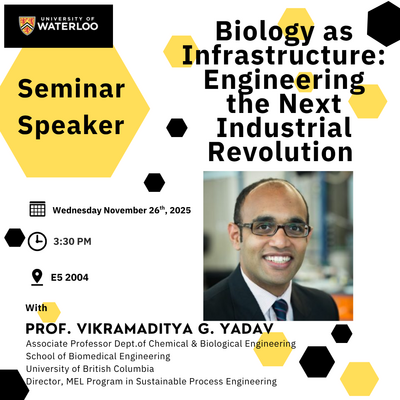
Abstract :
Humanity faces multiple converging crises such as pandemics, climate change, ecosystem degradation, and environmental pressures from rising global prosperity. We urgently need transformative solutions. At the same time, the past three decades have also witnessed sterling advances in genomics, synthetic biology, and computation, which have re-cast living systems as programmable platforms for innovation. Biology has now matured into a form of infrastructure - an enabling layer upon which solutions to health, the energy transition, material de-fossilization and the circular economy can be built.
Just as physical infrastructure underpinned the industrial age and digital infrastructure drives the current information age, biological infrastructure now offers the foundation for a sustainable one. Engineered biological systems can facilitate a more rapid response to emerging threats, enable sustainable resource recovery, as well as upcycle waste into high-value products. In this sense, biology is no longer confined to the laboratory; it is becoming the scaffolding of a new industrial paradigm where living and designed systems work in concert to sustain civilization.
In his talk, Prof. Yadav will present his team’s forays in harnessing synthetic biology, bioprocess engineering, and computational design to create deployable solutions for climate resilience, clean manufacturing, and global health. He will discuss modular cell-free systems that enable rapid, decentralized vaccine production for pandemic preparedness; bioelectrochemical platforms that recover critical metals from mine tailings while producing clean water; and data-driven biorefineries that convert agricultural waste into carbon-negative materials through engineered microbes and artificial intelligence. Each example illustrates how biology can be programmed, scaled, and industrialized to close loops, turning waste into value, liability into opportunity, and challenge into innovation. Together, these advances outline a blueprint for how engineered biology can drive the transition to a circular, carbon-neutral economy.
Biography:
Prof. Vikramaditya Yadav is an Associate Professor in the Department of Chemical & Biological Engineering and School of Biomedical Engineering at the University of British Columbia (UBC). He is also the Founding Director of the Master of Engineering Leadership (MEL) program in Sustainable Process Engineering. He leads one of Canada's most distinguished research programs in synthetic biology and biotechnology. He has made significant contributions to environmental engineering, clean manufacturing, and advancement of the circular economy.
Prof. Yadav is also a serial entrepreneur and thought leader in scaling climate technologies. He founded Metabolik Technologies (acquired by Allonnia in 2020) and Tersa Earth Innovations, an award-winning metal extraction company. He currently serves as Chief Science Officer of Tydra Labs, a biomaterials company decarbonizing cosmetics and textiles, and as Lead Climate Technologist at MAKS Global Repairs, overseeing sustainable infrastructure projects across North America and Asia. He also leads the Rio Tinto Centre for Future Materials research initiative in Canada.
Prof. Yadav has received Canada's Top 40 Under 40 and Business in Vancouver's Top 40 Leaders Under 40 honors. He is also a celebrated educator, winning the Killam Teaching Prize at UBC in 2023 and Foresight Canada's Climate Tech Educator of the Year award in 2024. Beyond academia, Prof. Yadav plays an active role in shaping global regulation and standardization of synthetic biology as a council member of the Engineering Biology Research Consortium.
He is also a current member of the Mitacs Research & Innovation Council, an influential body in Canada’s innovation landscape. He currently serves as an Associate Editor of Frontiers of Synthetic Biology and is a member of the editorial board of Catalysis in Green Chemistry & Engineering. He previously chaired the Biotechnology Division of the Chemical Institute of Canada
(2017-2024) and was also the Associate Editor of the Canadian Journal of Chemical Engineering (2020-2023) and the Associate Scientific Advisor for Science Translational Medicine (2019-2020).