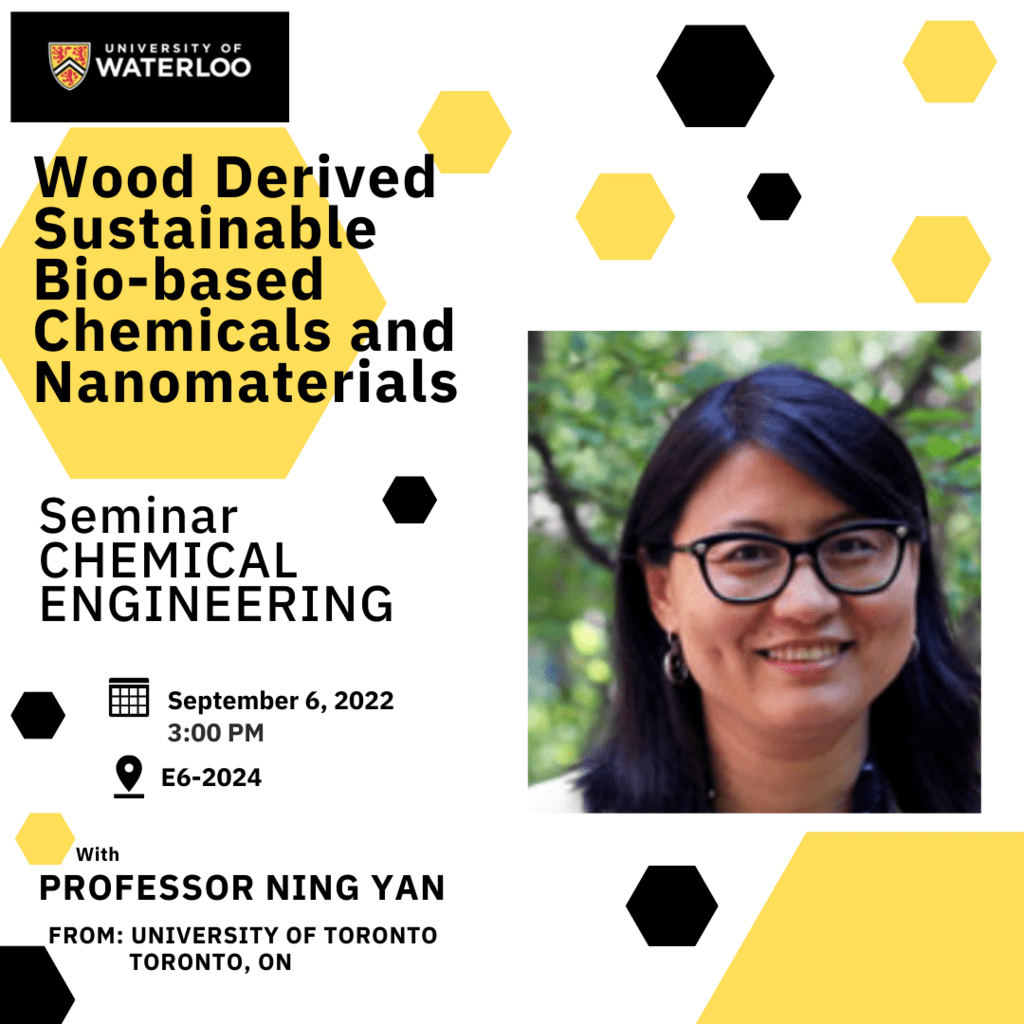
Seminar

Friday, November 18, 2022 11:00 am - 11:00 am EST (GMT -05:00)

Moving droplets chemically: Vision for tunable electrodes

The Waterloo Institute for Nanotechnology (WIN) and the Department Mechanical and Mechatronic Engineering (MME) are proud to present a joint seminar by Professor Bijoy Bera from the Transport Phenomena Group at Delft University of Technology (TU Delft).

The Department of Chemical Engineering and the Waterloo Institute for Nanotechnology are partnering to organize a series of discourses on technology-based solutions to global challenges linked to UN Sustainable Development Goals.

Thursday, June 16, 2022 2:00 pm - 2:00 pm EDT (GMT -04:00)

Cap and Trade Game and Project "Postmortem"

Cap and Trade Game and Project "Postmortem" with Alex Fleck and Dr. Jason Grove 

Canadian Cap and Trade Simulation is a serious game/simulation designed to teach undergraduate Chemical Engineering and Environmental Studies students about carbon tax and trade systems in Canada created by Ph.D. candidate Alex Fleck and Prof. Jason Grove. The two will talk about the game and how it works as well as their experience in the process of game design.

Thursday, June 16, 2022 1:30 pm - 1:30 pm EDT (GMT -04:00)

Molecularly engineered carbon conjugates for electrochemical applications Seminar

Molecularly engineered carbon conjugates for electrochemical applications

Part I: Carbon-grafted polymers for electrochemical energy storage in supercapacitors

Carbon-based nanomaterials are key components in energy storage devices. Their functions can be tailored by adjusting or developing new synthesis pathways. Our studies in this area are focused on living radical polymerization techniques, an electrochemically-aided atom transfer radical polymerization (e-ATRP), oxidative radical polymerization, and reversible addition chain transfer polymerization (RAFT) applied for grafting of carbon allotropes such as multi-walled carbon nanotubes (MWCNT), graphene and single-walled carbon nanohorns (SWCNH) among other carbons. The main goal of our research is to create new nanocomposites that demonstrate an improved gravimetric capacitance and electrochemical stability, originating from the synergy of a double-layer capacitance of carbon and pseudo-capacitance of redox active polymers. This is mainly own to the covalent linkage between carbon and electrochemically active molecules.