Events

Filter by:

Limit to events where the title matches:
Limit to events where the first date of the event:
Date range
Limit to events where the type is one or more of:
Limit to events tagged with one or more of:
Limit to events where the audience is one or more of:
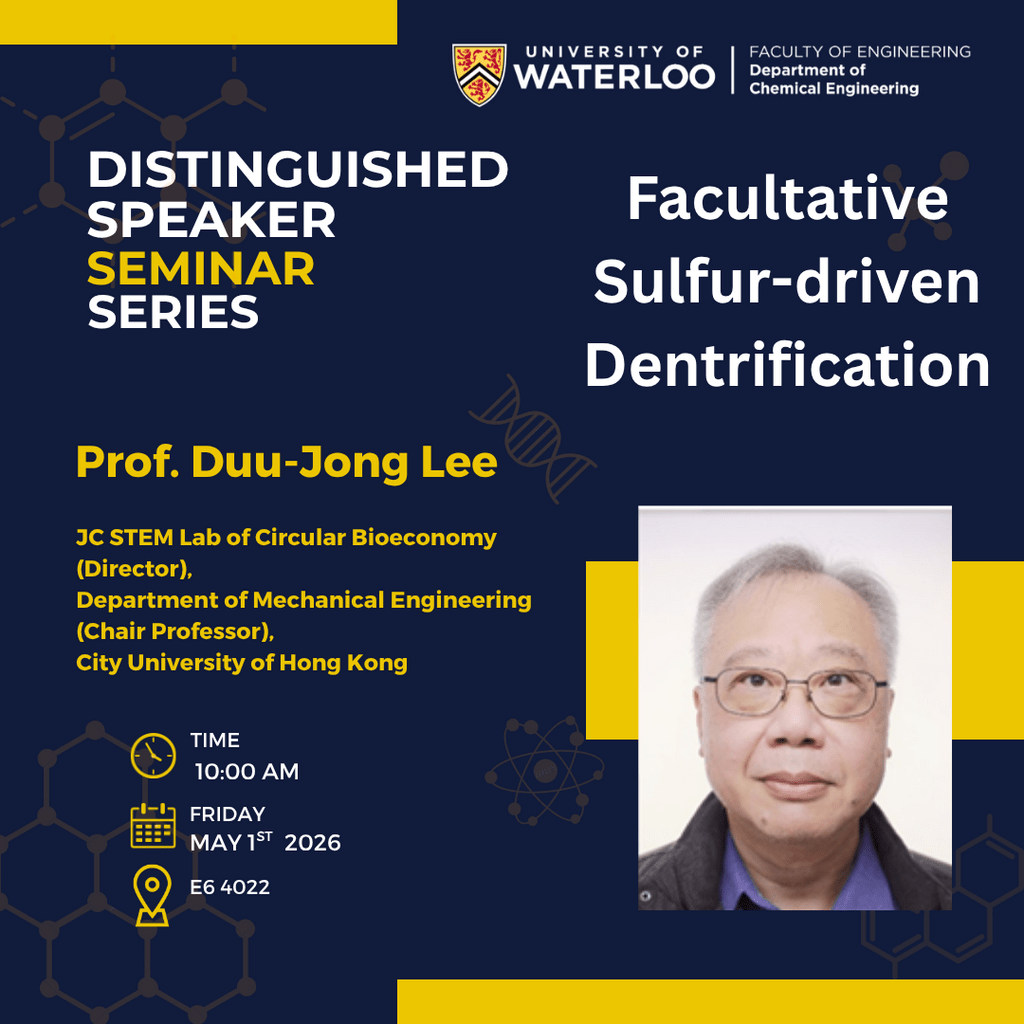
Friday, May 1, 2026 10:00 am - 11:00 am EDT (GMT -04:00)

Distinguished Speaker Seminar Series

Denitrification is a vital microbial process within the nitrogen cycle, where nitrate (NO3) is reduced to nitrogen gas (N2), thereby alleviating nitrogen pollution in aquatic environments. Traditionally, organic carbon sources have been recognized as the primary electron donors for denitrification. However, recent research has underscored the significance of sulfur compounds as alternative electron donors, especially in settings where organic carbon is scarce. The current paradigm acknowledges the coexistence of heterotrophic and autotrophic denitrifiers in completing the denitrification pathway.
Facultative sulfur-driven denitrification represents an innovative biological process that integrates sulfide oxidation with denitrification, providing a dual solution for wastewater treatment. This process leverages specific heterotrophic bacteria capable of oxidizing sulfide while concurrently reducing nitrates, effectively eliminating both sulfide and nitrogen compounds from wastewater. The facultative nature of these bacteria enables them to adapt to fluctuating oxygen levels, thereby enhancing the process's flexibility and efficiency. This presentation will delve into recent advancements in facultative sulfur-driven denitrification, with a focus on its application in engineered systems such as wastewater treatment plants and bioreactors. By exploring the mechanisms and benefits of this process, we aim to highlight its potential for improving wastewater management and contributing to sustainable environmental practices.

Tuesday, May 5, 2026 10:00 am - 11:00 am EDT (GMT -04:00)

CHE-WIN Joint Seminar

Abstract: Dehumidification accounts for a substantial fraction of energy use and associated emissions in air‑conditioning systems, representing roughly 53% of energy‑related air conditioning emissions on a global average. Vapor-selective membranes, which preferentially transport water molecules while blocking the transport of other gases, have emerged as a promising alternative technology for the heating, ventilation, and air conditioning (HVAC) industry, even being ranked as a top alternative technology by the US Department of Energy. Over the past 20 years, the field has seen a significant amount of research interest in the development of high-performance membrane materials and synthesis procedures. However, translation of these materials advances into practical HVAC systems has largely relied on idealized thermodynamic system models, with a notable lack in experimental demonstration. As a result, a disconnect persists between membrane material development, component-level limitations, and realistic system and process design. This seminar presents our ongoing work aimed at bridging this gap by explicitly linking real membrane properties to component sizing, operating constraints, and systemlevel efficiency. The broader goal of this research is to establish a holistic framework that integrates materials, components, and system design to clarify tradeoffs, define benchmark performance targets, and guide future research and development towards the broader adoption of high-efficiency, membrane-based HVAC technologies.