Events

Filter by:

Limit to events where the title matches:
Limit to events where the first date of the event:
Date range
Limit to events where the type is one or more of:
Limit to events tagged with one or more of:
Limit to events where the audience is one or more of:

An online seminar presented by David Liñán Romero on Local Mixed-Integer Nonlinear Programming (Minlp) Through Ordered-Discrete Variable Decomposition: A New Paradigm For Minlp Optimization In Chemical Engineering

Monday, May 26, 2025 3:30 pm - 4:30 pm EDT (GMT -04:00)

Designing Hydrogel Biomaterials for Therapeutic Revascularization

Abstract :

Heart failure remains one of the leading causes of death worldwide, driven by persistent coronary artery occlusion that reduces blood supply to the myocardium, leading to cardiomyocyte death and fibrotic remodeling. Effective revascularization of the injured myocardium is essential to restore tissue viability and preserve cardiac function. In this talk, I will present our strategies for engineering hydrogel platforms to actively promote revascularization. We developed a computationally designed affinity-based delivery system to precisely regulate the presentation of proangiogenic growth factors, and optimized matrix properties to support the transplantation and functional integration of CD34⁺ vascular progenitor cells. Together, these approaches aim to create a regenerative microenvironment capable of driving robust and functional vascularization.

Biography:

Dr. Yuan Yao is an Assistant Professor in the Department of Mechanical Engineering and Division of Cardiology at University of British Columbia. She graduated from University of Waterloo, supervised by Dr. Evelyn Yim, and completed her postdoctoral training with Dr. Molly Shoichet in the Department of Chemical Engineering at University of Toronto. Her lab is located at the Center for Heart Lung Innovation at the St Paul’s Hospital in Vancouver.

Her research focuses on engineered biomaterials and biofabrication approaches for cardiovascular repair and regeneration.
Enabling technology platforms for tissue engineering and regenerative medicine research

CHAN PUI BARBARA

SBS, iTERM, BME, CUHK

The research focus of the Tissue Engineering Lab at CUHK centers around bioengineering of cell- and biomaterial-based complex living tissue substitutes for tissue engineering and regenerative medicine applications. During the prolonged journey of developing engineered tissues for regenerative medicine purposes, we have faced many technical challenges associated with the major components of engineered tissues including stem cells, biomaterials and cell niche signals. A handful of technology platforms were developed to enable and facilitate research in tissue engineering and regenerative medicine research, including but are not limited to (1) a multiphoton microfabrication and micropatterning (MMM) technology to define the cell niche interactions; (2) a multi-level mechano-regulation (MMR) platform to facilitate mechano-characterization and manipulation of cells and tissues; and (3) a biomimetic biomacromolecular microencapsulation (BBM) platform to facilitate physiologically relevant scaffolding. In this seminar, the rationales, the technological capability and the relevant applications will be discussed. 

Thursday, August 21, 2025 10:00 am - 11:00 am EDT (GMT -04:00)

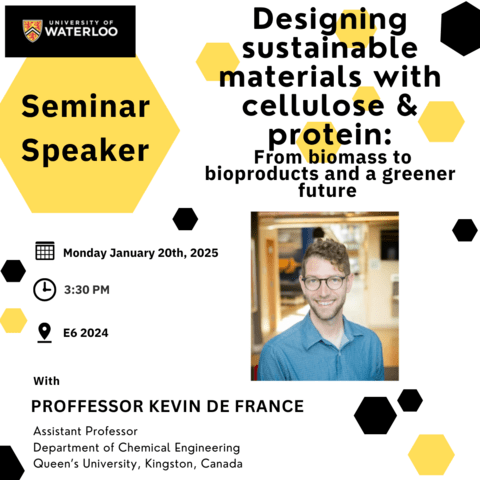
Seminar/ Biomass Valorization for Sustainable Bioeconomy

Abstract:I

It is clear, that by mid-century, to avoid the worst-case scenarios of anthropogenic climate change, our society will have to rely on sustainable and renewable resources rather than fossil fuels. Biomass is a key proposed component of several climate mitigation strategies, with substantial involvement of future energy and material systems. The general objective of my research is utilizing biomass, photo/bio/electro-catalysts, and cell factories to design and fabricate renewable and sustainable bioproducts and systems, via bioinspired routes, for Energy, Environmental, and Biomedical application. These hybrid technology approaches provide potential route to economically viable energy production (hydrogen + biofuels) + biomass CO2 captured negative emission technologies (NET) (biomaterials + biochemicals), thus are clearly an important early step in the complete decarbonization of our society. In this presentation, I will introduce our new technology platform of using photocatalysis and photo/electro-bio hybrid system for biomass valorization. I will also talk about our recent progress on design and fabrication of cellulose based materials with genetically engineered proteins for biomedical application