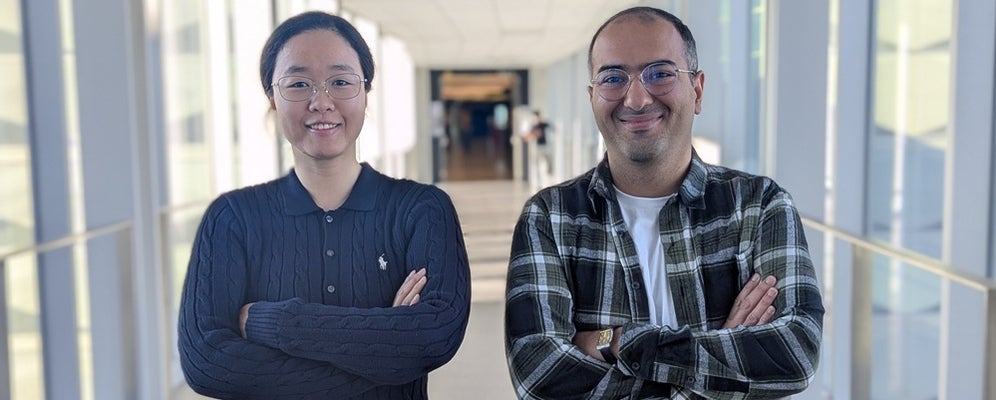
From left to right: Hao Wang and Mohammad Mehrnia
Two Chemical Engineering PhD students have been recognized for their research excellence, earning prestigious awards that support their work in sustainable energy and carbon utilization.
Hao Wang (BASc, 2023) received the Carl Pollock Postgraduate Fellowship in Engineering, valued at $23,000.
“I was thrilled to receive this award because eligibility requires students to have completed their undergraduate degree at Waterloo Engineering,” says Wang. “It feels rewarding to see the hard work I put into my undergraduate studies pay off.”
Supervised by Professor Luis Ricardez-Sandoval, Wang is developing computational methods to design catalysts for reactors that transform carbon dioxide (CO₂) into valuable chemicals.
Her research focuses on catalysts for the reverse water-gas shift reaction, an important carbon utilization process that converts CO₂ and hydrogen (H₂) into water and carbon monoxide (CO) which is a basic material used in the production of multiple chemical products. For example, CO can be combined with H₂ to produce syngas, a key building block for fuels and chemical products.
To accelerate catalyst development, Wang is using reinforcement learning to train a machine-learning agent to efficiently explore potential catalyst designs.
“We use the machine-learning agent to search the design space and identify promising candidates without having to evaluate every possible design,” says Wang.
PhD student Mohammad Mehrnia was also honoured for his research, receiving the Dr. M. Chandrashekar Memorial Award in Sustainable Energy.
Working under the supervision of Professor Jeff Gostick, Mehrnia studies alkaline water electrolyzers, devices that use electricity to split water into hydrogen and oxygen. When that electricity comes from wind or solar power, the result is green hydrogen, a clean fuel and chemical feedstock.
His research focuses on what happens inside the porous electrodes of these devices. Mehrnia builds pore-network models, which represent the electrode as a network of tiny, connected pores, to track how gas bubbles and ions move through it and where energy is lost.
“We model the electrode at the pore scale to see where electricity is wasted, for example by gas bubbles trapped in the pores,” says Mehrnia. “The goal is to use the model to design electrode structures that produce the same amount of hydrogen with less electricity.”
Gostick and Mehrnia collaborate on the project with the National Research Council of Canada (NRC) and Waterloo’s Multi-Scale Additive Manufacturing Lab (MSAM). The electrodes are 3D printed at Waterloo and tested at the NRC. Mehrnia builds his models from X-ray CT scans of the printed electrodes and checks their predictions against the NRC’s measurements.
Mehrnia is also a developer of OpenPNM and PoreSpy, open-source software developed in Professor Gostick’s group and used by porous-media researchers worldwide.
The long-term aim is for the model to guide the design of new electrode structures, which the team can then print and test. More efficient electrolyzers make green hydrogen cheaper for uses such as fuel-cell vehicles, fertilizer production and steelmaking.
“I’m very grateful to receive this award,” says Mehrnia. “The funding allows me to focus more fully on my research and worry less about finances. The recognition that comes with the award is also deeply meaningful.”
Congratulations to Wang and Mehrnia on their well-deserved recognition and continued research success!