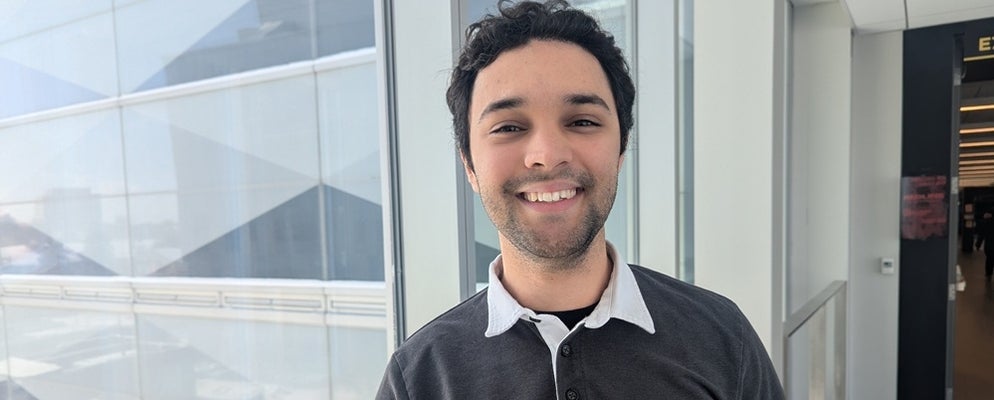
Cole Fredericks is a master’s student in the Department of Chemical Engineering. He also completed his undergraduate degree in chemical engineering at the University of Waterloo.
Fredericks received the Canada Student Merit Award from the Society of Chemical Industry. The award recognizes students with the highest academic standing in the final year of a chemical engineering undergraduate program.
For Fredericks, earning this distinction reflects a long-standing commitment to learning and maintaining balance both inside and outside the classroom.
“I have always been curious and tried my best academically,” says Fredericks. “My philosophy is that learning is a skill that must be practised— a muscle that must be exercised to better master what really interests you.”
He describes his undergraduate experience as a series of diverse challenges, each requiring different approaches to problem-solving, technologies and ways of thinking.
Fredericks thrived in Waterloo’s co-op program. He worked in a range of settings, from large corporations specializing in thermoplastics to startups developing protective automotive coatings.
“The co-op program gave me insight into how the world works. You may work with people with a wide variety of educational and experiential backgrounds, which represents a stark contrast from working with your classmates. Yet, you must still collaborate with them as part of an effective team,” Fredericks says. “These professional dynamics happen in every industry, and you can’t really learn how to navigate these situations until you experience them.”
Fredericks’ most influential co-op position was as a research assistant with Hamed Shahsavan, a professor of chemical engineering, an experience that ultimately inspired him to pursue graduate studies. Shahsavan arranged for him to go on a research exchange to Barcelona, Spain, while he was still an undergraduate student.
“It was a life-changing experience academically, professionally and personally,” says Fredericks. “I was supported by a supervisor who encouraged me to grow as both a researcher and an individual.”
As an undergraduate in Shahsavan’s Smart Lab, Fredericks studied soft materials capable of controlled robotic motion for biomedical applications. His current graduate research focuses on manufacturing these materials at the microscopic scale using digital micromirror devices—technology commonly used in digital projectors and virtual reality systems.
“The idea is that if we are using light to make our samples, we can employ an existing modular technology to do the same. I want to investigate how this tool can be used to make these soft robots at the microscopic scale,” says Fredericks.
Fredericks emphasizes the importance of balance. He says his academic success is supported by personal well-being. For him, this balance comes through music, which offers a fulfilling creative outlet. He performs in a musical quartet and a vocal ensemble that competes internationally.
He recently returned to Spain as a graduate student to continue his research with the same team. During this trip, he also competed in a singing competition in Germany, where his ensemble won a gold medal representing Canada.
Fredericks continues to build on his academic journey in chemical engineering as he advances research in soft robotic materials.