Milad Kamkar wins student teaching excellence award from Waterloo Engineering Society
Congratulations to Chemical Engineering professor Milad Kamkar for receiving the Igor Ivkovic Teaching Excellence Award! The Waterloo Engineering Society, a student run group presents this award to professors, lab instructors and teaching stream faculty who excel at supporting student success and advocate on behalf of students.
“I am over the moon about receiving this award. It is especially meaningful because it comes directly from undergraduate student nominations and votes.” says Prof. Kamkar.
Building strong foundations
Kamkar teaches two first year courses, CHE 100 (Fundamentals of Chemical Engineering) and CHE 102 (Chemistry for Engineers). These are core concepts that students will use throughout their journey in chemical engineering and other disciplines.
“When I see them a couple of years later, they tell me they still use the concepts from these courses and how essential those fundamentals are,” says Kamkar. “It’s really rewarding because I get to see how they grow over time, and I have the privilege of interacting with them from the very first day of their undergraduate degree.”
Dedicated to continually improving in his teaching methods, Kamkar attends the Teaching Excellence Workshop annually. Kamkar also conducts two online anonymous evaluations in each of the courses he teaches to allow students to express what they enjoyed and how they feel the course could be improved.
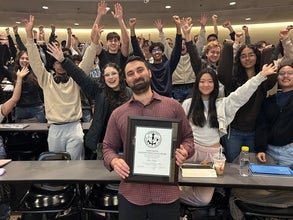
Professor Milad Kamkar and his CHE 100 Class
Connecting classroom learning to real-world research
Kamkar, whose research is rooted in materials science and engineering, often brings samples from his lab into the classroom. His cutting-edge work fascinates students; so much so that he recently had 40 students from his 2025 CHE 100 class line up for a tour of his Multiscale Materials Design Lab.
“I always try to connect the concepts I am teaching in class to industrial applications, and in each session, I connect each of these concepts to a process that we are designing in the lab,” says Kamkar. “I show examples of the materials we produce and highlight how essential the concepts they are learning are when designing materials or developing chemical engineering processes.”
Students find Kamkar to be a very approachable professor; many students request that he take them on as co-ops in his lab. Kamkar strives to create a friendly and inclusive learning environment, always ensuring that each student is encouraged to engage in discussions and feels comfortable asking questions in his classroom.
Kamkar credits his teaching philosophy to the many excellent educators he encountered throughout his academic career, including his former supervisors. He learned something valuable from each of them, and these individual lessons have shaped his own approach to teaching, one grounded in inclusivity, respect, and the creation of a safe and welcoming learning environment, as well as a commitment to engaging and inspiring students.
Looking ahead, Kamkar hopes to empower his students to think critically about the challenges they will face as engineers. He aims to instill a sense of responsibility towards our planet ensuring that as the next generation of chemical engineers, they consider sustainability in all aspects of not only their engineering design, but also their daily lives.