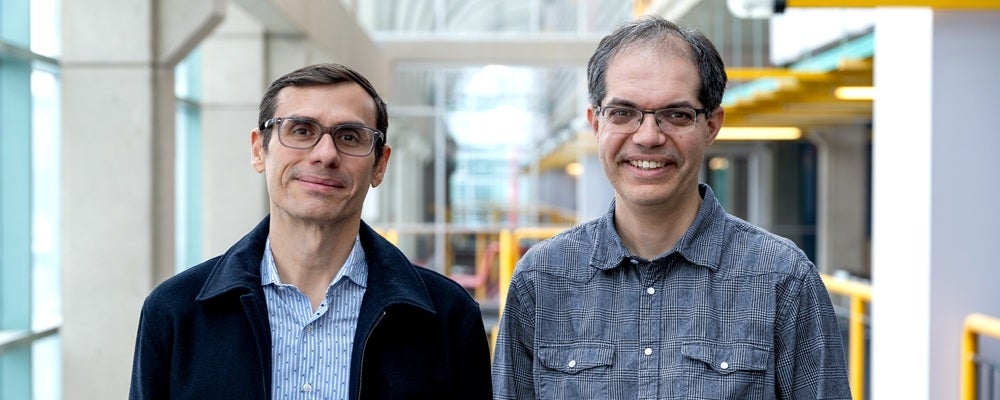
From left to right: Professors Luis Ricardez-Sandoval and Pascal Poupart
Professors Luis Ricardez-Sandoval and Pascal Poupart received $480K from the Bank of Montreal (BMO) and MITACS to design reinforcement learning tools for rare earth element (REE) recycling. The four-year interdisciplinary project between the Department of Chemical Engineering and Cheriton School of Computer Science will use reinforcement learning (RL) to design more efficient, sustainable recycling systems for REEs.
RREs are essential to global economies and used in a wide range of high-tech applications. They are used in the electronics, clean energy, aerospace, automotive, and defence industries to create products like cell phones, computers, batteries, MRI machines, jet craft, lasers, LEDs and more.
Canada is invested in being a global leader in critical‑mineral recycling and leveraging its resources to strengthen national security and promote economic growth. As demand for batteries, semiconductors, and clean‑energy technologies accelerates, Canada is looking beyond traditional mining.
“Eventually, we’re going to run out of those mining resources, and we will need to recycle rare earth elements using advanced systems that can reduce waste, capital expenses and energy consumption,” says Ricardez-Sandoval, Director of the Chemical Process Optimization, Multiscale Modelling and Process Systems Group. “We are aiming to go one step ahead and present novel process designs that can efficiently recycle rare earth elements (REEs).”
While REE recycling technologies exist, many are built on heuristics that may not examine optimal process design decisions and long-term sustainability considerations.
The research team aims to apply RL and Bayesian optimization to redesign both the recycling flowsheets, the step‑by‑step processes used to extract REEs, and the operations management strategies that can be implemented to run recycling plants near optimal conditions.
The University of Waterloo team will develop tools and algorithms that are specifically tailored for this application by utilizing process systems engineering, chemical engineering expertise and state-of-the-art machine learning strategies.
The project will focus on creating RL methods that can work safely and reliably in real recycling environments. One focus is constrained RL which helps AI systems follow real‑world operational limits and safety rules.
Researchers will use Bayesian and partially observable RL to help the system make decisions when information is uncertain or incomplete. They will transfer learning and foundation models so that solutions created for one recycling setup can be adapted and reused across many different recycling systems.
“We will design new systems that can in principle, improve how much we can recover from recycled REE materials,” says Ricardez-Sandoval a Canada Research Chair in Multiscale Modelling and Process Systems. “By doing that, we promote sustainability and make better use of critical minerals.”
BMO is a key player in this project, as a national institution, they are invested in promoting sustainability. They’ll use the outcomes of this research to make informed strategic decisions. BMO regularly publishes sustainability reports and sees REE recycling as a key area where financial institutions can influence Canada’s transition to cleaner and sustainable technologies.
This interdisciplinary collaboration will potentially accelerate commercial adoption of REE recycling systems. The research will provide training opportunities for four PhD students and one master’s student.