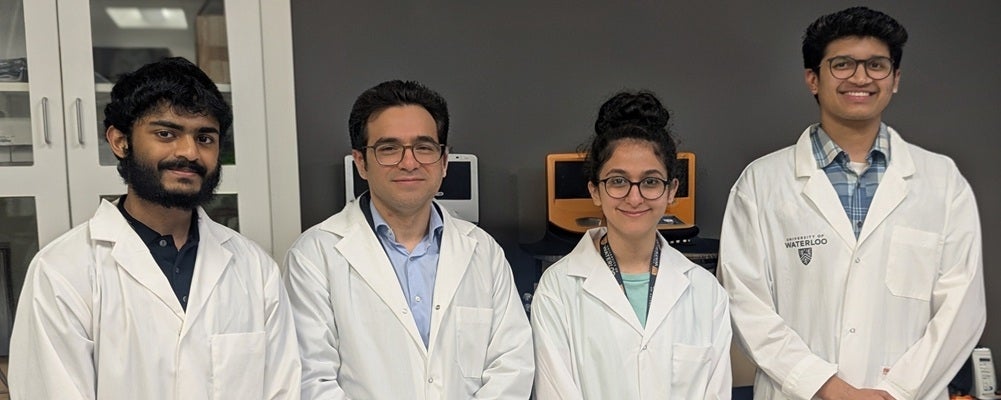
From left to right: Nrushanth Suthaharan, Professor Hamed Shahsavan, Negin Bouzari and Micahel Ali
A student-led research team at the University of Waterloo designs an easy method to generate programmed shape-change and movement in soft robots.
The team worked with hydrogels—soft, tissue‑like materials that are biocompatible. These materials are promising for developing microrobots to perform non-invasive biomedical tasks within biological media, like gastrointestinal or reproductive tracts. Their approach could pave the way to create motion in soft robots and other smart devices, opening the door to a new generation of soft medical devices.
This research was driven by student curiosity. PhD student Negin Bouzari was inspired by a review paper.
“I felt the idea was hidden between the lines of the introduction of that paper. One sentence grabbed my attention. I realized that although this had been a research topic for many years, it had never been applied to the material system that we are working with,” says Bouzari.
Her supervisor, Hamed Shahsavan, a professor in the Department of Chemical Engineering hired four undergraduate co-op students from across faculties to assist with her research.
A research team on point with Waterloo’s commitment of bringing undergrads into the heart of cutting-edge research and fueling interdisciplinary collaboration.
“Complex problems rarely fit inside one discipline. Interdisciplinary research brings complementary tools and viewpoints together, leading to creative, high-impact solutions,” says Edward Hong, a nanotechnology engineering student who was part of the team. “Beyond innovation, working across disciplines improves communication skills and adaptability; abilities that are invaluable in both industry and academia.”
Molecules forming hydrogels typically do not have significant polarity (i.e. nonuniform distribution of electrical charge within a molecule). But some do, like zwitterionic molecules that contain both a negative and positive charge within the same molecule.
By combining these two types of molecules within a solution and inserting the solution between two glass slides—one hydrophilic and one hydrophobic, polar molecules move toward the hydrophilic slide, while non-polar molecules move toward the hydrophobic slide.
After exposure to UV light, the solution transforms to a solid hydrogel that has a gradient of polarity and accordingly different mechanical properties within one continuous film. One side of the hydrogel film can be soft and the other side stiff.
When exposed to environmental triggers such as changes in pH or salinity, the materials will bend creating actuators—or the robot’s “muscles” that change shape in response to their environment to create movement.
In previous research, achieving bending or twisting required multiple fabrication steps. With this new approach, the glass slides themselves are the “programming tool.”
The hydrogel has self-healing properties and pieces can be cut and pasted together to form different shapes depending on the application.
The study Shape-change programming of zwitterionic hydrogels via chemical gradients directed by surface energy was recently published in the Journal of Materials Chemistry A.