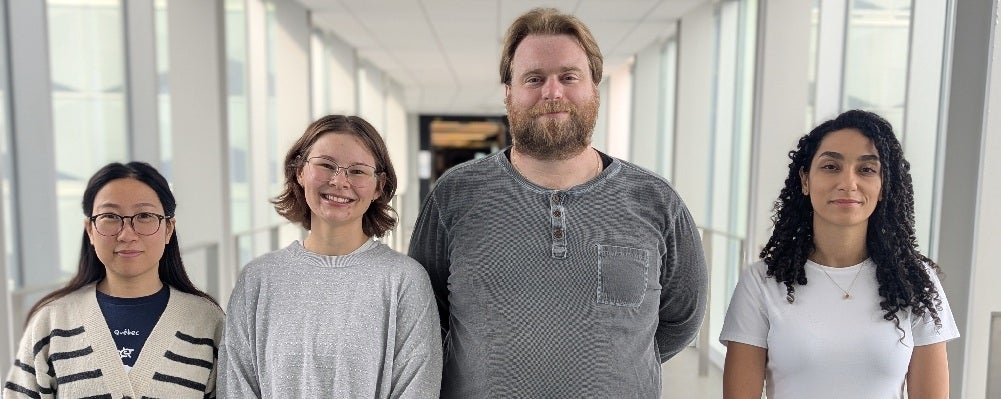
From left to right: Chuchi Chen, Ellie Zarnke, Drew Davidson and Bahareh Arab
Three chemical engineering graduate students won in the Academy of Research Commercialization (ARC) inaugural pitch competition.
ARC is a new program launched jointly between the Faculty of Engineering and the Conrad School of Business in collaboration with Velocity and WatCo (Waterloo Commercialization Office). ARC provides programming such as fund preparation, and workshops for PhD students aiming to transform deep-tech research into for-profit ventures.
Three entrepreneurially minded chemical engineering graduate students were winners of the competition.
Drew Davidson’s start-up ArcticEdge Technologies Inc. was one of the winners. Davidson, who is co-supervised by Professors Milad Kamkar and Valerie Ward, was inspired by his mother, Kelley Willemze who was a firefighter in Cambridge for over 30 years.
Standard firefighter's gear was traditionally made with PFAS as a moisture barrier. PFAS has been identified as carcinogenic and can cause firefighters to develop occupational cancer. Utilizing nanotechnology engineering techniques, Davidson has fabricated a new moisture barrier material for firefighting gear.
ArcticEdge Technologies is in the process of sending several batches of the moisture barrier material to clients for evaluation, including LION, one of the largest fire gear manufacturers and Wuxly, a company that makes cold weather gear for the Canadian military.
“Being one of the winners of the ARC pitch competition was a great validation of the skills that I've developed in presenting my research to those outside of academia. I think that the ARC program covers a critical gap in helping researchers gain the skills and knowledge they need when adapting their research towards commercialization,” says Davidson. “The feedback and connections from the pitch day were extremely valuable.”
Chuchi Chen and Ellie Zarnke, students of Professor Valerie Ward, won for their pitch about Aqualis Bio a probiotic nutrition company for salmon feed. It’s a little-known fact that salmon, which mainly come from salmon “farms” get their characteristic pink colour from an additive in their feed called Astaxanthin. This additive represents a significant cost to salmon farmers, ranging from $2000 to $7000 depending on how Astaxanthin is produced.
Zarnke and Chen’s engineered Astaxanthin-secreting probiotics that could be added to salmon feed pellets at $1500, lowering the cost for farmers. They have filed a provisional IP and validated function at lab scale.
“It was incredibly exciting to be selected as an ARC winner and to have the opportunity to take our research one step closer to commercialization,” says Chen and Zarnke. “Our next steps are to validate our engineered probiotic technology in fish, scale up the production process, and continue developing our intellectual property and commercialization strategy.”
Bahareh Arab was the third winner from chemical engineering. Her venture, Porphyrion, aims to replace synthetic dyes in everyday products with natural colours. There are toxicity concerns around synthetic dyes which are facing global bans and pose regulatory risks.
Arab, who is supervised by Professors Perry Chou and Murray Moo Young, uses engineered microbes and a precision fermentation platform to replace synthetic dyes in everyday products with sustainable, fermentation-derived colours.
With her collaborators, Chou and Professor Yilan Liu, Arab leverages metabolic engineering and synthetic biology to replace dyes. The platform they designed programs microorganisms to produce high-purity, tunable pigments while reducing dependence on agricultural and animal-based sources.
“Being selected as one of the ARC Pitch Competition winners showed me that the idea resonates beyond the research environment and has the potential to create meaningful real-world impact,” says Arab. “We have spent years developing this technology in the laboratory, and the ARC experience challenged me to look beyond its scientific performance and think more strategically about market needs, customers, regulatory pathways, and commercialization.”
ARC receives funding from the Norman Esch Foundation, whose support helps PhD students transform deep-tech research into viable startups.