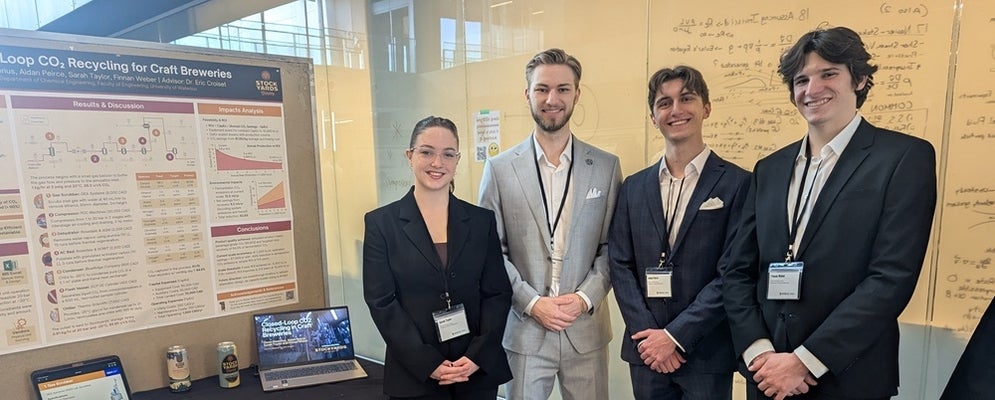
Group 1, from left to right: Sarah Taylor, Owen Pastorius, Aidan Peirce, and Finnan Weber
Each year, the Capstone Design Symposium stands as a defining milestone for our graduating class, marking the moment when years of study, experimentation, and hands‑on learning culminate in original engineering solutions.
Group 12: sustainable, natural glitter for cosmetics
This year’s graduating class identified meaningful problems, developed innovative approaches, and created their projects under the guidance of instructors, mentors, and industry partners.
Students tackled challenges as diverse as designing environmentally friendly glitter for cosmetics that avoids microplastics found in most commercial products to developing early fault detection systems for lithium‑ion batteries to improve safety and reliability.
This year there were eight winning teams. Group 1 won the Bhattacharyya Capstone Design Award, valued at up to $3,000. This award is made possible through the generosity of Dr. Dilip and Mrs. Manjusha Bhattacharyya.
Group 1 designed a closed‑loop carbon dioxide recycling system tailored specifically for craft breweries. During fermentation, breweries naturally generate CO₂, which is often vented into the atmosphere.
The group, whose members include Finnan Weber, Aidan Peirce, Sarah Taylor, and Owen Pastorius developed a right‑sized, safe, and practical solution that allows craft breweries to capture and reuse their own CO₂, reducing emissions, lowering costs, and improving resilience.
“Through our industrial mentor, Stockyards Brewery, we saw the intricacies of a craft brewery firsthand, worked alongside industry experts; we saw all the chemical engineering principles that we learned about in class put into practice,” says Weber.
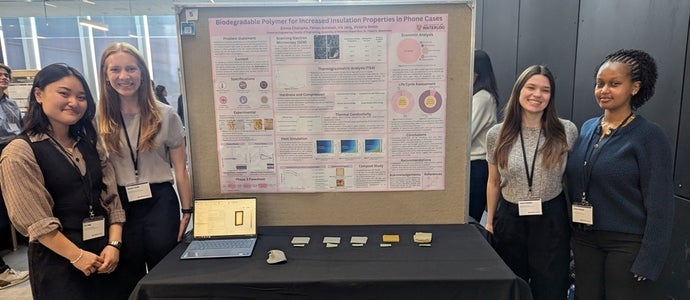
Group 5, from left to right: Iris Jang, Faiven Anteneh, Emma Chalupka, and Victoria Smith
Group 5 won the Walmart Award, valued at $2,000. They developed a biodegradable material to insulate phones in the winter to extend their battery life. The group created a biodegradable plastic material using two eco‑friendly polymers, PLA and PBAT. Group members included Faiven Anteneh, Emma Chalupka, Iris Jang and Victoria Smith.
"In simulated -10°C weather, the designed polymer material keeps the phone battery at 0°C. Seven degrees warmer than a typical silicone rubber phone case! Costing only $10.57 to manufacture, a phone case constructed from our material is projected to fully decompose in a composting environment in under 60 days," says Chalupka. "It was incredibly gratifying to receive an award for our project and to represent our extraordinary supervisor, Professor Tizazu Mekonnen."
Two groups won the Sustainable Development Capstone Design Award, valued at $1,000.
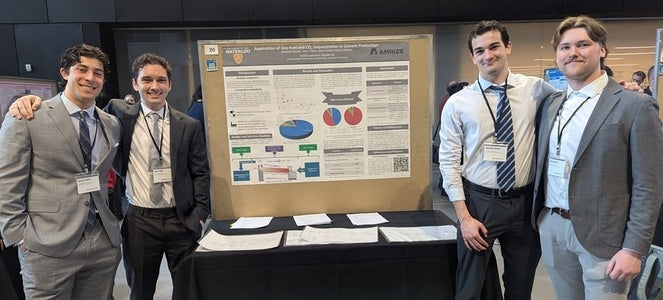
Group 20, from left to right: Nathan Ruberto, Asher Thakur, Alexander Berardi and Gavin Plunkett
Group 20 collaborated with industry partner Amrize to focus on cement production, which accounts for about 8% of global CO₂ emissions. Approximately 90% of CO2 emissions originate from the clinker stage of the production process. Group members Gavin Plunkett, Alexander Berardi, Nathan Ruberto, and Asher Thakur addressed this through an oxy-fuel retrofit for the cement kiln to reduce the carbon footprint while preserving clinker quality and operation.
The results provide an economically viable solution that reduces the carbon footprint of the clinker stage by 97.5%.
“My favourite part of this Capstone project was working to solve complex problems together. There were many challenges along the way, and we enjoyed applying our engineering judgement, thinking through different options, and finding practical solutions as a team,” says Plunkett.
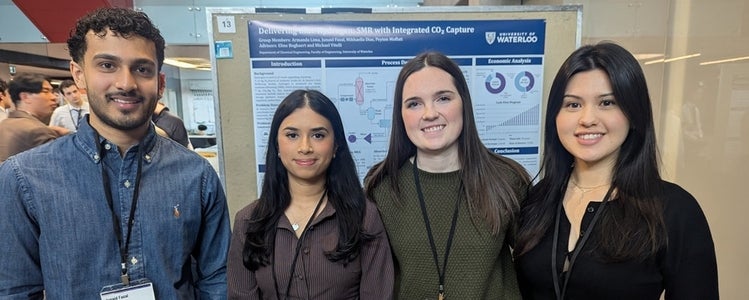
Group 13, from left to right: Armanda Lima, Peyton Moffat, Junaid Fazal, and Mikhaella Dias
Another Sustainable Development Award went to Group 13. They designed a carbon capture system to improve the environmental performance of hydrogen production at a major Canadian oil operation, Suncor Energy’s Fort McMurray site. Their design used an amine solvent to capture CO₂ from the plant’s primary emissions source, improving both greenhouse gas impact and economic viability. Group members were Peyton Moffatt, Armanda Lima, Mikhaella Dias, and Junaid Fazal.
“Winning felt like validation of the long hours we spent refining our project, troubleshooting challenges, and improving our analysis. It was a great moment not just for our team, but also a reminder that the work we’re doing as engineering students can have a real impact on addressing environmental challenges,” says Dias.
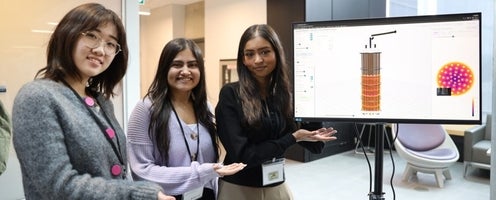
Group 10, from left to right: Jennifer Jin, Bansri Chudasama, and Melissa Ramdial
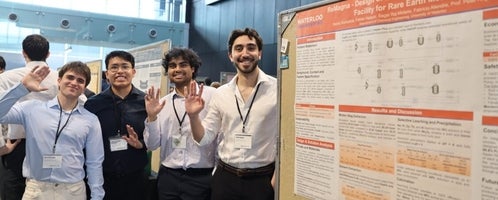
Group 19, from left to right: Harris Kartsaklis, Fabricio Aliendre Fernandez, Sagar Sebastian Raj-Molano and Fahim Haqyar
There were four winners under the Global Futures umbrella. In the technological category, Group 10 members Bansri Chudasama, Jennifer Jin, and Melissa Ramdial were one of the winners. Their project focused on the design of a waste valorization facility in Mombasa, Kenya that converts 5% of the incoming textile waste into value-added bio-oil product.
Group 19 with members Fahim Haqyar, Fabricio Aliendre Fernandez, Harris Kartsaklis, and Sagar Sebastian Raj-Molano won for their project on increasing local supply of rare earth elements (REEs) by designing a recycling plant for end-of-life NdFeB permanent magnets.
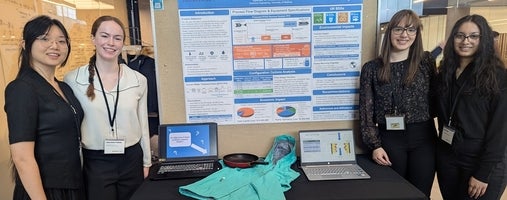
Group 2, from left to right: Rose Shi, Jenna Barker-Mulleder, Andrea Bareich and Nidhi Sarkar
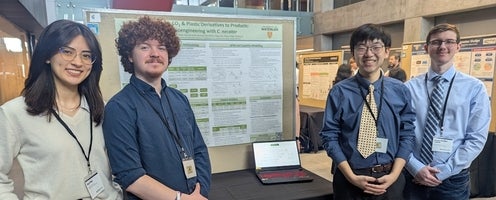
Group 6, from left to right: Maya Wilger, Toben MacDermott, Thomas Li and Nicholas MacMillan-Fagundes
Group 2 won the health category for their project focused on the removal of PFAS from Ontario drinking water. The group members Rose Shi, Nidhi Sarkar, Andrea Bareich, and Jenna Barker-Mulleder designed a subsystem utilizing reverse osmosis and ion exchange technologies to filter out PFAS, which could be installed in existing Ontario water treatment plants.
In the sustainability category, Group 6 with members Thomas Li, Toben MacDermott, Nicholas Macmillian-Fagundes and Maya Wilger won for their project that analyzed viable products that can be produced using the bacteria Cupriavidus necator from a feedstock of CO2 and ethylene glycol.
Congratulations to our winning teams!