The Enterprise Co-op (E Co-op) experience is more than just a work term. It’s an opportunity to build, test, and grow your own venture with the support of a dedicated entrepreneurial ecosystem.
This page brings together key resources to help you make the most of your Enterprise Co-op journey. From practical tips for a successful term to learning about mentorship, engaging with guest speakers and hands-on workshops, exploring funding opportunities, and gaining inspiration from past student founders.
Six tips for a successful E Co-op term
- Build the foundation of a successful business.
- Understand your market, customer and competitors.
- Develop a value proposition that is clear and can articulate your product/service to any stakeholder.
- Interact regularly with advisors and the E Co-op coordinator.
- Attend workshops and speaker series.
- Network with others in your industry, your customers, professionals and other E Co-op students.
As with any co-op term, you will be evaluated on leadership, dependability and response to supervision; communication, problem-solving, and quality of work; and setting goals, planning and organizing.
I can attribute a huge chunk of my growth and learning to the structure, support, and accountability provided by Conrad's E Co-op entrepreneurship program. E Co-op is one of Waterloo's best-kept secrets. I was able to independently explore, learn, build, and grow all while earning a co-op credit toward my degree, getting a bit of financial support, having peers to keep me accountable, and without interfering with my education.
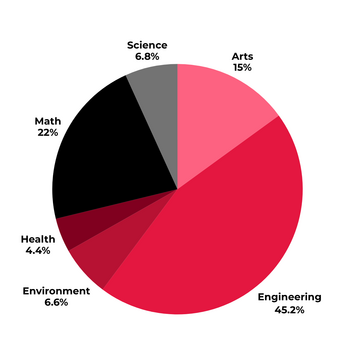
The pie chart illustrates the average distribution of participating students by faculty. Engineering accounts for the largest share, reflecting its mandatory co-op requirement.

Mentorship
Throughout the term, you will have opportunities to work with volunteer advisors. These are people, often Waterloo alumni, who have experience as entrepreneurs and are willing to act as a sounding board.
These volunteer advisors will be supportive and provide relevant business development advice, and ask questions that will provide you with the opportunity to reflect, re-affirm, or re-think aspects of your business plan or actions.
You, as the student and founder, will make all final decisions and retain full responsibility for any, and all, business plans and actions related to their venture.
Workshops and guest speakers
The term has a series of seminars for students to participate in. For students who are not staying in Waterloo, many of these seminars and workshops can be attended live virtually.
These seminars and workshops go through the major elements of starting a business and give you the theoretical background you need to build a strong business.
Funding options
As a student in a start-up, you’re most likely bootstrapping your company. You’re investing your own time and money (and often the money of friends and family) to get the idea off the ground. This allows you to devote your own time to building a product and allows you to maintain full control of your company.
As a student start-up, there are several grants, bursaries, loans and accelerator programs you can apply to. These will all require a thorough application process and often come with some restrictions.
Many companies experience a time when they absolutely need to bring in outside, professional funding to their company. Companies who have a proven prototype, interested customers, existing sales or are looking to expand the business often find investments by angel investors or venture capitalists beneficial.
A great way to receive funding is to apply for grants. Although not always the case, grants are an opportunity to receive free money.
Undergraduate students also have the chance to win awards of varying amounts.
E Co-op student spotlight
Naimah Venezia
Global Business and Digital Arts graduate, Naimah Venezia, leveraged the Enterprise Co-op (E-Co-op) pathway to build a financial literacy startup, CoinWa, while completing her degree. Her experience highlights how Waterloo’s interdisciplinary GBDA program—combining business, design, and technology—equipped her with the skills to develop business models, design user-centered solutions, and communicate effectively with technical and investor audiences.
Instead of following a traditional co-op route, she used E-Co-op to advance her own venture with mentorship and ecosystem support, ultimately growing CoinWa into a working startup that employs engineers and designers. Her goal is to make financial literacy more accessible to high school students and better prepare young people for real-world financial decision-making.
"Being at UW has taught me how to blend creativity with business. The Conrad School showed me that entrepreneurship doesn’t have to wait until after graduation. Through programs like E Co-op, I was able to build CoinWa during my degree—and that’s something I’ll always be grateful for. "
-Naimah Venezia, BGBDA '25
E Co-op student spotlight
Nain Abdi
Electrical engineering student Nain Abdi turned his co-op experience into a venture by co-founding Colare, a startup transforming how engineering talent is assessed and hired. Supported by Enterprise Co-op (E Co-op) and Velocity, Abdi developed the platform while earning co-op credit, gaining mentorship, and validating the business through real-world pilots.
Colare uses simulation-based assessments to evaluate candidates on real engineering tasks, giving employers deeper insight into how individuals think, build, and solve problems before they are hired.
Abdi’s journey highlights how E Co-op enables students to turn firsthand work experience into innovative, market-ready solutions, positioning their ventures for early traction and long-term impact.
"One of the major elements of being an entrepreneur is the ability to identify potential problems you can pursue and solve, which is really difficult to do without experience. Waterloo’s Enterprise Co-op and programs set up that foundation for entrepreneurial pursuit by providing early work experience.”
E Co-op student spotlight
Henriëtta van Niekerk
When fourth-year Global Business and Digital Arts student, Henriëtta van Niekerk, was unable to secure a traditional co-op placement, she chose to re-frame the setback as an opportunity.
Through the Enterprise Co-op (E Co-op) program at the Conrad School of Entrepreneurship and Business, she pursued an entrepreneurial co-op experience, developing her own venture for academic credit.
Her project, Skrimp.AI, draws on the breadth of Waterloo’s entrepreneurship ecosystem to support early-stage founders. Through Conrad School's Bridging Entrepreneurs to Students (BETS) program, Henriëtta was able to connect with and hire fellow Waterloo students, helping to build an initial technical team.
This enabled her to move from concept to execution more rapidly, turning her idea into a working product.
E Co-op student spotlight
Aileen Agada
Aileen Agada (BASc ’21, MBET ’24) turned a personal challenge into a scalable beauty-tech venture through her entrepreneurial journey at the University of Waterloo. After struggling to find salons equipped to work with Afro-curly hair, she co-founded BeBlended: an online marketplace that connects clients with specialized hairstylists while providing business tools for independent professionals.
While still a student, Agada advanced her startup through Waterloo’s entrepreneurial ecosystem, including Enterprise Co-op (E Co-op) and incubator support, transforming her idea into a growing platform that has facilitated thousands of bookings and supported both clients and stylists across Canada.
Her story highlights how E Co-op empowers students to turn lived experiences into impactful ventures while combining technical training, entrepreneurial mindset, and ecosystem support to create solutions that drive both economic opportunity and community impact.