Events

Filter by:

Limit to events where the title matches:
Limit to events where the first date of the event:
Date range
Limit to events where the type is one or more of:
Limit to events where the audience is one or more of:
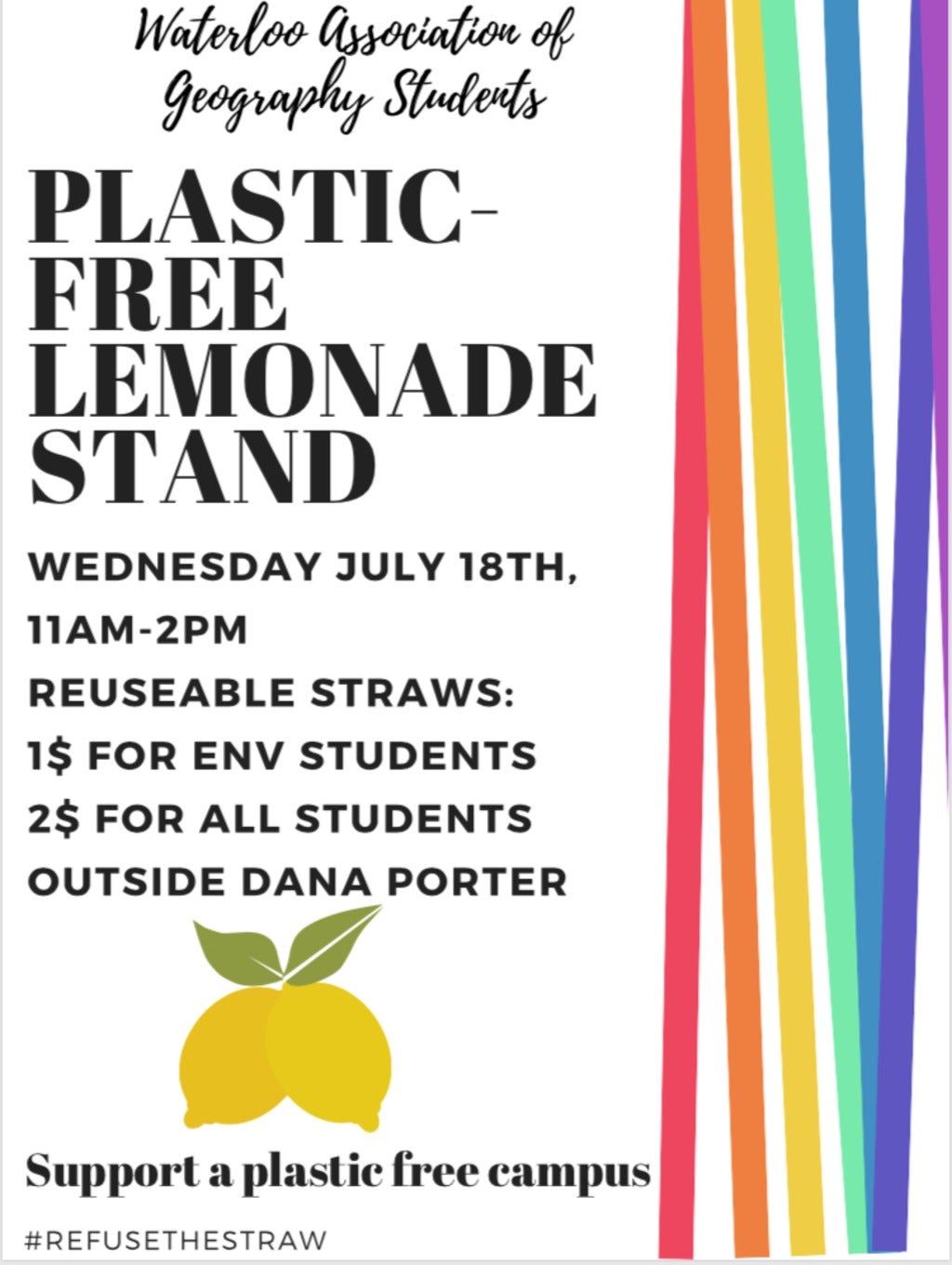
Wednesday, July 18, 2018 (all day)

Plastic-Free Lemonade Stand

A Plastic-Free Campus: 2025

Join the Waterloo Association of Geography Students (WAGS) in banning the sale of plastic on campus by the year 2025. Our first initiative is promoting the use of reusable straws and/or encouraging students, staff and faculty to refuse the plastic straw. We want to make University of Waterloo a leader in sustainability by eliminating the sale of wasteful plastics (water bottles, plastic bags, straws, unnecessary packaging, etc.) on our campus. The lemonade stand will run from 11:00am to 2:00pm in front of Dana Porter Library.

Tuesday, February 5, 2019 1:30 pm - 2:30 pm EST (GMT -05:00)

Guest Presentation by Dr. Steven R. Fassnacht

We are proud to have Dr. Steven R. Fassnacht, a professor of Snow Hydrology from Colorado State University, visit the University of Waterloo to present his research. Please join us in EV1-221 at 1:30 pm on Tuesday, February 5th, 2019 for his talk titled Integration of Multi-disciplinary Data Sources to Understand Hydro-Climatic Change”.

Title: “Integration of Multi-disciplinary Data Sources to Understand Hydro-Climatic Change

Friday, March 15, 2019 12:30 pm - 12:30 pm EDT (GMT -04:00)

N. Saberi PhD Practice Defense

In preparation for her upcoming PhD thesis defence, Nastaran Saberi will present her research at our seminar this month.  Her presentation is entitled:

Snow Properties Retrieval Using Passive Microwave Observations

Please join us with your tough questions to help Nastaran prepare.  Her abstract follows:

Wednesday, March 20, 2019 (all day)

ENVigorate Festival

ENVigorate Festival 2019 in the Faculty of Environment will be on Wednesday, March 20th

The ENVigorate Festival is a WESEF-funded festival that receives additional support from the Dean’s Office in the form of a Grad RA. The festival promotes community building and skill sharing in our faculty. We run many different workshops, programs, a community fair, a SWAP shop, open and closing ceremonies including food - all designed to bring our community together at the end of the winter term.

Wednesday, January 28, 2026 3:00 pm - 3:50 pm EST (GMT -05:00)

GEM Seminar Series

Topic: Making a home in Waterloo: international student families and housing insecurity

Speaker: Dr. Nancy Worth, with Dr. Alkim Karaagac

Location: EV3 1408

Our two-year case study in Waterloo, Ontario—a city known for its purpose-built student housing—reveals that international student families face distinct challenges in the local housing market. While all students contend with high housing costs, families struggle to find suitable accommodations in a market dominated by single-student units. International student families must also navigate unfamiliar rental processes with limited institutional support, as higher education institutions typically consider off-campus housing beyond their remit. Although international students are often blamed for housing affordability issues, our findings indicate they are among the housing crisis’ most vulnerable groups.

Wednesday, February 25, 2026 3:00 pm - 3:50 pm EST (GMT -05:00)

GEM Seminar Series

Topic: Exploring Amplification Pathways of Nature-Based Climate Solutions in Canadian cities

Speaker: Kayne Boyall (MSc student supervised by Dr. Sarah Burch)

Location: EV3 1408

Cities are increasingly central sites of climate action, amid compounding biodiversity and economic crises. Yet efforts to transform urban systems remain constrained by path dependency, indeterminacy, and shifting priorities. Nature-based climate solutions (NBCS) have gained prominence for their capacity to “multi-solve” by mitigating emissions, addressing climate risks, enhancing biodiversity, and delivering social–ecological co-benefits. Despite this promise, urban NBCS in Canada often remain confined to small-scale pilots and disconnected demonstration projects, limiting their transformative potential.

This research examines how NBCS can move beyond pilots to be amplified within broader systems of urban governance and transformation. Drawing on 20 semi-structured interviews with NBCS practitioners and governance experts alongside planning and policy documents in comparative case study of Vancouver, BC and Halifax, NS, this study maps distinct but interrelated pathways of amplification along with the actors, enabling conditions, and catalysts shaping the growth of NBCS initiatives. Particular attention is given to how institutional and organizational contexts influence the stability, diversity, and prioritization of co-benefits. The findings inform efforts to design, govern, grow and sustain NBCS in support of just, low-carbon and resilient urban futures.