EV1-332, ext. 47012
sdscott@uwaterloo.ca
For more information, visit Steffanie Scott's personal website.
Key Areas of Research and Graduate Supervision
- Future imaginaries; food futures; designing More-Than-Human futures
- Arts-based pedagogies; place-based learning
- Earth-centred consciousness, nature/land connection, and relational approaches to sustainability
- Ways of knowing and being to reconnect with the web of life, each other, and ourselves
- Hospicing modernity; decolonization; wisdom traditions; ancestrality; capoeira
- Food sovereignty, community food systems, agroecology, organic/ ecological/ regenerative agriculture, permaculture, ethnobotany
- Contemplative and embodied practices (such as learning circles)
Recent Courses Taught
ENVS 205: Sustainability: The Future We Want
GEOG 293: Research Methods in Human Geography
GEOG 361: Food Systems and Sustainability
GEOG 426: Geographies of Development
GEOG 460 Sustainable Food Systems: Regional Case Study
GEOG 700/800 Professional Skills in Geography

Research and Community Engagement
I am co-leading “Nourishing the Neighbourhood: A relational (re)turn to future local food systems in Waterloo Region” with Dr Lauren Judge.
I am part of “Towards a sustainable food system for all: Strengthening food sovereignty in Waterloo Region,” a SSHRC Partnership Engage Grant (2025-26), with the Food System Roundtable of Waterloo Region and the Laurier Centre for Sustainable Food Systems.
I am part of the new Environmental Humanities Network (EHN) at the University of Waterloo.
I led a research project on "Learning from the Land: Developing Capacity for Place-Based Learning at the University of Waterloo," and co-authored Nature Connection Across the Curriculum: Resources for Post-Secondary Educators – see this 2-minute promo video. I also co-led the Land Skills for Wellness and Sustainability project.
My past research focused on alternative food networks, Ecological Agriculture in China and China's Changing Food System, sustainable food systems, farmer livelihoods, and rural development.
I served as co-Chair of the Waterloo Region Food System Roundtable and am past president of the Canadian Association for Food Studies. I have mentored many students engaged in community-based food systems research.
Exploring ways of knowing and being to reconnect with the web of life, each other, and ourselves
To appropriately ‘hospice modernity’ and come to terms with our climate and nature emergency, human society needs to shift from the mainstream mechanical, siloed understanding of human-nature separation to a relational understanding in which human beings are intimately connected to all living beings and ecosystems. This is a holistic journey and consciousness shift that engages our minds, hearts, and hands.
This work builds on my recent research on "Learning from the Land: Developing Capacity for Place-Based Learning at the University of Waterloo," and the UWaterloo-based Land Skills for Wellness and Sustainability project. It is informed by my experience with community-based research and circle pedagogy, which have been found to reinforce students’ sense of connection to themselves, each other, and the land—or web of life. My research has explored students’ reflections of deep nature connection and feeling more human in a university classroom (“I finally felt like I was an actual human being in class.”). This work draws on the nested model of relationality (below). This model builds on and connects to the work of Dr. Joanna Macy, Dr. Hesson Bai, Dr. Elizabeth Lange, Dr. Christine Wamsler, Dr. Otto Scharmer, among others.
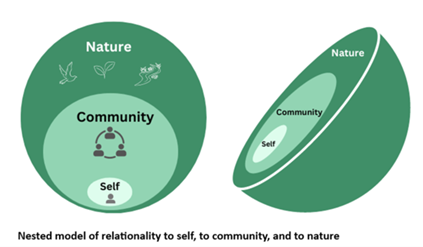
Below are foundational works and key themes in my research. I have included links to explore further. You can also view my 2023 talk, Learning to Fall in Love with the Land (82 min). I share how I am bringing nature connection and the ecology of love into my teaching and research at 63 mins.
Foundational works: Work that Reconnects · Relationality · Gesturing Towards Decolonial Futures · Deep Nature Connection · Inner Development Goals · Theory U · Outdoor Education ·
Research themes: nature connection · land-based practices · earth-centred consciousness · relational education · climate emotions · affective learning · community food systems & food sovereignty · sharing circles · contemplative and embodied practices · honouring our pain for the world · healing · holistic learning · story · decoloniality · ancestral ways of knowing and being · reskilling · wildlife tracking · foraging & hunting · ecology of love
Next Steps: Do these themes resonate with you? If so, please reach out by email (sdscott@uwaterloo.ca). We can set up a conversation to explore opportunities. I am accepting graduate students from across disciplines.

Selected Publications (also see my GoogleScholar page)
- S Scott and Jenny Fu. 2025. Nature Connection Across the Curriculum: Resources for Post-secondary Educators. eCampus Ontario.
- Qihua Feng, Zhenzhong Si, S. Scott. 2025. “Adapting to Climate Change on the Farm: Experiences of small-scale ecological farmers in two regions of China.” Journal of Agriculture, Food Systems, and Community Development, 14(4): 45-65.
- Ty Sorensen, Z. Si, S. Scott. 2025. “The implications of agroecology for meeting the sustainable development goals (SDGs): a scoping review.” Agroecology and Sustainable Food Systems, 49(7): 994-1026.
- Ning Dai, Zhenzhong Si, and S. Scott. 2022. “Cultivating sustainable diets in China: Challenges and opportunities.” In Kathleen Kevany and Paolo Prosperi (eds.), Routledge Handbook of Sustainable Diets. London: Routledge.
- Alesandros Glaros, Geoff Luehr, Zhenzhong Si, Steffanie Scott. 2022. “Ecological Civilization in Practice: A case study of urban agriculture in four Chinese cities.” Land.
- Zhenzhong Si and S. Scott. 2021. “Employing an Agroecological Approach to Achieve Sustainable Development Goals: A Case Study from China.” In CD Caldwell and Songliang Wang (eds.), Introduction to Agroecology. New York: Springer.
- Geoff Luehr*, Alesandros Glaros*, Zhenzhong Si and Steffanie Scott. 2020. “Urban agriculture in Chinese cities: Practices, motivations and challenges.” In Alec Thornton (ed.), Urban Food Democracy and Governance in North and South. London: Palgrave Macmillan.
- Taiyang Zhong, Zhenzhong Si, Steffanie Scott, Jonathan Crush *, Kui Yang, Xianjin Huang. 2021. “Comprehensive Food System Planning for Urban Food Security in Nanjing, China.” Land.
- Z. Si, T. Schumilas, W. Chen, T. Fuller, and S. Scott. 2020. “What Makes a CSA a CSA?”. Canadian Food Studies / La Revue Canadienne Des études Sur L’alimentation, 7(1): 64-87.
- Charles Z. Levkoe, Irena Knezevic, Donna Appavoo, Andrea Moraes, S. Scott. 2020. “Serving Up Food Studies Online: Teaching About “Food from Somewhere” from Nowhere.” Food, Culture & Society. [10%] - Most-downloaded article of the year for the journal & winner of the Best Paper award for 2020.
- S. Scott, Zhenzhong Si, Theresa Schumilas, and Aijuan Chen. 2018. Organic Food and Farming in China: Top-down and Bottom Up Ecological Initiatives. Routledge.