
First-of-its-kind interactive disaster preparedness workshop builds resilience in future pharmacists
With the increase of wildfires, floods, droughts, heatwaves and severe thunderstorms, the world is experiencing a rampant change in climate that brings more frequent and devastating extreme weather events. In 2025, the Earth experienced one of the hottest years on record, resulting in loss of life and billions of dollars in damage.
In response to the growing risk of extreme weather, and in recognition of personal experiences shared by pharmacists who have responded to emergencies in clinical practice, the need emerged to better prepare future pharmacists for unprecedented situations.
To answer the call, the Mobilizing and Advancing Pharmacy Leadership in Emergencies (MAPLE) Collective was formed. This collaboration spans four Canadian pharmacy schools: Memorial University, the University of Alberta, the University of British Columbia and the University of Waterloo.
The collective developed an interactive disaster preparedness workshop titled Preparing for the Unexpected in Pharmacy Workflows, designed to simulate a community pharmacy disaster response. The workshop was delivered to 119 Waterloo Pharmacy students in November 2025 and will reach over 325 pharmacy students across Canada by July 2026.
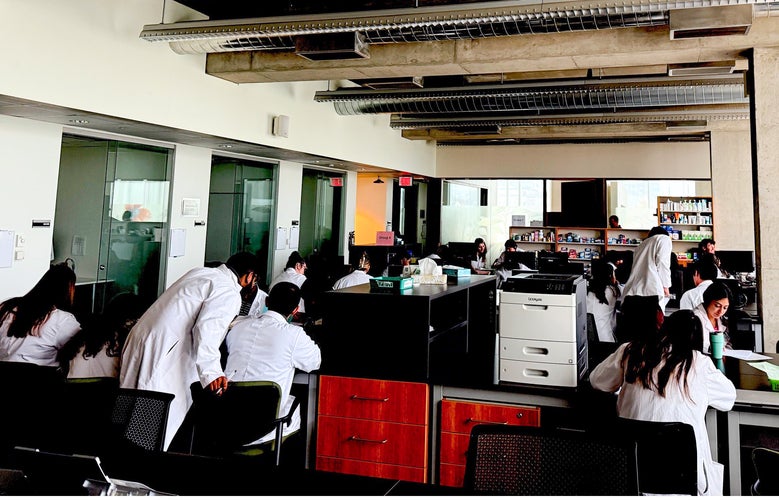
“This educational workshop was designed for senior level PharmD students as part of a professional practice lab course to introduce students to the principles of emergency preparedness as it relates to pharmacy practice,” says Allison Slater, assistant professor at Waterloo Pharmacy.
The workshop was implemented during the Fall 2025 semester in PHARM 330: Professional Practice 6. Students worked in groups of four, with each group acting as a community pharmacy team in a fictional rural community. Throughout the simulation, students were presented with typical community pharmacy tasks to complete including checking prescriptions, performing calculations, counselling patients, answering questions from other health care professionals and more. Some tasks required interacting with a standardized patient seeking care for a minor ailment or other concern.
“Tasks continued to build up throughout the activity, simulating the constantly evolving nature of real community pharmacy practice,” Slater adds. “Later in the activity, the nature of the tasks shifted to focus on the needs of patients displaced due to evacuation orders, and eventually, the pharmacy itself was faced with technology challenges that make providing care even more difficult. Students had to think on their feet and get creative to continue to care for the needs of all of their patients.”
Each pharmacy team needed to determine how to provide care for their patients with limited resources and unexpected scenarios. Following the simulation, all students participated in a group debrief, reflecting on their experiences and how they can prepare for circumstances like these in real practice.
“The tabletop simulation was extremely immersive with new problems emerging as the disaster scenario evolved. It really highlighted what it takes to take control of your practice under pressure by prioritizing effectively while still executing tasks in a complete, professional and patient focused way,” says Haley Lambert (Rx2026). “The experience better prepared me to juggle multiple responsibilities in real world practice and opened my eyes to the additional considerations pharmacists must account for during extreme environmental conditions. I feel much more confident and prepared for future emergency situations as a result.”
By engaging students in realistic, high-pressure scenarios, the workshop bridges the gap between classroom learning and real-world practice. The experience reinforces the critical role future pharmacists will play in maintaining continuity of care during emergencies and supporting community resilience.
The MAPLE Collective includes Allison Slater, Colleen Brady, associate professor at the University of British Columbia, Mikaela Thorne, pharmacy skills laboratory instructor at Memorial University and Kaitlyn Watson, assistant professor at the University of Alberta.