
The 19th issue of the Nanoscale Advances Journal features art compiled by University of Waterloo School of Pharmacy Mohamed Aborig (PhD’25) for their research, Engineered dual-functional gold nanoparticles enhance radiosensitization in prostate cancer cells: synergistic action of curcumin and gold.
Prostate cancer remains the leading cause of cancer-related deaths among men, with treatments options that include surgery, chemotherapy, hormonal therapy and radiotherapy, or a combination of depending on the stage of cancer. Radiotherapy is highly effective at destroying cancer cells; however the toxicity to nearby sensitive organs result in a major burden for patients and significantly reduces quality of life, including side effects such as rectal bleeding, diarrhea, sexual dysfunction and urinary pain.
To reduce the toxicity effects to healthy cells, the research team has developed a radiosensitizing agent, a curcumin-coated nanoparticle substance that increases the sensitivity of cancer cells to radiation therapy, making them easier to destroy during treatment.
Curcumin is a natural compound derived from turmeric, one of the most highly researched plant biologics. Plants contain phytochemicals with inherent protective properties as part of their immune system that fight against pathogens such as viruses, bacteria, fungi and parasites, and exhibit medicinal properties that align in fighting disease.
Coupled with gold, where its atomic mass gives it a higher photoelectric absorption of ionizing radiation and its increased local energy release that can cause direct DNA damage, the researchers have developed a novel substance that makes cells more sensitive to radiation by changing cell signaling and the surrounding environment, for faster and more efficient elimination of cancerous cells.
“We believe our procedure can improve efficacy and local tumor control, while reducing overall radiation dose and ultimately improving the patient’s quality of life,” says Aborig.
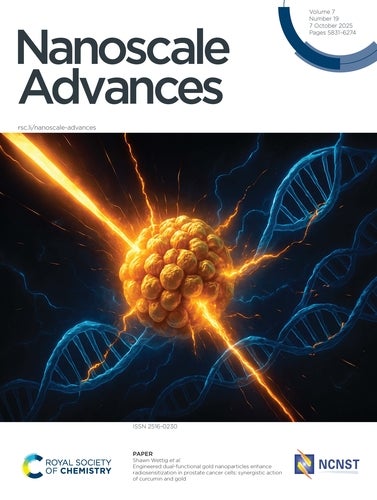
To depict this research in an image for the journal cover, Aborig sketched a gold core with a beam going running it and lightning being emitted to exaggerate the effect of radiation treatment. He then used Biorender and Adobe Illustrator as a starting point and experimented further with AI tools to create the final piece.
The gold nanoparticle core in the centre is a cluster of tiny gold spheres, representing the creation of gold nanoparticles. The gold ions form small clusters in a cell, which then merge during the growth phase into a larger gold nanoparticle. The DNA helixes in the background symbolize the gold nanoparticle inside the cell and its goal of landing near the defective DNA of cancer cells. The dark, diseased appearance of the DNA helixes reflects the environment within a cancerous cell. By being close to cancerous DNA, these nanoparticles can help break DNA helixes and trigger cell death. Lastly, the thick beam striking the gold nanoparticles represents radiation that passes through biological material and causes damage along its path. The gold nanoparticles amplify the radiation’s damaging effects due to their proximity to sensitive organelles in a cell. The emitted rays illustrate the release of energy during this interaction, symbolizing the destructive effects within a cancer cell.
Radionuclide therapy is a growing field, and one of its main advantages is its ability to deliver radiation internally to target cells, significantly reducing toxicity effects associated with radiation therapy. The research teams next steps are to advance research by using 3D spheroids, tiny clusters of cells grown in round 3D shapes, to better represent the anatomical conditions in the body compared to 2D cell models.
“Ultimately, we hope that our research could lead to a viable alternative therapy for prostate cancer that is minimally invasive and less damaging to tissues than current approaches,” Aborig adds.
This research is part of a multi-institutional project in combination with radiation oncology and medical physics experts from Waterloo Regional Hospital Network, nano-synthesis and drug design experts from the University of Waterloo School of Pharmacy and veterinary oncology specialists from the Ontario Veterinary College. This work has been funded by the WRHN Foundation, the local Telus Ride For Dad, and by MITACS.