Alumni

Alexander Cimprich, Steven B. Young.  July 2023.  Environmental footprinting of hospitals: Organizational life cycle assessment of a Canadian hospital.  Journal of Industrial Ecology  

Jonathan Raikes, Daniel Henstra, Jason Thistlethwaite. July 2023.  Public Attitudes Toward Policy Instruments for Flood Risk Management.  Environmental Management

Sadaf Mollaei, Leia M. Minaker, Jennifer K. LynesGoretty M. Dias.  June 2023. Perceptions and determinants of adopting sustainable eating behaviours among university students in Canada: a qualitative study using focus group discussions.  International Journal of Sustainability in Higher Education 

Francisco Martin del Campo, Simron Singh, Tomer Fishman, Michael Drescher.  June 2023. The Bahamas at risk Material stocks, sea-level rise, and the implications for development.  Journal of Industrial Ecology

Ankesh Siddhantakar, Jair Santillan Saldivar, Thomas Kippes, Steven B. Young.  June 2023.  Helium resource global supply and demand: Geopolitical supply risk analysis.  

Larry Swatuk, David R. Black.  May 2023.  Editors’ introduction: The complexities of worlding international relations: perspectives from the margins.  International Journal Canada s Journal of Global Policy Analysis 

Yi-Shuai Re, SabriBoubaker, Pei-Zhi Liu, Olaf Weber.  May 2023.  How does carbon regulatory policy affect debt financing costs? Empirical evidence from China.  The Quarterly Review of Economics and Finance 

Adeboye Oyegunle, Olaf WeberAmr Elalfy.  April 2023.  Carbon Costs and Credit Risk in a Resource-Based Economy: Carbon Cost Impact on the Z-Score of Canadian TSX 260 Companies.  Journal of Management and Sustainability 

Jeffrey Wilson, Céofride Gaudet, Anders Hayden.  April 2023.  Towards Sustainable Wellbeing: Moving beyond GDP in Canada and the World.   

Dr. Neil Craik, law professor in the School of Environment, Enterprise and Development and Waterloo Climate Interventions Strategies Lab member, is part of a growing area of research critically assessing the impacts and governance challenges of large-scale climate interventions in the world’s oceans. Recently, he was part of a team of experts assembled by the Deep-Ocean Stewardship Initiative that were tasked with assessing and recommending paths on how to tackle this emerging challenge. Their new paper, Deep-sea impacts of climate interventions, which appears in the journal Science, explores the environmental risks of climate interventions, the current ocean governance challenges and what needs to be done to address them.

Originally posted on Waterloo News

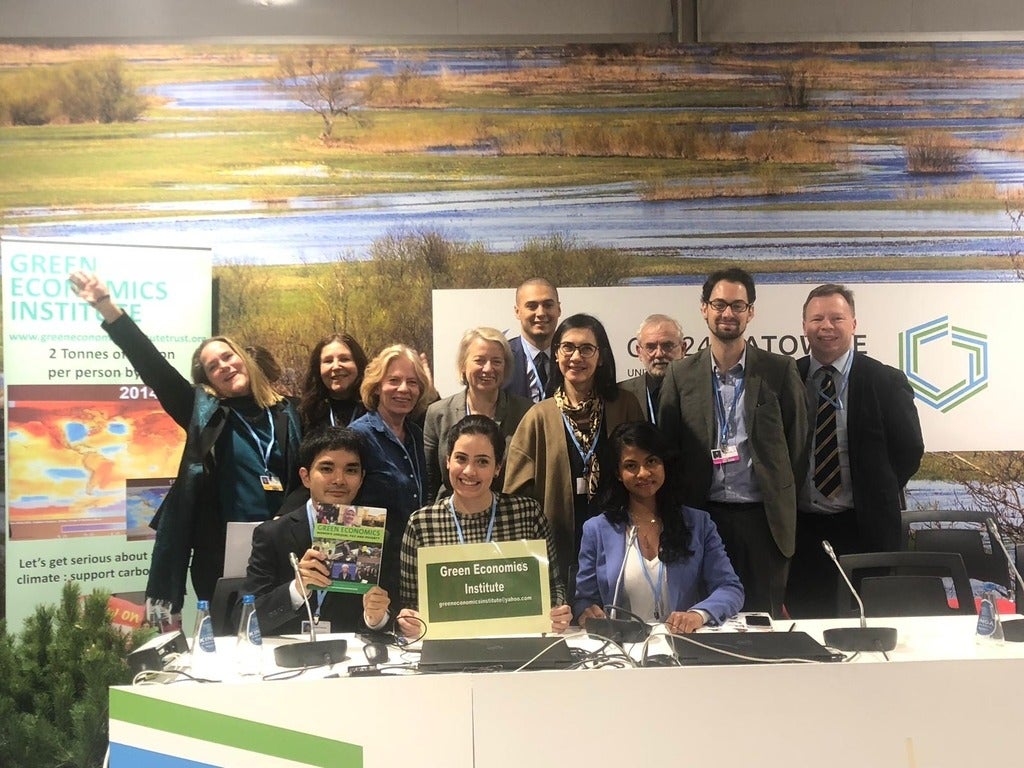
During the 24th Conference of the Parties (COP) of the United Nations Framework Convention on Climate Change (UNFCCC) on 7 December 2018 in Katowice, Poland, Prof Barbara Mikolajczyk of the University of Silesia and University of Waterloo SEED Professor Marie-Claire Cordonier Segger, chaired the international law symposium Advancing Law & Governance Contributions to Climate Action under the Paris Agreement.

Guest Lecture: Food Security as an Outcome of Urban Vulnerability: The Case of Southern Africa

Prof. Bruce Frayne, our guest lecturer, is Director and Associate Professor in the School of Environment, Enterprise and Development. He is a geographer and urban planner, teaching in the International Development program at the University of Waterloo. His expertise is within the realm of sustainable cities and related areas of human migration, urbanization and food security. Prof. Frayne’s regional focus is Sub-Saharan Africa and China.

Thursday, April 12, 2018

Changes in the Chilika Lagoon

Following are my reflections on the final lecture of Prof. Prateep Nayak for INDEV 101. He revisited the case of Chilika Lagoon, which was his point of departure in his first lecture for the Winter Term last January 2018. Prof. Nayak wrapped up the term by asking the class to discuss our chosen development issue and how we propose to address it, given the new insights and knowledge we have gained through the course.

We were privileged to have two guest speakers in the INDEV 101 class on Governance and Development. The two speakers, Pranab Choudhury and Evan Andrews, both talked about their experiences with water and watersheds in their respective areas of research. The many issues linked to the topic of governance and development that were spoken about by both speakers are also relevant to other topics on international development that were tackled throughout the term.

Dr. Mohammed Moniruzzaman is a PhD student in a joint Geography and Environmental Studies Program at the University of Waterloo and Wilfrid Laurier University. His talk about ‘Migration and Development’ during our INDEV 101 lecture was primarily focused on migration and food security linkages, more specifically the impact of migrants’ remittances on household food security in Bangladesh.

Rural Development in an Increasingly Urbanized World

Brock Dickinson is the Assistant Director of the Economic Development Program, the Entrepreneur in Residence and an Adjunct Professor with the University of Waterloo. He was the CEO of MDB Insight, has worked for the U.N., and helped with the development of many different communities, including his own community in Nova Scotia. Throughout his presentation to our INDEV 101 class, he spoke about dislocation, development, and opportunities relating to rural development.

Sunday, April 8, 2018

Conflict and Development

When asked if we can ever truly achieve peace, peace was compared to health by Nathan Funk, an associate Professor at Conrad Grebel University College in Peace and Conflict Studies. He illustrated peace as health, in that we need to always be striving towards it, always seeking to be better and to not give up on it. Nathan, during his presentation to the INDEV 101 class, presented the traditional African practices to illustrate his view of peace and conflict. Traditionally, many cultures have peace rituals to resolve conflict and to promote peace.

INDEV 101 had the opportunity to hear from Michaela Hynie, a professor at York University. We had the pleasure of hearing her lecture on Culture and Development, and how it relates to her studies on mental health. Michaela Hynie is an accomplished professor at York University’s Faculty of Health, having received her Ph.D. at Mcgill University. She applies her studies of Psychology not only in her teaching, but in an upward of 30 publications and influential research.