Tuesday, April 11, 2017 2:30 pm
-
2:30 pm
EDT (GMT -04:00)
Alumni
Wednesday, April 12, 2017 10:30 am
-
10:30 am
EDT (GMT -04:00)
Seminar - “Regenerative Medicine from an Engineer's Perspective”, by Professor Hua (Cathy) Ye, Associate Professor Engineering Science and Deputy Director of the CRMI Technology Centre for Regenerative Medicine, University of Oxford
ABSTRACT: Regenerative medicine offers great hope in curing many currently untreatable diseases. Tissue engineering and stem cell therapy are the two main components of regenerative medicine. In this talk, I will discuss how engineering can make contributions to this highly interdisciplinary field, including biomaterials as 3D scaffolds, bioreactor design, and stem cell bioprocessing.
Bio-Sketch: Professor Hua (Cathy) Ye, University of Oxford
Monday, March 27, 2017 11:30 am
-
11:30 am
EDT (GMT -04:00)
Seminar - “Polysaccharide Hydrogels for Soft Tissue Regeneration”, by Catherine Le Visage, Research Director and Deputy Director, School of Dental Surgery, University of Nantes, France
ABSTRACT: The Regenerative Medicine and Skeleton laboratory (INSERM U1229, Nantes, France) has developed an injectable and self-hardening silated-HydroxyPropylMethyl Cellulose (Si-HPMC) hydrogel. In this talk, we will go through our recent approaches using Si-HPMC hydrogels as a drug and/or cell carrier in the context of degenerative diseases. Intervertebral disc (IVD) disease is a major cause of low back pain and a low-invasive approach for intradiscal delivery of therapeutics is of particular interest.
Thursday, March 30, 2017 10:00 am
-
10:00 am
EDT (GMT -04:00)
Notice of PhD Oral Defence - "Multiscale Modeling in Mathematical Programming: Application of Clustering" - Falah Alhameli
Monday, April 3, 2017 3:00 pm
-
5:00 pm
EDT (GMT -04:00)
Zero to Hero: Steps to Funding - Spectrum 28 Mentor & Venture Program
Tuesday, April 11, 2017 1:00 pm
-
1:00 pm
EDT (GMT -04:00)
Notice of PhD Oral Defence - "Nature-Inspired Polymers: Promising Materials for OTFT-Based Sensors" by Jesse Quinn
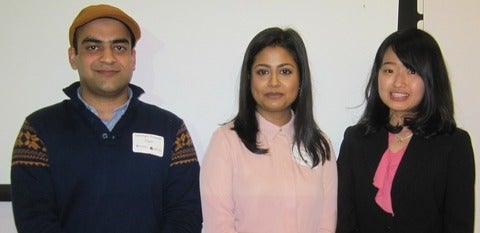
Tuesday, March 7, 2017
Department "3 Minute Thesis" competition winners announced

Congratulations to the graduate students in Chemical Engineering for winning in the 3 minute Thesis on Thursday, February 16, 2017.
Monday, April 10, 2017 3:30 pm
-
3:30 pm
EDT (GMT -04:00)
Seminar - “Multiphase Electrically Conducting Polyolefin Nanocomposites with Well-Defined Structures” by Marianna Kontopoulou, Department of Chemical Engineeirng, Queen's University, Kingston, Ontario
ABSTRACT: Polyolefins are ubiquitous in polymer technology, yet conductive nanocomposites based on these materials are very difficult to manufacture, because of the inability to efficiently disperse conductive nanoparticles, and the poor interfacial adhesion between polymers and fillers. During the last decade we have done extensive research to develop melt compounded electroconductive polyolefin composites, containing well dispersed conducting fillers, such as carbon black, multi walled carbon nanotubes (MWCNT), graphite and graphene.
Wednesday, March 29, 2017 1:00 pm
-
1:00 pm
EDT (GMT -04:00)
Notice of PhD Oral Defence "Utilizing 'Power-to-Gas' Technology for Storing Energy and to Optimize the Synergy Between Environmental Obligations and Economical Requirements" by Kamal Al Rafea
Thursday, March 23, 2017 11:00 am
-
11:00 am
EDT (GMT -04:00)
Seminar - “Three Decades of Fun and Lessons Learned in the Energy Storage Industry”, by Ken Rudisuela, Chief Technology Officer, Ioxus Corporation, Oneonta, NY
ABSTRACT: A reflection on over three decades of Li-ion and EDLC development from my personal involvement. I would recount my experiences and try to connect them with either the significance in advancement in energy storage or to the significance of personal development. I would try to be inspirational in expressing the excitement of the challenges that exist for those who pursue them. I would also talk about our latest patented EDLC chemistry.