Wednesday, April 13, 2016 10:00 am
-
10:00 am
EDT (GMT -04:00)
Current students
Wednesday, March 16, 2016
Students showcase innovative Capstone Design projects
The next big innovation to hit the marketplace could be among the Waterloo student projects on display at the annual Capstone Design symposia beginning March 16.
Senior-year engineering students at Waterloo will exhibit projects ranging from a technology that reduces agricultural water waste through intelligent irrigation systems to a device that may help people with Parkinson`s disease avoid falls.
Monday, March 21, 2016 9:00 am
-
12:00 pm
EDT (GMT -04:00)
Chemical Engineering Capstone Design Symposium
Friday, April 8, 2016 9:00 am
-
9:00 am
EDT (GMT -04:00)
Notice of PhD Oral Defence "Simultaneous Removal of Ammonia and Phosphorus from Wastewater in a Continuous Flow Vertical Bioreactor" by Maryam Reza
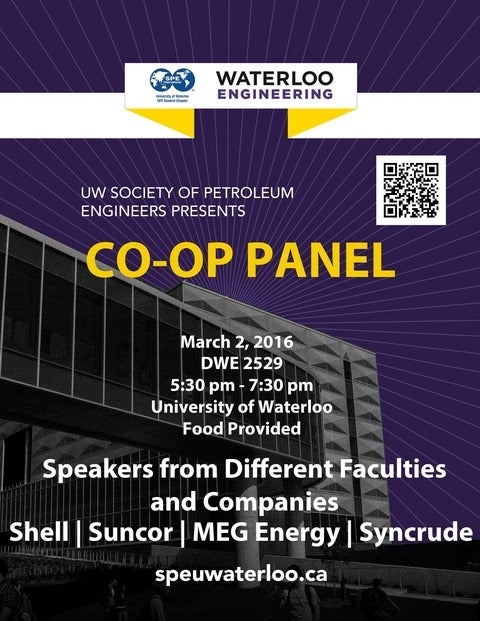
Wednesday, March 2, 2016 5:30 pm
-
7:30 pm
EST (GMT -05:00)
UW Society of Petroleum Engineers presents Co-op Panel, Speakers from Different Faculties and Companies Shell/Suncor/MEG Energy/Sycrude

Tuesday, February 16, 2016
Rechargeable battery expert awarded prestigious Steacie honour
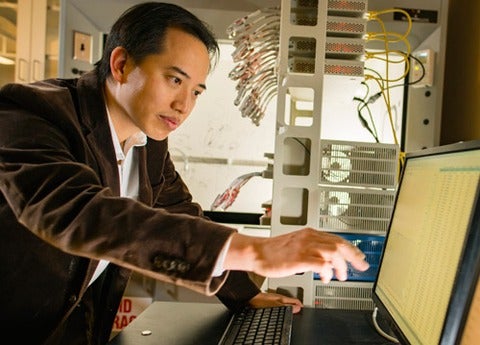
A Waterloo Engineering researcher has received an E.W.R Steacie Memorial Fellowship from the Natural Sciences and Engineering Research Council of Canada (NSERC) for his work in developing new materials that make batteries and fuel cells smaller, lighter and longer lasting.
Tuesday, March 8, 2016 10:00 am
-
10:00 am
EST (GMT -05:00)
Notice of PhD Oral Defence - "Effect of Silica Nanoparticles on Interfacial Tension and Crystallization Behavior of Poly (Lactic Acid) under the Influence of Compressed Carbon Dioxide" by Kaveh Sarikhani
Friday, March 11, 2016 1:00 pm
-
1:00 pm
EST (GMT -05:00)
Notice of PhD Oral Defence - "Development of a Topical Ocular Drug Delivery System Using Polymeric Nanoparticles" by Shengyan Liu
PLEASE NOTE THAT THIS PHD DEFENCE IS RESTRICTED
Thursday, March 10, 2016 9:30 am
-
9:30 am
EST (GMT -05:00)
Notice of PhD Oral Defence - "Advanced Heteroatom Doped Nanocarbon Materials as Platinum Catalyst Supports for Fuel Cells" by Md Ariful Hoque
Monday, February 8, 2016
Congratulations to Murray Moo-Young scholarship award winners
The 2015-2016 Murray Moo-Young Biotechnology Scholarship has been awarded to two Chemical Engineering students: Brandon Seo, a MASc student who is being supervised by Professor Ting Tsui, and Adam Westbrook, a PhD student who is being supervised by Professor Perry Chou.
The Murray Moo-Young Biotechnology Scholarship was established in 1982 with a donation by Distinguished Professor Emeritus Murray Moo-Young to encourage research of bioprocessing strategies in industrial biomanufacturing and environmental bioremediation.