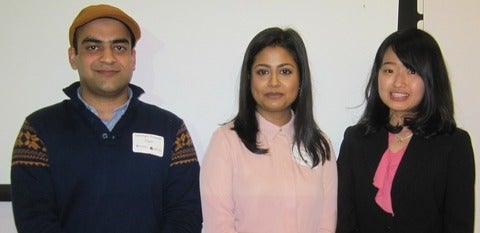
Department "3 Minute Thesis" competition winners announced

Congratulations to the graduate students in Chemical Engineering for winning in the 3 minute Thesis on Thursday, February 16, 2017.

Congratulations to the graduate students in Chemical Engineering for winning in the 3 minute Thesis on Thursday, February 16, 2017.
ABSTRACT: Polyolefins are ubiquitous in polymer technology, yet conductive nanocomposites based on these materials are very difficult to manufacture, because of the inability to efficiently disperse conductive nanoparticles, and the poor interfacial adhesion between polymers and fillers. During the last decade we have done extensive research to develop melt compounded electroconductive polyolefin composites, containing well dispersed conducting fillers, such as carbon black, multi walled carbon nanotubes (MWCNT), graphite and graphene.
ABSTRACT: A reflection on over three decades of Li-ion and EDLC development from my personal involvement. I would recount my experiences and try to connect them with either the significance in advancement in energy storage or to the significance of personal development. I would try to be inspirational in expressing the excitement of the challenges that exist for those who pursue them. I would also talk about our latest patented EDLC chemistry.
ABSTRACT: In total Duane has almost 20 years of experience in fluid flow, heat and mass transfer analysis, nuclear thermal-hydraulics, energy system analysis and design. Duane is a mechanical engineer with Masters’degrees in Mechanical Engineering and Chemical Engineering, both from University of Waterloo. After graduation Duane started his career in CFD modeling in Waterloo working for CFX, which later was later acquired by Ansys, supporting CFX users, giving training courses, and doing multi-phase, turbulence and combustion validations.
Please arrive early so the event can start on time.
Attendance at this event may be counted toward Masters and PhD students Seminar Attendance milestone. Please note, you will be required to stay for the duration of the competition.
Light refreshments provided.
Recruitment Open House Waterloo IGEM

ABSTRACT: Implanted medical devices are at significant risk of developing bacterial biofilm-associated infections and approximately 60% of all hospital-acquired infections are due to biofilm formation on implanted devices. Bacterial biofilms are encased in an extracellular matrix, largely polysaccharide, which protects from antibiotics and the host immune system. Herein I will present three ‘bio-inspired’ approaches to design surfaces to prevent bacterial attachment and biofilm formation.

Prof. Boxin Zhao's bio-inspired "pick and place" technology was highlighted by the university. This research involves the integration of biomimetic "smart" adhesives and functional materials based on liquid crystalline networks. In his own words,