Friday, April 8, 2016 9:00 am
-
9:00 am
EDT (GMT -04:00)
Faculty
Wednesday, March 2, 2016 5:30 pm
-
7:30 pm
EST (GMT -05:00)
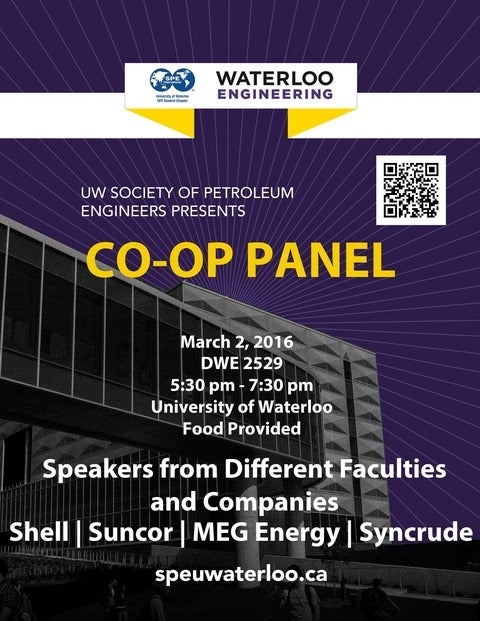
UW Society of Petroleum Engineers presents Co-op Panel, Speakers from Different Faculties and Companies Shell/Suncor/MEG Energy/Sycrude

Tuesday, February 16, 2016
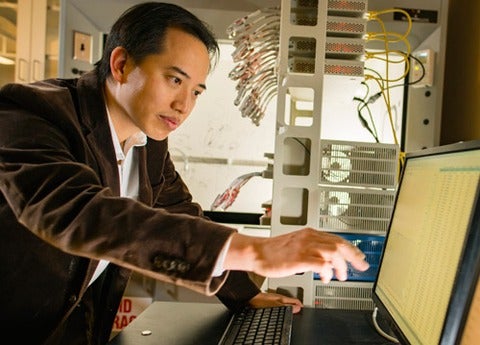
Rechargeable battery expert awarded prestigious Steacie honour
A Waterloo Engineering researcher has received an E.W.R Steacie Memorial Fellowship from the Natural Sciences and Engineering Research Council of Canada (NSERC) for his work in developing new materials that make batteries and fuel cells smaller, lighter and longer lasting.
Tuesday, March 8, 2016 10:00 am
-
10:00 am
EST (GMT -05:00)
Notice of PhD Oral Defence - "Effect of Silica Nanoparticles on Interfacial Tension and Crystallization Behavior of Poly (Lactic Acid) under the Influence of Compressed Carbon Dioxide" by Kaveh Sarikhani
Friday, March 11, 2016 1:00 pm
-
1:00 pm
EST (GMT -05:00)
Notice of PhD Oral Defence - "Development of a Topical Ocular Drug Delivery System Using Polymeric Nanoparticles" by Shengyan Liu
PLEASE NOTE THAT THIS PHD DEFENCE IS RESTRICTED
Thursday, March 10, 2016 9:30 am
-
9:30 am
EST (GMT -05:00)
Notice of PhD Oral Defence - "Advanced Heteroatom Doped Nanocarbon Materials as Platinum Catalyst Supports for Fuel Cells" by Md Ariful Hoque
Monday, February 8, 2016
Congratulations to Murray Moo-Young scholarship award winners
The 2015-2016 Murray Moo-Young Biotechnology Scholarship has been awarded to two Chemical Engineering students: Brandon Seo, a MASc student who is being supervised by Professor Ting Tsui, and Adam Westbrook, a PhD student who is being supervised by Professor Perry Chou.
The Murray Moo-Young Biotechnology Scholarship was established in 1982 with a donation by Distinguished Professor Emeritus Murray Moo-Young to encourage research of bioprocessing strategies in industrial biomanufacturing and environmental bioremediation.
Thursday, March 10, 2016 3:30 pm
-
3:30 pm
EST (GMT -05:00)
Seminar “Electrocatalysis in Oxygen Reduction Reaction: New Materials & Understandings for Fuel Cell & Lithium Air Battery Applications” by Di-Jia Liu, Chemical Sciences & Engineering Division, Argonne National Laboratory
ABSTRACT: Globe warming and energy security are two major challenges the world is facing today. To preserve our environment and energy resource, it is imperative to maximize the utilization of existing fuels while exploring renewable sources. Fuel cell and lithium metal battery as the next-generation high-efficiency energy conversion and storage devices have attracted a great deal of attentions in recent years. This presentation summarizes some recent progresses in my laboratory in these two research areas.
Wednesday, March 16, 2016 1:30 pm
-
3:30 pm
EDT (GMT -04:00)
Three Minute Thesis (3MT) Competition
Friday, January 22, 2016 1:45 pm
-
1:45 pm
EST (GMT -05:00)
Seminar - “Insights into Multiphase Flows in Porous Media from Direct Numerical Simulations” by Orest Shardt, Postdoctoral Research Fellow, Complex Fluids Group, Mechanical and Aerospace Engineering, Princeton University
ABSTRACT: Lattice Boltzmann methods, due to their amenability to parallelization and ability to handle geometrically complex boundaries, are appealing for simulating flows with particles, droplets, and bubbles when experimental observations and manipulations are not possible. This talk will present recent advances in the use of these methods for simulating droplet coalescence and particle motion in confined geometries.