Future students

Self-assembled block polymers containing a sacrificial (i.e., chemically etchable) component are versatile precursors to functional nanoporous materials. The two most common ordered morphologies used to generate nanoporous materials in this way are the hexagonally-packed cylindrical and bicontinuous gyroid phases.

In this talk, Professor Marc Hillmyer will discuss approaches to nanostructured, bicontinuous but disorganized morphologies through either thermal or light-induced chemical fixation of block polymers in the disordered state in close proximity to the order-disorder transition.

Cellulose nanocrystals (CNCs) are known as nature’s latest wonder material. This renewable, sustainable, biodegradable and nontoxic nanomaterial can be extracted from cellulose fiber - the most abundant biopolymer on earth and competitively produced at an industrial-scale.

Congratulations to Gregory Lui, who is completing his PhD in Chemical Engineering at University of Waterloo, for winning the University’s Three Minute Thesis (3MT) competition. 3MT is an international research communication competition in which graduate students have three minutes to distill their research into a presentation that is both understandable and engaging to a non-technical audience.

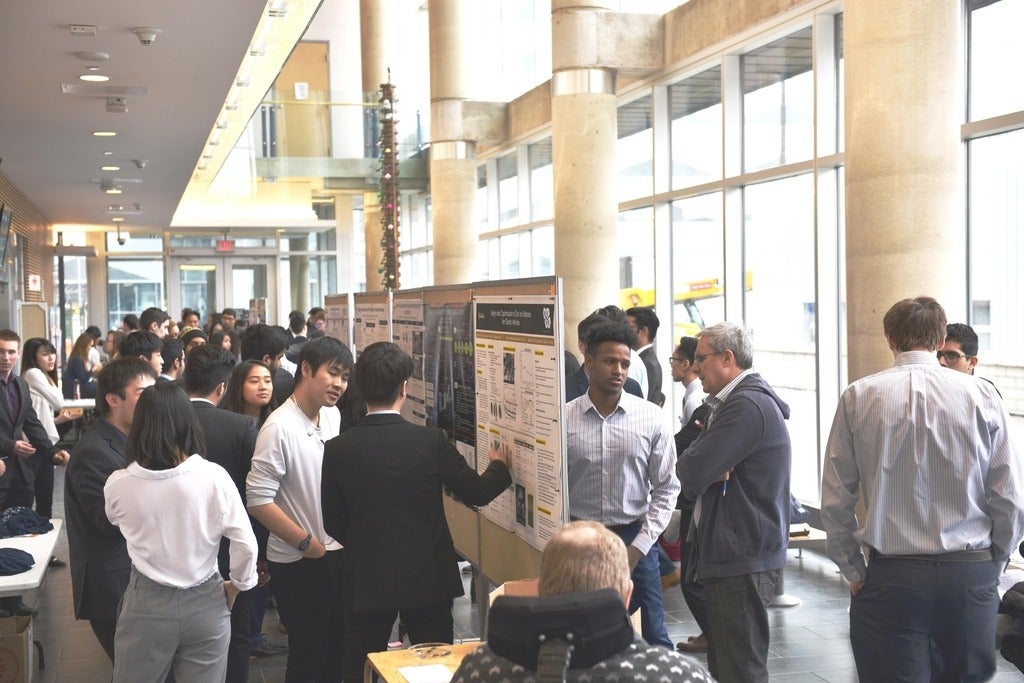
Forty-one teams of fourth-year chemical engineering students presented the results of their Capstone Design projects at the annual Capstone Design Symposium, which was held March 12th in the atrium of Engineering 6. In the process of sharing their research, they demonstrated the diverse and creative nature of chemical engineering and the promise it holds for future generations.

Our approach to mathematically describing a cell population behaviour has evolved in the past decades. From the use of Monod kinetics, when a limiting nutrient shows to control cell behaviour, we now see modelling approaches based on a genome-wide description of a biosystem, integrating the various “omics” datasets available. However, do we always need that level of complexity to face a problem of bioprocess optimization or to elucidate the mechanisms of a metabolic disease?