Friday, August 12, 2016 9:00 am
-
9:00 am
EDT (GMT -04:00)
Staff
Monday, July 18, 2016 11:30 am
-
11:30 am
EDT (GMT -04:00)
Seminar - “Electrical Conductivity, Electromagnetic Interference Shielding and Dielectric Properties of Carbon Nanotube/Polymer Nanocomposites” by Mohammad Arjmand, Postdoctoral Scholar, Polymer Processing Group, University of Calgary
ABSTRACT: Carbon nanotube (CNT)/polymer nanocomposites (CPNs) have recently drawn great interest for use in electronics, due to their superior properties such as tunable electrical conductivity, light weight, low cost, corrosion resistance, processability, etc. (compare with properties of currently used metals). In fact, the polymer matrix is insulative; however, incorporating a low content of conductive filler transforms it into conductive via forming a conductive network.
Thursday, July 21, 2016 3:00 pm
-
3:00 pm
EDT (GMT -04:00)
Waterloo Institute for Nanotechnology and the Department of Chemical Engineering, Distinguished Lecture Series
"Adhesion, Friction & Lubrication of Surfaces & Liquid Films and their Relation to Diverse Phenomena Such as how Geckos Climb on Walls and Ceilings, Surface Damage, and Sensing" by Professor Jacob Isrealachvili, Chemical Engineering, University of California Santa Barbara, United States
Thursday, July 21, 2016 4:30 pm
-
9:30 pm
EDT (GMT -04:00)
Chemical Engineering Annual Picnic
An invitation to all grad students, visitors, staff and faculty in Chemical Engineering (and their families).
It would be appreciated if you could bring a salad or dessert to the barbeque.
Please RSVP here.
Wednesday, July 13, 2016 9:00 am
-
9:00 am
EDT (GMT -04:00)
Notice of PhD Oral Defence - "From Metabolite Concentration to Flux-A Systematic Assessment of Error in Cell Culture Metabolomics" by Stanislav Sokolenko
Friday, July 15, 2016 10:30 am
-
10:30 am
EDT (GMT -04:00)
Notice of PhD Oral Defence - "Use and Control of Co-Expression in the Baculovirus-Insect Cell System for the Production of Multiple Proteins and Complex Biologics" by Steve George
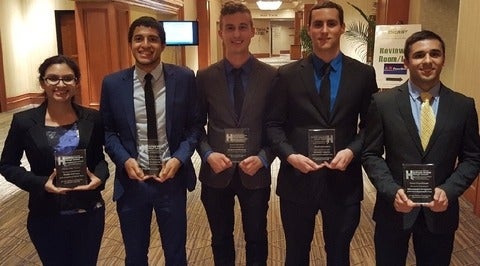
Friday, June 10, 2016
2016 Hydrogen Student Design Contest Winners
Thursday, July 7, 2016 3:30 pm
-
3:30 pm
EDT (GMT -04:00)
Seminar - “Biomimetic Membranes Based on Aquaporin Z for Water Purification”, TONG Yen Wah, Department of Chemical and Biomolecular Engineering, National University of Singapore
ABSTRACT: The regulation of intracellular water activity is a necessary characteristic of many physiological functions in all living organisms. The high water transport rate across cell membranes is due to a type of water channel protein, aquaporin. The unique selectivity, high water transport capability, and low activation energy of aquaporins have garnered strong scientific interests with many studies concentrating on the fabrication of biomimetic membranes based on the reconstitution of aquaporins into self-assembled amphiphilic lipid or polymer bilayers.
Thursday, June 30, 2016 3:30 pm
-
3:30 pm
EDT (GMT -04:00)
Seminar - “Multifunctional Materials for Electronics and Photonics”, Federico Rosei, UNESCO Chair in Materials and Technologies for Energy Conversion, Saving and Storage, Centre for Energy, Materials and Telecommunications, INRS, Varennes (QC), Canada
ABSTRACT: The bottom–up approach is considered a potential alternative for low cost manufacturing of nanostructured materials [1]. It is based on the concept of self–assembly of nanostructures on a substrate, and is emerging as an alternative paradigm for traditional top down fabrication used in the semiconductor industry. We demonstrate various strategies to control nanostructure assembly (both organic and inorganic) at the nanoscale.
Thursday, July 14, 2016 3:30 pm
-
3:30 pm
EDT (GMT -04:00)
Seminar - “pH-Controlled Complex Formation in Charged Polymer Systems” by Kenneth R. Shull, Department of Materials Science and Engineering, Northwestern University, Evanston, IL USA
ABSTRACT: Complexes formed in systems containing both positive and negative charges are of fundamental importance in a variety of materials applications. A common method for producing polyelectrolyte complex films is to sequentially deposit oppositely charged polymers, an effective but tedious process that is not readily scalable. A focus on this talk is on the deposition of relatively thick films directly onto conducting surfaces, using electrochemical processes to modulate the local pH. The process is carried out on a quartz crystal microbalance, which in addition to