Image
Abstract
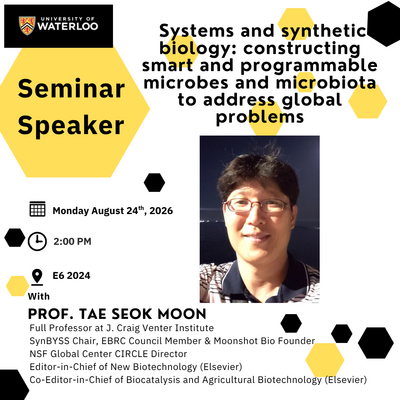
The past decade has witnessed the tremendous power of systems and synthetic biology in the creation of genetic parts, devices, and systems, which helps understand complex biological systems. However, its potential for real-world applications has not been fully exploited. One of its promising applications is the construction of programmable cells that integrate multiple environmental signals and implement synthetic control over biological processes. My research interests are focused on developing microbes and microbiota that can process multiple input signals and generate user-defined outputs. Specifically, I aim to build genetic programs to control various bacterial processes such as gene expression, chemical reactions, and evolution. I will present published and unpublished results of my selected research projects by discussing the potential and challenges of systems and synthetic biology to address global problems, including plastic and agricultural waste issues, non-invasive diagnostics and disease treatment using smart probiotics and microbiota engineering, sustainable bioproduction, and biocontainment of genetically engineered microbes.
This work is supported by U.S. Department of Energy, U.S. Environmental Protection Agency, U.S. Office of Naval Research, U. S. Department of Agriculture, National Science Foundation, National Institutes of Health, Defense Advanced Research Projects Agency, Air Force Research Laboratory, AIChE, Joint Genome Institute, and Gates Foundation.
Biography
Tae Seok Moon is a full professor at J. Craig Venter Institute, an EBRC (Engineering Biology Research Consortium) Council Member, a SynBYSS (Synthetic Biology Young Speaker Series) Chair, a founder of Moonshot Bio, an Executive Board Member of the European Federation of Biotechnology, and an editor of 10 journals, including the Editor-in-Chief of New Biotechnology and the Co-EIC of Biocatalysis and Agricultural Biotechnology. He is also the director of NSF Global Center CIRCLE consisting of >20 companies and >40 academic investigators at 18 institutes from 6 nations.
He has expertise in Systems and Synthetic Biology. He aims to solve global agricultural, environmental, manufacturing, and health problems through engineering biology. His research projects have been supported by Gates Foundation, AIChE, BWF, and 15 other funding agencies (34 external grants), and he has secured >$16M ($46M for the entire teams since 7/1/2012). These projects and his prior research efforts have resulted in 116 publications (105 as the PI), 279 invited talks, 225 contributed conference presentations, and 12 patents. His achievements have also been recognized with many awards, including a Langer Prize for Innovation and Entrepreneurial Excellence (AIChE & MIT), a B&B Daniel I.C. Wang Award (Wiley & ACS), an NSF CAREER award, an ONR Young Investigator Award, a John C. Sluder Fellowship (MIT), an ILJU Foundation Award, an LG Chemical Fellowship, and the SNU President Prize.