Events

Filter by:

Limit to events where the title matches:
Limit to events where the first date of the event:
Date range
Limit to events where the type is one or more of:
Limit to events tagged with one or more of:
Limit to events where the audience is one or more of:

Enabling technology platforms for tissue engineering and regenerative medicine research

CHAN PUI BARBARA

SBS, iTERM, BME, CUHK

The research focus of the Tissue Engineering Lab at CUHK centers around bioengineering of cell- and biomaterial-based complex living tissue substitutes for tissue engineering and regenerative medicine applications. During the prolonged journey of developing engineered tissues for regenerative medicine purposes, we have faced many technical challenges associated with the major components of engineered tissues including stem cells, biomaterials and cell niche signals. A handful of technology platforms were developed to enable and facilitate research in tissue engineering and regenerative medicine research, including but are not limited to (1) a multiphoton microfabrication and micropatterning (MMM) technology to define the cell niche interactions; (2) a multi-level mechano-regulation (MMR) platform to facilitate mechano-characterization and manipulation of cells and tissues; and (3) a biomimetic biomacromolecular microencapsulation (BBM) platform to facilitate physiologically relevant scaffolding. In this seminar, the rationales, the technological capability and the relevant applications will be discussed. 

Solid oxide electrolysis cell (SOEC) is a promising technology for CO₂ electrolysis and subsequent conversion to useful chemicals. This thesis combines the experimental development of new cathode materials with system-level simulation to enhance the performance of SOECs for CO2 electrolysis and assess their applicability for fuel production. There are two components to the work: (1) proposing nanoparticle decorated perovskites cathode material and (2) integration of DAC, SOEC and synfuel production and asses its performance with techno-economic and environmental analysis.

In the experimental section, the focus was on the cathode material of the SOEC since it is the limiting factor for CO₂ electrolysis.

Thursday, August 21, 2025 10:00 am - 11:00 am EDT (GMT -04:00)

Seminar/ Biomass Valorization for Sustainable Bioeconomy

Abstract:I

It is clear, that by mid-century, to avoid the worst-case scenarios of anthropogenic climate change, our society will have to rely on sustainable and renewable resources rather than fossil fuels. Biomass is a key proposed component of several climate mitigation strategies, with substantial involvement of future energy and material systems. The general objective of my research is utilizing biomass, photo/bio/electro-catalysts, and cell factories to design and fabricate renewable and sustainable bioproducts and systems, via bioinspired routes, for Energy, Environmental, and Biomedical application. These hybrid technology approaches provide potential route to economically viable energy production (hydrogen + biofuels) + biomass CO2 captured negative emission technologies (NET) (biomaterials + biochemicals), thus are clearly an important early step in the complete decarbonization of our society. In this presentation, I will introduce our new technology platform of using photocatalysis and photo/electro-bio hybrid system for biomass valorization. I will also talk about our recent progress on design and fabrication of cellulose based materials with genetically engineered proteins for biomedical application

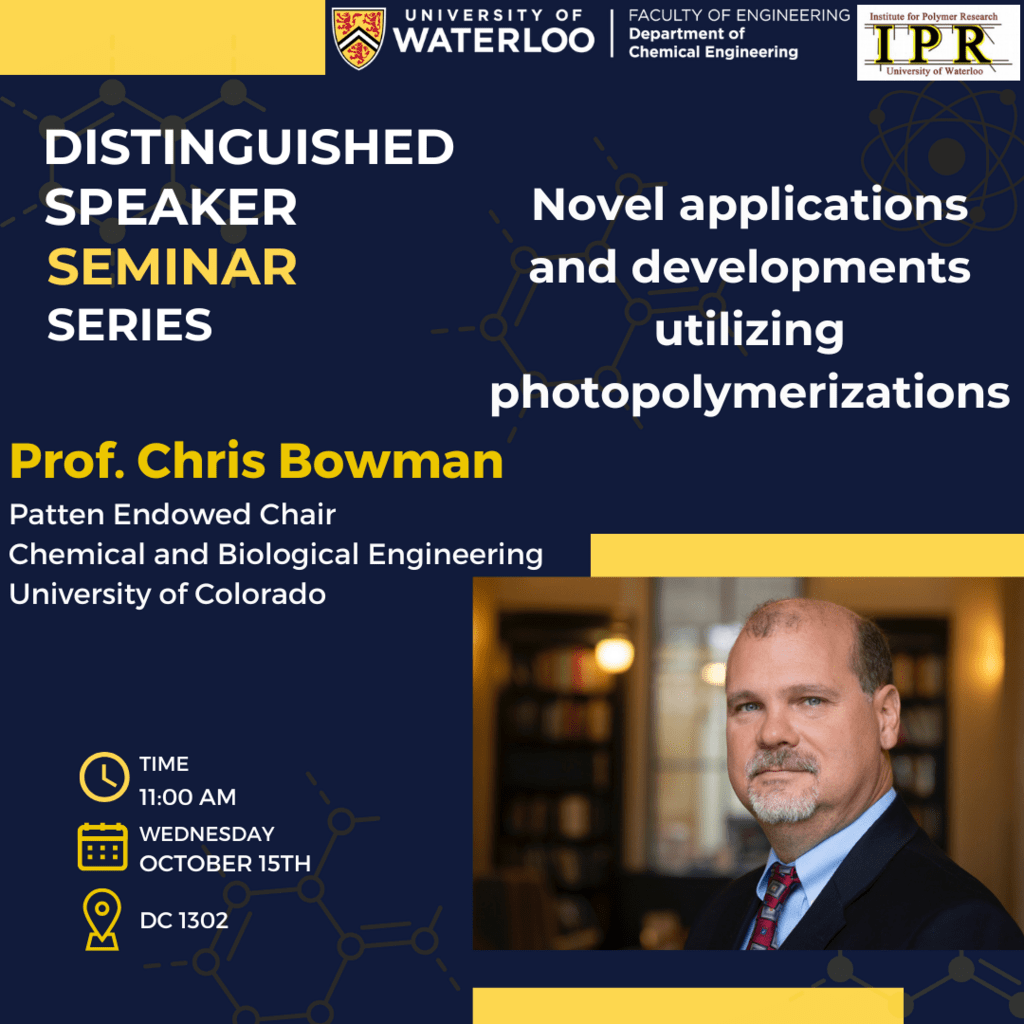
Photopolymerization reactions have been explored and utilized since the time of the ancient Egyptians; however, development of new photopolymerization methodologies and applications continues at an ever more rapid pace.  Traditionally, photopolymerization of multifunctional monomers results in highly crosslinked materials suitable for applications as optical lenses, optical fiber coatings, and dental materials.  These reactions are ubiquitous not only because of the nature of the final polymer product, but also for the characteristics of the reaction itself.  Photopolymerizations are far more energy efficient than their thermal counterparts, are typically performed in a solventless manner that is more environmentally compatible, the reactions occur rapidly at ambient conditions, and the polymerization can be controlled in both time and space.