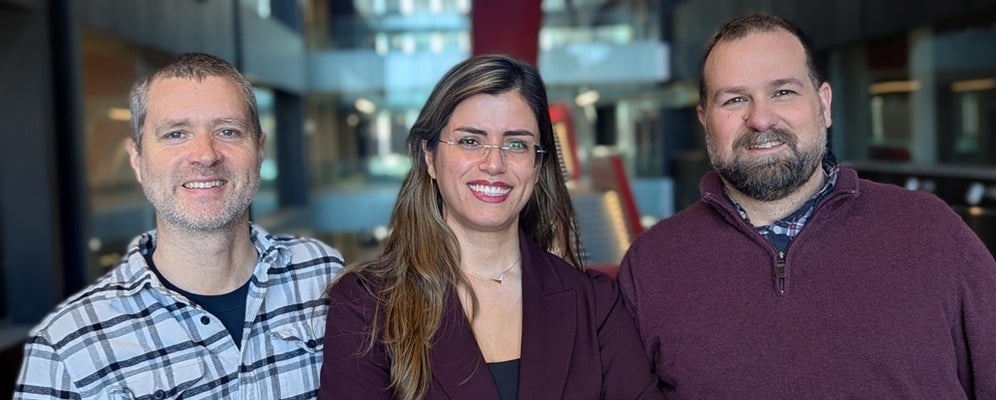
From left to right: Professor Brian Ingalls, Dr. Sara Sadr, and Professor Marc Aucoin
Researchers at the University of Waterloo and industrial partner Center for Research on Environmental Microbiology (CREM Co. Labs) have advanced research that uses bacteria to target cancer. The research group leveraged synthetic biology to prompt bacteria to “eat” tumors from the inside out to treat cancer.
The idea began as PhD student Bahram Zargar’s dream to create a therapy that could attack cancer tumors from the inside. He studied under the supervision of Professors Brian Ingalls and Pu Chen, a retired professor from the Department of Chemical Engineering.
The center of a cancer tumor is made of dead cells with no oxygen present. Clostridium sporogenes is a bacterium that can only grow in the absence of oxygen. These bacteria can grow in the dead, oxygen-free center of tumors and “eat” them from the inside.
“C. sporogenes will form spores that will grow under "good" growth conditions. These conditions exist in the core of a solid tumour. The challenge is that these organisms die when they reach the outer part of the tumour where oxygen still exists and are unable to complete the job of getting rid of the tumor fully,” says Marc Aucoin a professor in the department of chemical engineering who has continued this work with Ingalls.
The group found two solutions to advance this research. First, they added a gene to C. sporogenes, from a related bacteria that can tolerate oxygen, so the bacteria could survive longer near the outer edges of the tumor.
Then they engineered a way to turn the gene on at the right time through quorum sensing, which is a way that bacteria communicate with each other.
Bacteria release chemical signals into their environment. When enough bacteria are close by, these signals build up. Once the signal level is high enough, it can turn on certain genes. This is known as quorum sensing. One such quorum sensing system is the agr system from Staphylococcus aureus, which is encoded in S. aureus DNA.
Researchers engineered this system (DNA) into C. sporogenes, ensuring that the bacteria only turn on the oxygen-resistance gene after many bacteria have gathered in a tumor. This is critical to ensure that the bacteria do not grow in oxygen-rich places like the blood stream, and could be used to trigger other anti-cancer activity such as drug delivery.
In one study, the research group demonstrated that C. sporogenes can be made to tolerate oxygen. In a more recent study, instead of turning on the oxygen-resistance gene, they made the bacteria produce a green fluorescent protein to show that the quorum system from S. aureus works in C. sporogenes.
“Using synthetic biology, we built something like an electrical circuit, but instead of wires we used pieces of DNA. Each piece has its job. When assembled correctly, they form a system that works in a predictable way,” says Ingalls.
The research group includes recently graduated PhD student, Sara Sadr funded by MITACS to conduct the research at CREM Co. Labs.
The next step in this research is to combine oxygen resistance and quorum sensing into one bacterium and test it on a real tumor in preclinical trials.