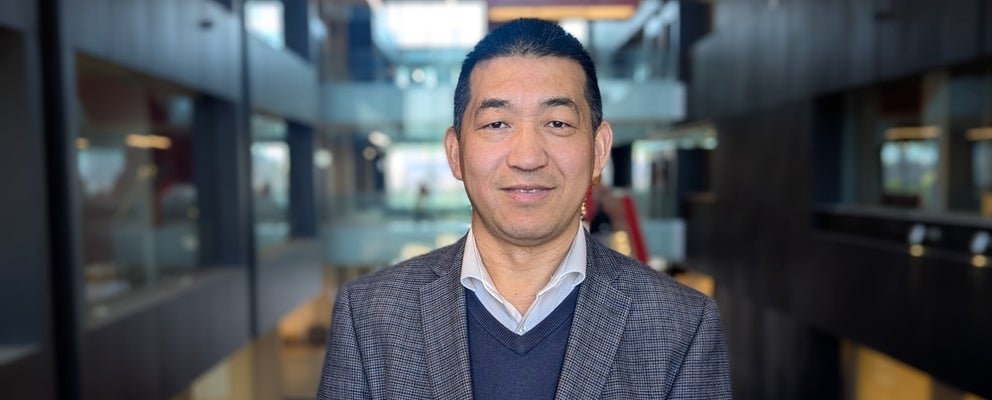
Professor Boxin Zhao has been elected as a Fellow by the Canadian Academy of Engineering (CAE). CAE Fellows are nominated and elected by their peers in recognition of their outstanding achievements and lifelong contributions to the field of engineering.
“I’m honored to be elected as a CAE Fellow because this recognition goes beyond academia to engineering practice. I’m grateful that my work is acknowledged by engineers working in industry and across society,” says Zhao.
Zhao’s research centers on creating advanced functional materials aimed at addressing pressing industrial and environmental challenges, with a particular focus on understanding and engineering surface adhesion and interfacial interactions.
His research group has utilized polymer nanotechnology to create smart materials that interact with light, heat, and humidity, enabling novel applications in advanced manufacturing, including soft robotics and flexible electrical devices.
Drawing on his expertise in adhesion science, Zhao has designed a hydrogel engineered specifically for underwater construction, including applications such as sealing and reinforcing submerged pipelines.
“In dry conditions, adhesion can be easy but in environments such as the ocean or the human body, water molecules interfere with bonding. This new hydrogel can bond things underwater quickly and easily,” says Zhao, Director of the Surface Science and Bio-nanomaterials Laboratory Group.
The process uses directed UV light which activates the hydrogel in 20 seconds. Zhao’s research group is also working on the problem of removing the hydrogel when the pipeline needs to be dismantled, a process called reversible adhesive bonding.
Zhao’s work has contributed to sustainable technologies addressing global environmental challenges such as microplastics pollution. In collaboration with the Waterloo Institute of Nanotechnology, he has advanced research on mitigating nano plastic and microplastic pollution. Using a novel strategy to address this emerging issue, Zhao’s group used biopolymers to create gel beads that aggregate nanoplastics for water remediation.
The team recently received a $600,000 grant from Environment and Climate Change Canada and NSERC to build artificial coral reefs coated with the specialized hydrogel that captures nano‑ and microplastics. By diverting these particles to the artificial structures, the approach could reduce the amount of plastic that would otherwise accumulate on living coral reefs. The research on this project will also include the use of AI to monitor and process data.
With the support of WatCo, Zhao also founded EverBond Interface Technologies to commercialize PFAS-free coatings and antimicrobial technology developed from his lab, bringing research innovations into engineering practices and the market.
For Zhao, the rewards of being a university professor are not solely in research and working with industrial partners to solve real-world problems. He also enjoys training highly qualified personnel (HQP) to advance engineering research and innovation.
“We do research in the lab to generate new knowledge. However, as engineers, part of our mission is to better society. The true legacy of an engineering professor is not just innovation, but the people we train to carry it forward,” says Zhao, University of Waterloo Endowed Chair in Nanotechnology.
Zhao plans to attend the Canadian Academy of Engineering annual meeting in Edmonton on June 1, where he will be inducted as a fellow.