New chemical engineering professor focuses on sustainable energy storage solutions
From left: Sehej Budhiraja, Jihad Salah Khan, Ethan Park, Professor Maxime Van der Heijden, Sonia Khalghollah, Minh-Anh Zaiser, Arielle Chung
Professor Maxime Van der Heijden is a new faculty member in the Department of Chemical Engineering. Her research focuses on electrochemistry and electrochemical systems, using a combination of computational modelling, 3D printing and laboratory experimentation.
She was inspired to pursue this area of research by her PhD supervisor at Eindhoven University of Technology in the Netherlands.
“At the time, I had no background in electrochemistry or computational modelling. My supervisor, however, was very enthusiastic about both fields. I was not the obvious choice for his project, but I was eager to take on the challenge—and that’s where my passion for electrochemistry began,” said Van der Heijden.
Van der Heijden now has expertise in engineering porous electrodes for redox flow batteries through modeling, optimization and lab experimentation. Redox flow batteries are not well known in Ontario and Van der Heijden hopes to raise awareness about their potential.
Redox flow batteries are electrochemical devices with a reactor and tanks filled with two different electrolyte solutions that store and discharge energy through redox reactions.
The energy stored in liquid electrolytes is housed in tanks, while power is generated in the reactor. These systems offer scalable energy storage and are significantly safer than conventional lithium-ion batteries.
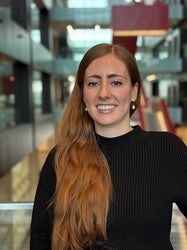
Professor Maxime Van der Heijden
They are well suited for storing renewable energy from wind and solar sources at a large scale. For example, solar collected on sunny days can be stored in redox flow batteries and used on cloudy days. Another potential application is as a sustainable alternative to diesel-powered backup generators in hospitals.
Flow fields in these batteries distribute electrolytes through porous electrodes where the electrochemical reactions take place to charge and discharge the battery. In her research, Van der Heijden designs optimal flow field and electrode structures using computer simulations.
“We want to optimize these structures, for example, using topology optimization techniques or genetic algorithms to improve the performance of the battery. After that, we want to 3D print these structures and use them in real batteries. 3D printing is very versatile as you can print any shape you want, and you can also play with properties that the final print should have,” said Van der Heijden.
To increase the efficiency, durability and capacity of redox flow batteries, her group focuses on improving the electrodes, the components responsible for storing and releasing energy. By tailoring the internal structure of these components, they enhance how the electrolyte moves through the electrodes and increase the effectiveness of the electrochemical reactions. These improvements are designed to fit the unique needs of specific battery systems.
Van der Heijden previously used commercial resin to print plastic and carbonize it into conductive carbon electrodes. Her lab is now expanding toward in-house made materials offering greater flexibility in design and performance.
As demand grows for efficient and reliable energy storage, innovations like these are essential for improving battery performance and exploring their potential within Ontario’s energy landscape.
“I am looking forward to collaborating with talented researchers and students here at the University of Waterloo to work on sustainable solutions for the future,” said Van der Heijden.