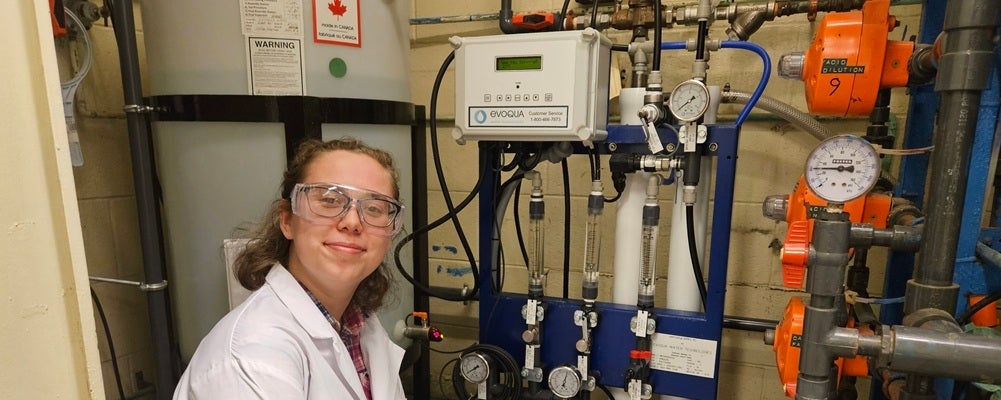
Above: Chemical Engineering student Aidan Ryan in front of the reverse osmosis (RO) water system.
The Department of Chemical Engineering continues to advance its role as leader in sustainability, pioneering innovative solutions to reduce its carbon footprint.
Demonstrating a steadfast commitment to sustainability teaching and practice, the Department of Chemical Engineering achieves Green Lab Gold Certification of its undergraduate teaching labs in the Douglas Wright Engineering Building (DWE).
The labs earned Green Lab Gold Certification for the second year in a row, with a higher score than last year!
It’s clear that sustainability is more than a buzzword for the department; the certification demonstrates the department’s focus on sustainability as an integral part of how experiential learning is designed and delivered.
“I am thrilled to see the work by Chemical Engineering to integrate sustainability into labs. Labs are areas of high resource intensity and environmental impact, and the team has identified meaningful activities for operational improvement,” says Mat Thijssen, Director of Sustainability at the University of Waterloo. “It’s doubly exciting to see these projects translating into learning and skill development opportunities that build highly relevant sustainability competencies for students.”
So, what exactly goes into earning Green Lab Gold Certification? The program evaluates how labs manage chemicals and utilities and run everyday operations.
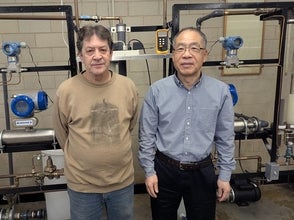
Richard Hecktus (left), mechanical technician and John Zang, lab director.
Under the leadership of Lab Director John Zhang and his team of lab instructors, with technical support from Rick Hecktus, they completed three major initiatives.
Regenerating, recycling, and reusing chemicals and solvents
“We have been reusing chemicals and solvents for the last 10 years. In the lab, we prioritize regenerating costly chemicals to minimize expenses and model sustainable practices for students,” says Zhang.
Many of the hands‑on experiments students complete are designed to recover and reuse expensive chemicals and solvents. This is not only cost-effective, it also shows students what sustainable chemical engineering looks like in practice.
Expanding virtual labs and open educational resources
The second and most innovative initiative is the integration of virtual labs, computer simulations, and Open Educational Resources into lab courses at all levels. Incorporating relevant virtual labs into first- and second-year lab courses amplifies experiential learning at a fraction of the cost of additional physical experimentation.
With support from eCampus Ontario, the department created a 360o virtual tour of its continuous distillation pilot plant—the only one of its kind in Ontario. This interactive resource blends virtual reality, theory, high fidelity process simulations, and multimedia to help students explore complex processes.
The free open resource has become a valuable green educational asset not only for the department but also for other chemical engineering programs worldwide.
These tools help students plan lab activities effectively, minimize trial‑and‑error, and focus their in-person lab time on experiments that are essential to their projects. This approach not only improves learning outcomes but also significantly reduces chemical usage, energy consumption, and utility demand.
Recognizing these benefits, the department has continued to expand its green lab efforts by developing three additional Open Education Resource modules on energy storage processes over the last two years on LEARN, Waterloo’s web-based learning management system.
Saving water through smart recirculation systems
Last year, a new state-of-the-art reverse osmosis (RO) water system, used to purify water, was installed in the chemical engineering undergraduate teaching labs, eliminating the need for chemicals. The team also modified existing equipment to recirculate and reuse utility water, dramatically reducing municipal water consumption.
“We are reimagining what sustainability education for engineers can look like, following an approach that goes beyond curricular changes at the graduate and undergraduate level to touch every aspect of student experience,” says Professor Mario Ioannidis, Chair of the Department of Chemical Engineering.
Photo credits: Sima Alekberova and Nicola Kelly