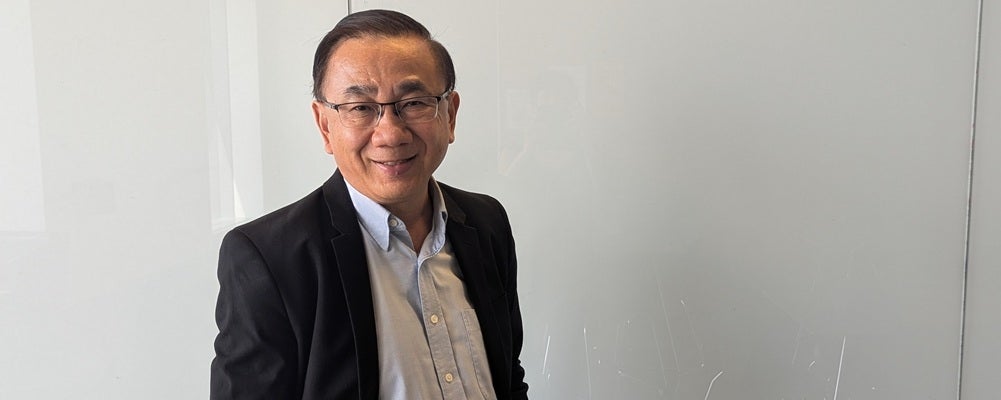
A research group led by Professor Michael Tam has developed a new water-based pesticide delivery formulation that dramatically improves how pesticides stick to plant leaves even in wind and rain.
Early field trials conducted with an industrial partner in Singapore demonstrated the potential of the technology. Cabbage plots were seeded with insect pests and the water-based formulation outperformed conventional pesticide systems, delivering better pest control using less active ingredients.
Current pesticide delivery systems rely on chemicals and solvents to help pesticide droplets stay on plant leaves and spread, which can be harmful to the environment.
Standard practice is that crops are protected by pesticides via liquid sprays using nozzles, mist sprays or from airplanes. As a result, pesticides do not always reach their intended target, bouncing off plant leaves, drifting into the air or washing into soil and waterways, leading to economic loss for farmers and environmental contamination.
The research group designed a formulation using cellulose nanocrystals (CNCs), which are carbon-neutral, produced from water, pesticides and inorganic and metallic nanoparticles.
Tam, Director of the Laboratory for Functional Colloids & Sustainable Nanomaterials carefully tunes the surface chemistry of CNCs, creating a nanostructured formulation that stabilizes pesticide droplets without relying on surfactants or solvents.
Instead of splashing, fragmenting or rebounding off leaves, the droplets containing CNCs remain intact upon impact. Flattening into thin pancake-shaped film that adheres strongly to the leaves.
The research group created a formulation that disperses the CNCs into water. The high surface area of the CNCs captures and transports the pesticide, forming stable dispersion making the system both more effective and more environmentally friendly.
The next step in the research is to work closely with an industrial partner to bring this more targeted and eco-friendly pesticide delivery systems to agricultural fields.
The study Self-assembly of cellulose nanocrystals for splash suppression and enhanced pesticide delivery on hydrophobic surfaces was recently published in the Journal of Colloid and Interface Science and ACS Nano.