News

Filter by:

Limit to news where the title matches:
Limit to items where the date of the news item:
Date range
Limit to news items tagged with one or more of:
Limit to news items where the audience is one or more of:

Chemical engineering alumni Jacqueline Hanton and Kayli Smith (both BASc ’20) founded a start-up called Friendlier in 2019. The company is dedicated to addressing Canada’s single-use plastic problem.

Hanton and Smith both did a study term in Sweden during their undergraduate degrees. This experience opened their eyes to the power of conscious consumerism and ignited a shared determination to preserve the planet and minimize the effects that humans are having on the environment—leading to the creation of Friendlier.

Since 2019, Hanton and Smith have raised a total of $10 million and prevented 3.7 million food and beverage containers from ending up in landfills. Friendlier has expanded its operations and now has 200 locations in Ontario, British Columbia, Nova Scotia, Manitoba, and Quebec, quickly building a national presence.

Mohamed Wanas is a technical leader for Nuclear Island Hydraulic Systems at GE Hitachi Nuclear Energy- a role that caps an interesting career path. His journey brought him to Canada, where a pivotal decision to pursue an MEng degree in the Department of Chemical Engineering helped lay the foundation for his current role in clean energy production.

Wanas completed his undergraduate degree in chemical engineering at the University of Alexandria in Egypt.  He worked on design, commissioning and normal operation phases in the oil and gas industry for eight years while he completed a Master of Applied Science (MASc) degree in Egypt.

Wanas had family in Canada and often travelled to Canada as a child and always hoped to return as an adult. In 2017 he returned with plans to pursue a PhD, however he had a strong desire to return to work in industry and began considering doing an MEng degree to return to work sooner.

Wanas initially considered applying to several Canadian universities; however, he was ultimately drawn to the University of Waterloo—not only because of its renowned engineering program, but also due to a connection he established with Chemical Engineering Graduate Studies Manager Judy Caron.

The 2025 Capstone projects were ambitious and innovative! Aiming to solve problems, running the gamut from converting plastic waste into hydrogen to creating a modular water treatment plant for Six Nations of the Grand River.

This graduating class pushed themselves to their limits, persevering through their first two years, which took place during the pandemic, and finishing their undergraduate degrees with innovation and tenacity.

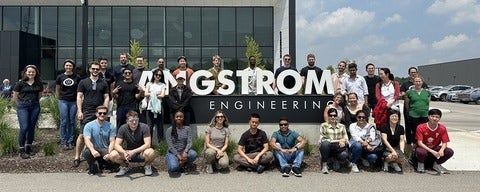
The excitement was palpable at the Capstone Symposium as fourth-year students explained their projects to instructors, industrial partners, parents and eventgoers.

This year, there were six winning Capstone Projects in the Department of Chemical Engineering:

Winning a pitch competition is never easy, but it becomes even more challenging when there is no prototype or product ready for market. Despite these obstacles, Capstone Group 4 defied the odds and won $12,000 to advance their project!

The project, called Direct-Li, won the Norman Esch Entrepreneurship Award for Capstone Design. The group proposed a more efficient and eco-friendly process for lithium extraction.

Through engineering innovation, Group 4 developed a two-stage process called direct lithium extraction (DLE). Group members Rachel Kumara, Sophie Campbell, Maeve Seto and Louise Tayzon utilized nanofiltration and ion pump separation to extract 90 per cent more lithium per litre of water in half the time compared to industry standards.

“We were delighted that we were successful in conveying our idea in a way that made the judges see value in something that we do not actually have, a solid prototype. Our ideas are based on simulations and models. We were shocked to win! We were just happy to be there and to be challenging ourselves, especially since we were the only all-women group in the competition!”

Professor Valerie Ward is part of a new global coalition to revolutionize vaccine production with disruptive health technology. The technology is designed to enable local vaccine production, reducing production time from nine days to just one day. A breakthrough that has the potential to save millions of lives and significantly lower the cost of vaccine production.

A research coalition led by the Centre for Process Innovation (CPI) received $2.8 million from the Coalition of Epidemic Preparedness Innovation (CEPI) to fund technology development to combat epidemics and pandemics. The aim is to make small transportable units to manufacture vaccines, making vaccines more accessible and better able to deal with local outbreaks.

Ward is working with researchers and industry partners in Brazil, the UK, and Canada to aid the world in responding more swiftly and equitably to future epidemics and pandemics. 

The grant focuses on developing technology to meet two specific goals. The first is rapid production of vaccines. The second is to decentralize manufacturing so it can be produced at different sites in smaller batches.

Researchers from the Universitat Duisburg-Essen in Germany and the University of Cambridge arrived at the University of Waterloo in June to participate in ongoing graduate student training aimed at leveraging 2D materials for various manufacturing applications. This international collaboration is supported by an NSERC CREATE grant, with Professor Michael Pope from the Department of Chemical Engineering serving as lead Principal Investigator. Researchers from the Faculty of Engineering, the Faculty of Science and the Waterloo Institute for Nanotechnology are involved in the collaboration.