Submit content for the Daily Bulletin through the Daily Bulletin article or When and Where intake forms.
For all other requests, please contact communications@uwaterloo.ca.
Waterloo releases updated guidance on responsible research assessment
A message from the Libraries.
The University of Waterloo has released Measuring Research Outputs with Bibliometrics, an updated position paper that builds on the institution's influential 2016 White Paper on Bibliometrics and Research Impact. Developed through a multi-year collaboration involving the Libraries, Institutional Analysis and Planning, the Office of Research and representatives from all six faculties, the paper provides a contemporary framework for understanding and assessing research impact across disciplines.
The updated resource expands guidance on research assessment in the arts, humanities and social sciences; alternative metrics; equity, diversity, inclusion, accessibility and Indigeneity considerations; interdisciplinary research; and knowledge mobilization. It emphasizes that research metrics should be used alongside expert judgment and other evidence to support fair and meaningful evaluation.
The position paper is openly available through UWSpace and offers practical guidance for researchers, academic leaders and libraries at Waterloo and beyond. Learn more about what's new on Library News.
What does sustainability have to do with your job?
A message from the Sustainability Office.
What does sustainability have to do with your job? More than you might think. The new Sustainability Fundamentals: Introduction to Sustainability course explores how sustainability is influencing decisions across the University and provides practical tools, resources, and ideas you can apply in your own work. It's the first in a new series of micro-courses designed to help employees build sustainability knowledge one topic at a time. Learn more and register for Sustainability Fundamentals: Introduction to Sustainability.
Environmental solutions we can’t see

This article was originally published in Waterloo News.
The most powerful environmental solutions might come from organisms too small to see. Microbes are everywhere — in soil, water, waste sites and ecosystems, and Waterloo researchers across the Faculty of Science are working to uncover how these tiny organisms can be harnessed as tools to address complex environmental challenges and drive lasting global impact.
Microbes fighting landfill emissions
Methane is 20 times as potent as carbon dioxide as a greenhouse gas, but it breaks down much faster in the atmosphere. As a result, reducing methane emissions is an important lever to tackle climate change.
In the Hug Research Group in the Department of Biology, Dr. Laura Hug’s goal is to address “legacy” methane from older landfilled waste, where research suggests microbial solutions could substantially reduce emissions. The lab aims to fill gaps in existing mitigation approaches and identify areas where conventional tools have been ineffective, and where microbial solutions could make a significant difference.
“Microbial communities use waste contaminants as energy,” Hug says. “Within these communities live groups of microorganisms performing useful functions, including oxidizing methane that will otherwise be emitted to the atmosphere. We’re also working with organisms that can degrade bioplastics and break down industrial solvents.”
Hug’s lab has maintained a decade-long collaboration with the Region of Waterloo’s Division of Waste Management to collect samples. The team is using the samples to develop tools to control, degrade or transform contaminants that are pervasive in the environment and have long-term impacts on climate change, human health, and ecosystems. By utilizing these natural processes, the team aims to develop innovative strategies to reduce greenhouse gas emissions from landfills in our community.
Microbes protecting freshwater systems
Dr. Jozef Nissimov leads the University of Waterloo’s Environmental Virology and Ecology Research Group in the Department of Biology, where his team investigates whether microbial communities help control harmful algal blooms (HABs) or worsen them.
Scientists have long assumed that viruses that infect bacteria and algae act as natural population control, killing off bloom-forming species and keeping them in check. However, Nissimov’s lab has shown experimentally that when a virus infects and kills the common bloom-forming cyanobacterium, such as Microcystis aeruginosa, it can trigger a spike in the liver toxin microcystin, releasing levels many times higher than safe drinking-water limits, even when the water looks clear again. The lab also investigates the mechanisms that trigger the emergence of virus resistance in this species. Nissimov aims to change how HABs are predicted and managed by revealing blind spots in basic understanding of these host-virus systems and current monitoring practices.
“We are exploring whether manipulating these virus-algae relationships could someday help manage blooms rather than simply react to them," Nissimov says. “It could turn a naturally occurring microbial process into a deliberate tool for protecting freshwater.”
Samples are collected from freshwater systems under Waterloo’s collaborative forWater Network and the Water Institute, as well as lakes located in the IISD Experimental Lakes Area. The team then uses photobioreactors and other culturing methods to recreate lake conditions and examine specific virus-host interactions that occur during blooms, in hopes of developing innovative strategies to protect freshwater systems.
Mine site microbes for remediation
When a mine closes, environmental risks can persist years later. Canada has more than 10,000 abandoned mines that predate current closure and reclamation requirements. Many are still leaching acidic, metal-rich drainage into surrounding land and water.
In Dr. Jenine McCutcheon’s lab in the Department of Earth and Environmental Sciences, their goal is to encourage natural microbial processes that improve water quality and reduce contamination while suppressing processes that worsen site conditions.
The research team visits both active and historic mine sites throughout Canada to better understand these microbial processes. The team collects water, rock, and biofilm samples to characterize the microbial communities and how they impact the site’s geology and geochemistry. Samples are also collected at natural sites, such as wetlands, to see how the biogeochemical processes in these systems can help develop mine site remediation strategies.
“Microbial activity in mine waste can both help and hinder remediation processes,” McCutcheon says. “Some organisms help remove contaminants from the water by storing them in minerals, through a process called biomineralization. Other organisms accelerate the release of contaminants from mine waste, making the problem worse.”
McCutcheon aims to fully understand the balance between the two to develop solutions that utilize microbial processes for mine waste remediation.
Fall 2026 Quantum Valley Investments® Problem Pitch Competition
A message from Conrad School of Entrepreneurship and Business, Faculty of Engineering.
Innovation starts with understanding, not solving.
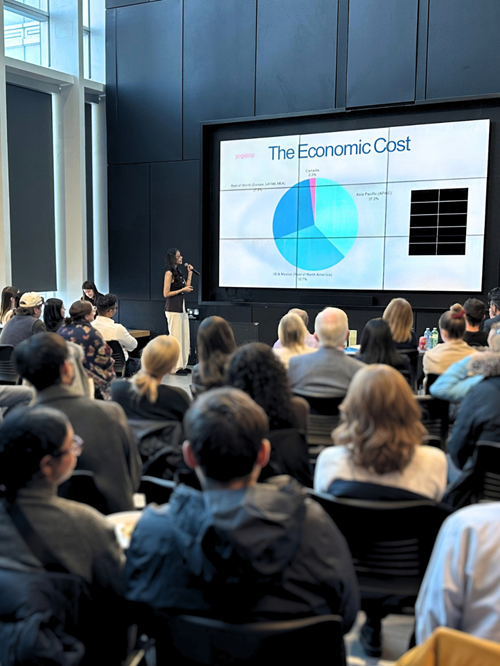
The Problem Lab at the Conrad School of Entrepreneurship and Business is inviting University of Waterloo students to participate in the Fall 2026 Quantum Valley Investments® Problem Pitch Competition.
The competition challenges student teams to research an important real-world problem, examine it from multiple perspectives and pitch their findings to a panel of judges. Rather than starting with a solution, students begin by developing a deep understanding of the problem, its context, the people affected and why existing approaches may not be working.
R&D funding is awarded to support teams that demonstrate the most thorough understanding of their chosen problem as they work toward developing a solution.
For Fall 2026, students can explore problems connected to Waterloo’s five Global Futures themes. Students may also propose a problem in another area of interest.
Through the Problem Pitch process, students develop skills in problem framing, research, analysis, stakeholder understanding and communication. The competition provides an opportunity to explore a meaningful problem before attempting to build a solution around it.
Applications for the Fall 2026 Problem Pitch Competition are due Friday, October 9, 2026, at 11:59 p.m. And will be reviewed by the Problem Lab team, with selected semi-finalist teams invited to move forward to the finals.
Building closure
The Douglas Wright Engineering Building (DWE) will remain closed until Sunday, October 4. Please avoid DWE and the surrounding affected area until further notice. Classes and planned activities scheduled in DWE will be relocated or rescheduled as needed, and affected students, faculty, and staff will receive further details.
Employee Recognition Awards nominations
Recognize a colleague or team who brings Waterloo’s values to life through their actions and contributions. Nominations are open until Friday, October 9.
When and Where
The Campus Wellness Student Medical Clinic offers healthcare visits with Physicians and Nurse Practitioners to current undergraduate and graduate students. Services include: vaccinations, immunity testing, naturopathic services and more.Counselling Services offers appointments with counsellors in person as well as via phone and video. Students can book appointments for these services by calling Campus Wellness at 519-888-4096.
The privately-run Student Health Pharmacy(located in the lower level of the Student Life Centre) is now offering new COVID booster shots and flu shots. Covid booster shots are available by appointment only – please call ext. 33784 or 519-746-4500. The Student Health Pharmacy’s summer hours are Monday to Friday, 9:30 a.m. to 4:30 p.m. Naloxone kits are still available – pick them up in the pharmacy at no charge.
The Waterloo Eye Institute optometry clinics in Waterloo and downtown Kitchener offer comprehensive eye exams and eyewear, including glasses and contact lenses, with the Waterloo location offering various specialized services including urgent eye care. Discounts apply for University of Waterloo students and employees. The Waterloo Clinic is at a nearby interim location, 419C Phillip St, during construction at the School of Optometry and Vision Science. The Kitchener Clinic remains at the Health Sciences Campus, 10B Victoria St. S. Book online or by phone at 519-888-4062.
New methods and strategies for the synthesis of nucleoside analogues and natural products with speaker Robert Britton, Professor, Simon Fraser University and host Derek Schipper, Monday, October 5, 10 to 11 a.m., C2-361 (Reading Room)
Kairos Blanket Exercise hosted by St. Jerome's University, Monday, October 5, 3 p.m. to 6 p.m., St. Jerome's Chapel, dinner included.
More Feet on the Ground Certificate, Monday, October 5, 3 to 4 p.m., PSE 7303/7363.
The Co-Op Workplace Simulation Oct. 5, Monday, October 5, 4:45 to 7 p.m., 2nd floor IDEAs clinic, PSE.
Project 529 Bike Registry Registration Rallies, (weather dependent), Tuesday, October 6, noon to 2 p.m. at SLC Green; Wednesday, October 7, 11 a.m. to 1 p.m. at CPH/Ring Road. Let's end bike theft. Bring your bike to register and get a free 529 Shield.
WUSA Bike Auction, Tuesday, October 6 at noon, SLC Green
GIS Speed Run Session 3: Every Map is Wrong!, Tuesday, October 6, 12:45 to 1:45 p.m., online.
Safeguarding Science Webinar: Module 2: Dual-Use Technologies: Know Your Research - Know Your Partners - Assess the Risk(English) - Tuesday, October 6, 1 to 2:30 p.m.
WaterLeadership Certificate: Knowledge Mobilization 101, Wednesday, October 7, 10 to 11:30 a.m. in E2-2350. Earn the certificate, gain transferable skills. All undergrads and grads welcome from all faculties. Space is limited, registration required.
Community Well-being Fruits and Veg Market, Wednesday, October 7, 11 a.m. to 3 p.m., SLC Marketplace and PSE 1st floor.
Cybersecurity at Home and Beyond, Wednesday, October 7, noon to 1 p.m, EIT 3142
Indigenous Speakers Series presents Sarah Deer, Wednesday, October 7, 3 to 4:30 p.m. Theatre of the Arts, ML
Anti-Racism Reads: Alt-Right From 4Chan to the White House, Thursday, October 8, noon to 1 p.m., LIB 338
IEEE Lunch and Learn: How AI is Reshaping the Future of Publishing, Thursday, October 8, noon to 1 p.m., DC LIB 1568.
From Idea to Impact: Investigating Industries and Companies, Thursday, October 8, 12:30 to 1:30 p.m., online.
Warriors Men's Hockey, Friday, October 9, 7 p.m., CIF Arena
Instructional Innovations Week, Tuesday, October 13 to Friday, October 16. Featuring a range of sessions exploring innovative approaches to teaching and learning, with a particular focus on generative AI and emerging technologies.
Social Acceptance and the Energy Transition: German and European Perspectives(presentations by three visiting Germany-based researchers), Tuesday, October 13, 11 a.m. to 1 p.m., EV3-3412. Please register in advance.
Launching the AI and Teaching Instructor Resources Site - (CTE7568), Tuesday, October 13, 12:30 to 1 p.m., Online
Introduction to Assessment Redesign and GenAI - (CTE7567), Tuesday, October 13, 1:30 to 3:30 p.m., MC 2036
Introduction to Crochet, Wednesday, October 14 and 21, noon to 1:00 p.m. (class is held over two weeks). It will also be held on Monday, November 2, 5 to 7 p.m. Location will be sent at registration. Note: This workshop costs $25
From First Contact to Lasting Impact: Building International Research Collaborations Between Canada and Germany/Europe, an informal and open discussion facilitated by Ian Rowlands (ENV) with three visiting Germany-based researchers, Wednesday, October 14, 10 to 11 a.m., EV3-3406.
NEW - Don McCrae Naismith Classic Basketball Tournament, Thursday, October 15th to Saturday, October 17th, PAC
Teaching Critical Thinking in a Time of AI (CTE7563), Thursday, October 15, 1:30 to 3 p.m., MC 2036
GenAI Assessment Showcase (with faculty examples) (CTE7564), Thursday, October 15, 10:30 a.m. to noon, MC 2036
Identity offboarding, Friday, October 16, 9 to 10 a.m., virtual
Augmented Reality Video for Online / Hybrid Teaching and Tutoring (CTE7566), Friday, October 16, 1:30 to 3 p.m., Tech Sandbox (LIB 329)
NEW - Warriors Football vs McMaster (Senior Game), Saturday, October 17, 1:00 p.m., Warrior Field
AI Before the Ruins: Industry and Inquiry Before and After the Bubble, keynote lecture by Dr. Anne Pasek, Environmental Humanities Symposium, Saturday, October 17, 9 to 10 p.m. EV3 1408
NEW - Cybersecurity for Researchers: Supporting secure research, Tuesday, Oct 20, 10:30 to 11:30 a.m., hybrid, EC5 1111 or online via Teams
NEW - Protecting research data in the age of AI, Wednesday, Oct 21, 1 to 2 p.m., Grad Lounge, SLC 3216
Bodies, Bones, and Burials: What Human Remains Reveal About the 1845 Franklin Northwest Passage Expedition, Wednesday, October 21, 7 to 8:30 p.m., Humanities Theatre, Hagey Hall
Safeguarding Science Webinar: Module 7 - Conducting Open-Source Due-Diligence (English), Thursday, October 22, 1 to 2:30 p.m.
NEW - Open Access Week: Into the Open, A conversation about affordable education resources, Thursday, October 22, 11 a.m. to 12:30 p.m., DC 1568.
NEW - Open Access Week: Publishing Open Access (for free!), Tuesday, October 20, 11 a.m. to 12 p.m., online.
NEW - GIS Speed Run Session 4: Essential Analysis Tools, Tuesday, October 20, 12:45 to 1:45 p.m., online.
NEW - Data Journeys: Data actually, the basics for figuring out your situationship with data, Wednesday, October 21, 11 a.m. to 12 p.m.,online.
NEW - Anti-Racism Reads: Alt-Right From 4Chan to the White House, Thursday, October 22, 12 to 1 p.m., LIB 338
NEW - Open Access Week: Geospatial Open Data, Thursday, October 22, 12:30 to 1 p.m., online.
NEW - Systematic Reviews for the Environmental Sciences, Thursday, October 22, 1 to 3 p.m., online.
NEW - Endpoint protection on campus: SentinelOne and Tenable Nessus agents, Friday, Oct 23, 9 to 10 a.m., virtual.
NEW - Warriors Women's Hockey, Friday, October 23rd, 7:00 p.m., CIF Arena
NEW - Systematic and Scoping Reviews: Systematic and Scoping Review Methods, Tuesday, October 27, 10 a.m. to noon., online.
NEW - GIS Speed Run Session 5: Creating Map Layouts, Tuesday, October 27, 12:45 to 1:45 p.m., online.
NEW - Teaching with Tech: A Practical ViewBoard Workshop - In Person (TII5010), Tuesday, October 27, 10:30 a.m. to 11:30 a.m., Tech Sandbox (LIB 329). Part of the Tech Sandbox series, this introductory workshop helps instructors build confidence using ViewBoard Interactive displays.
NEW - Warriors Volleyball vs. Nipissing (Home Opener), Friday, October 30, 6:00 p.m.., Carl Totzke Court PAC
Upcoming service interruptions
Stay up to date on service interruptions, campus construction, and other operational changes on the Plant Operations website.