Connecting the classroom to city-building
Adam Clark gives future planners a hands-on role in shaping real communities.
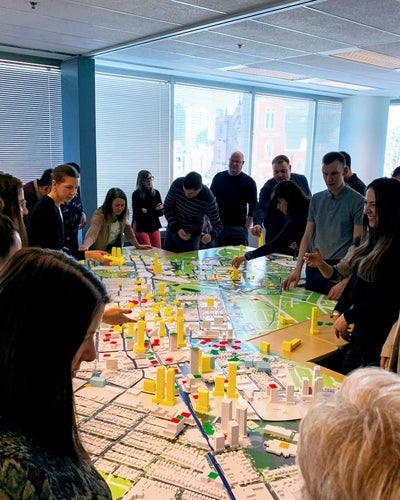
Two residents stand over a scale model of their neighbourhood, moving miniature buildings around. They debate where new homes belong, question each other's ideas and imagine how their community might grow. Adam Clark (BAS '06, MArch '09) doesn't interrupt. Watching the conversation unfold without an expert leading it is his favourite part of the process.
Years earlier, Clark had experienced something similar when he was a University of Waterloo architecture student. A third-year urban design studio challenged his class to reimagine a large section of Toronto, from Fort York to the Don Valley. His team built an 8-by-60-foot model. That project changed the trajectory of his career, shifting his focus from buildings to cities.
Years later, the experience helped inspire the public engagement process Clark would lead for Growing Together, Kitchener's planning framework for accommodating future growth around its ION light rail stations. Residents used physical models to test ideas and visualize how greater density might reshape their neighbourhoods.
Growing Together went on to earn eight awards and international recognition, including the Ontario Professional Planners Institute's Project of the Year and a Congress for the New Urbanism Charter Award.
But some of the project's contributors weren’t on the City of Kitchener's payroll. They were University of Waterloo planning students.
As project client for Professor Katherine Perrott’s graduate planning studio, Clark invited students to tackle planning questions the City was actively working through. Their research explored everything from housing and zoning to how other municipalities were approaching similar challenges. Their work challenged assumptions, sparked new ideas and, in some cases, directly informed City policy.
For Clark, involving students means bringing another set of perspectives into the planning process, including ideas that can challenge the City’s own assumptions.
For Clark, involving students means bringing another set of perspectives into the planning process, including ideas that can challenge the City’s own assumptions.
Clark's involvement with Waterloo extends well beyond that project. Over the years, Clark has become a familiar presence in the School of Planning, first volunteering with Professor Luna Khirfan and later supporting multiple courses as a guest lecturer, critic, walking tour leader and project client. He gives students access to active municipal projects and the realities of professional practice.
The collaboration has influenced how planning is taught, too. Clark's use of physical models during Growing Together inspired Perrott to reintroduce model-making in planning courses using the ENV Makerspace's 3D-printing technology.
Clark doesn't see his work with students as volunteering or giving back. He sees it as collaboration. Every semester brings new ideas, unexpected questions and fresh perspectives that challenge his assumptions and strengthen his own work.
“It feels like I'm being asked to accept help, not that I'm being asked to do any work,” he says. Student reports have saved him hours of research on emerging planning tools and introduced perspectives he hadn't considered. “There are so many opportunities to find stuff that is useful, which is, I think, the coolest part.”
Clark is also energized by students' curiosity. He lights up when they linger after a presentation to ask one more question or challenge an assumption.
“I just love to see that spark,” he says. “They've got this bug in them that they just need to figure something out.”
And Clark is more than happy to be part of the process.
Adam Clark is a recipient of the 2026 Friend of the Faculty Impact Award, which recognizes individuals and organizations whose volunteerism, promotion, philanthropic leadership, collaboration or active participation strengthens the Faculty of Environment and its mission.